

124
Chapter 6 · Sweet Chemistry - Mono- and Disaccharides
6
have been made to convert sorbitol by aqueous phase reforming on Pt/Al 2 O 3 catalysts into
alkanes, which can, for example, be added to
fuels. Through this “dehydration-hydrogenation”
sorbitol can be converted into hexane with currently 50% selectivity.
Glucose can also be microbiologically
converted into the C 4 sugar alcohol erythritol (butane-1,2,3,4-tetrol) using special yeasts
(. Fig. 6.11). The also naturally occurring erythritol is a very low-calorie sweetener.
5 If the keto group of d-fructose is catalytically hydrogenated (. Fig. 6.11), sorbitol is
formed in addition to mannitol, since the two
molecules differ only in the orientation of
the hydroxyl group at C-atom 2. d-Mannitol
is also found in nature, e.g. in larches, ashes,
olive trees or figs. It is also an important sugar
substitute, e.g. in chewing gum, and is used in
the pharmaceutical industry as an auxiliary
agent in tablet pressing.
Like sorbitol and erythritol, mannitol has a positive enthalpy of solution in water. Sucking sweets
containing these sugar alcohols has a cooling
effect in the mouth. Advantageously, they also do
not cause caries when consumed; thus, they are
referred to as “non-cariogenic”.
to as glucitol. Sorbitol has a lower energy
content of 10 kJ g −1 than sucrose (17 kJ g −1 ),
but only half the sweetening power. The
human body does not need insulin for the
metabolism of sorbitol, so sorbitol is also
suitable for diabetics. Sorbitol is of great
industrial importance as a starting material for l-ascorbic acid, vitamin C, via the
classical “Reichstein synthesis” (Chap. 17,
. Fig. 17.10). l-ascorbic acid has great physiological importance for the human body and
prevents the occurrence of scurvy disease.
It is easily oxidized and therefore acts as an
antioxidant. The acid itself or its salts, the
so-called ascorbates, are added to many
foods as preservatives. Today, the synthesis
is carried out exclusively biotechnologically,
predominantly in China.
Sorbitol can be dehydrated to 1,4 or 2,5 sorbitan
and bicyclic isosorbide already at mild temperatures (. Fig. 6.12). Because isosorbide is very
hygroscopic, it serves as a humectant. The two
hydroxyl groups make isosorbide an interesting
starting molecule for polymers such as polyesters
or polyurethanes.
More than 500,000 tons of sorbitol are produced worldwide every year. Recently, attempts
HO
CHO
OH
OH
OH
OH
Glucose
HO
COOH
OH
OH
OH
OH
HOOC
CHO
OH
OH
OH
OH
HO
COOH
OH
OH
OH
O
HOOC
COOH
OH
OH
OH
OH
Gluconic acid
Glucuronic acid
Glucaric acid
(Saccharic acid)
2-Ketogluconic acid
6
5 4
3
2
1
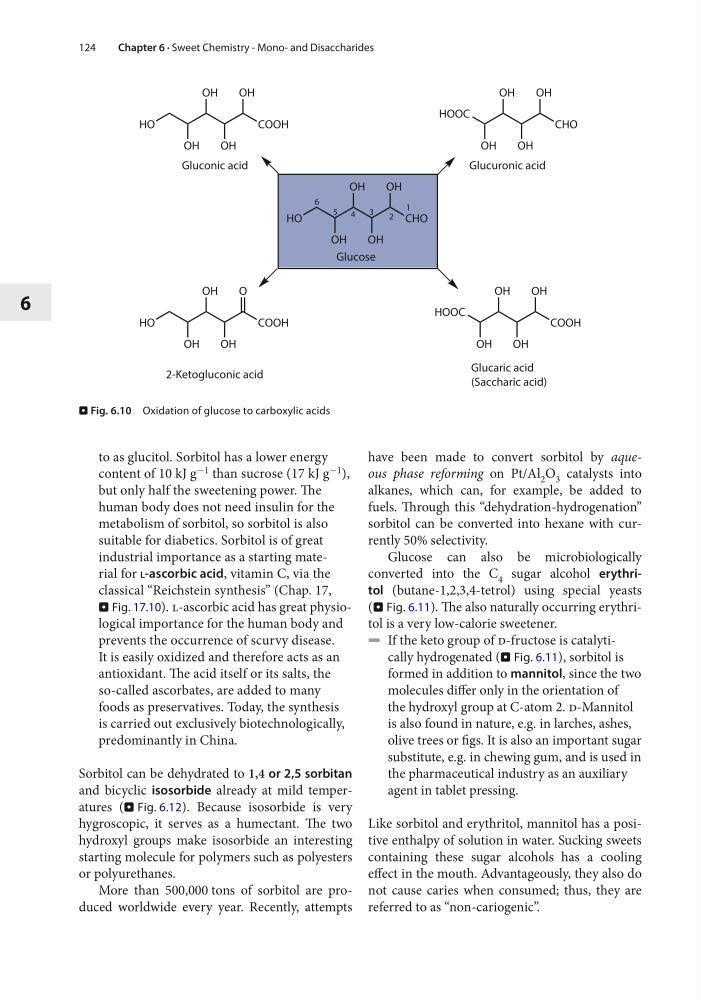
. Fig. 6.10 Oxidation of glucose to carboxylic acids
Chapter 6 · Sweet Chemistry - Mono- and Disaccharides
6
have been made to convert sorbitol by aqueous phase reforming on Pt/Al 2 O 3 catalysts into
alkanes, which can, for example, be added to
fuels. Through this “dehydration-hydrogenation”
sorbitol can be converted into hexane with currently 50% selectivity.
Glucose can also be microbiologically
converted into the C 4 sugar alcohol erythritol (butane-1,2,3,4-tetrol) using special yeasts
(. Fig. 6.11). The also naturally occurring erythritol is a very low-calorie sweetener.
5 If the keto group of d-fructose is catalytically hydrogenated (. Fig. 6.11), sorbitol is
formed in addition to mannitol, since the two
molecules differ only in the orientation of
the hydroxyl group at C-atom 2. d-Mannitol
is also found in nature, e.g. in larches, ashes,
olive trees or figs. It is also an important sugar
substitute, e.g. in chewing gum, and is used in
the pharmaceutical industry as an auxiliary
agent in tablet pressing.
Like sorbitol and erythritol, mannitol has a positive enthalpy of solution in water. Sucking sweets
containing these sugar alcohols has a cooling
effect in the mouth. Advantageously, they also do
not cause caries when consumed; thus, they are
referred to as “non-cariogenic”.
to as glucitol. Sorbitol has a lower energy
content of 10 kJ g −1 than sucrose (17 kJ g −1 ),
but only half the sweetening power. The
human body does not need insulin for the
metabolism of sorbitol, so sorbitol is also
suitable for diabetics. Sorbitol is of great
industrial importance as a starting material for l-ascorbic acid, vitamin C, via the
classical “Reichstein synthesis” (Chap. 17,
. Fig. 17.10). l-ascorbic acid has great physiological importance for the human body and
prevents the occurrence of scurvy disease.
It is easily oxidized and therefore acts as an
antioxidant. The acid itself or its salts, the
so-called ascorbates, are added to many
foods as preservatives. Today, the synthesis
is carried out exclusively biotechnologically,
predominantly in China.
Sorbitol can be dehydrated to 1,4 or 2,5 sorbitan
and bicyclic isosorbide already at mild temperatures (. Fig. 6.12). Because isosorbide is very
hygroscopic, it serves as a humectant. The two
hydroxyl groups make isosorbide an interesting
starting molecule for polymers such as polyesters
or polyurethanes.
More than 500,000 tons of sorbitol are produced worldwide every year. Recently, attempts
HO
CHO
OH
OH
OH
OH
Glucose
HO
COOH
OH
OH
OH
OH
HOOC
CHO
OH
OH
OH
OH
HO
COOH
OH
OH
OH
O
HOOC
COOH
OH
OH
OH
OH
Gluconic acid
Glucuronic acid
Glucaric acid
(Saccharic acid)
2-Ketogluconic acid
6
5 4
3
2
1
. Fig. 6.10 Oxidation of glucose to carboxylic acids