

123
6
saccharic acid. It acts as a biodegradable
complexing agent in detergents and is an
intermediate in the production of polyesters
and emulsifiers.
Hydrogenation Reactions
Hydrogenation of monosaccharides opens
up the group of sugar alcohols. The carbonyl
group of the aldoses or ketoses is converted into
a hydroxyl group so that polyols are formed
(. Fig. 6.11). Industrially, this reaction with
hydrogen takes place in the presence of heterogeneous nickel, palladium or platinum catalysts.
Polyols are frequently used in the food industry
as low-calorie sweeteners.
5 The hydrogenation of aqueous glucose
solutions with Raney nickel yields sorbitol
(hexanhexol), which is also often referred
The following carboxylic acids are of industrial importance:
5 Gluconic acid is formed by oxidation of the
aldehyde group at C-atom 1. 60,000 t a −1 tons
per year are produced in this way worldwide,
usually enzymatically. Gluconic acid is used
in the food and pharmaceutical industries.
Sodium gluconate is an important complexing agent.
5 In glucuronic acid, the primary hydroxyl
group at C-atom 6 is oxidized to the carboxyl
group. d-Glucuronic acid can be further
processed to vitamin C.
5 Oxidation of the hydroxyl groups at C-atoms
1 and 2 of glucose produces 2-ketogluconic
acid, an important antioxidant in food.
5 By oxidations at the C-atoms 1 and 6,
glucaric acid is formed, which is also called
[H + ]
Ox.
O
CHO
Furfural
Pentoses
-H 2 O [H
+ ]
+H 2
O
CH 2 OH
Furfuryl alcohol
O
CH 2 OH
Tetrahydrofurfuryl alcohol
O
2-Methylfuran
O
2-Methyl-THF
+ 2 H 2
+2 H 2
Red.
Red.
Amine
O
CH 2 NH 2
O
CHO
HOCH 2
O
O
O
COOH
Furfurylamine
HMF
Furan
THF
2-Furoic acid
+CH 2 O
[cat.]
[cat.]
-CO
+2 H 2
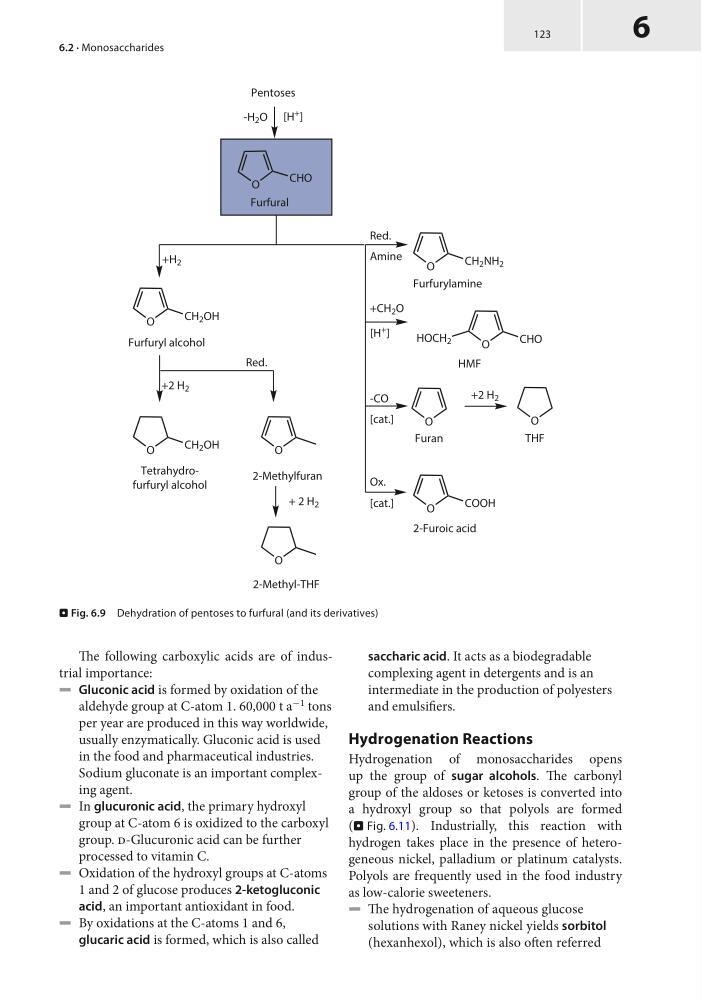
. Fig. 6.9 Dehydration of pentoses to furfural (and its derivatives)
6.2 · Monosaccharides
6
saccharic acid. It acts as a biodegradable
complexing agent in detergents and is an
intermediate in the production of polyesters
and emulsifiers.
Hydrogenation Reactions
Hydrogenation of monosaccharides opens
up the group of sugar alcohols. The carbonyl
group of the aldoses or ketoses is converted into
a hydroxyl group so that polyols are formed
(. Fig. 6.11). Industrially, this reaction with
hydrogen takes place in the presence of heterogeneous nickel, palladium or platinum catalysts.
Polyols are frequently used in the food industry
as low-calorie sweeteners.
5 The hydrogenation of aqueous glucose
solutions with Raney nickel yields sorbitol
(hexanhexol), which is also often referred
The following carboxylic acids are of industrial importance:
5 Gluconic acid is formed by oxidation of the
aldehyde group at C-atom 1. 60,000 t a −1 tons
per year are produced in this way worldwide,
usually enzymatically. Gluconic acid is used
in the food and pharmaceutical industries.
Sodium gluconate is an important complexing agent.
5 In glucuronic acid, the primary hydroxyl
group at C-atom 6 is oxidized to the carboxyl
group. d-Glucuronic acid can be further
processed to vitamin C.
5 Oxidation of the hydroxyl groups at C-atoms
1 and 2 of glucose produces 2-ketogluconic
acid, an important antioxidant in food.
5 By oxidations at the C-atoms 1 and 6,
glucaric acid is formed, which is also called
[H + ]
Ox.
O
CHO
Furfural
Pentoses
-H 2 O [H
+ ]
+H 2
O
CH 2 OH
Furfuryl alcohol
O
CH 2 OH
Tetrahydrofurfuryl alcohol
O
2-Methylfuran
O
2-Methyl-THF
+ 2 H 2
+2 H 2
Red.
Red.
Amine
O
CH 2 NH 2
O
CHO
HOCH 2
O
O
O
COOH
Furfurylamine
HMF
Furan
THF
2-Furoic acid
+CH 2 O
[cat.]
[cat.]
-CO
+2 H 2
. Fig. 6.9 Dehydration of pentoses to furfural (and its derivatives)
6.2 · Monosaccharides