

104
Chapter 5 · The Coproduct of Oleochemistry - Glycerol
5
sirable by-products, e.g. hydroxypyruvic acid
(. Fig. 5.14). Catalytic variants, including catalysts of the platinum group and gold catalysts,
are also currently being intensively investigated.
For example, R. M. Waymouth reported in 2010
that glycerol can be converted into DHA in the
presence of a cationic palladium complex with
atmospheric oxygen with a yield of 73%. Dihydroxyacetone is a worthwhile target molecule
because it is used in cosmetics as a self-tanning
agent. The world market for this very special use
is estimated at approx. 2000 t a −1 tons per year.
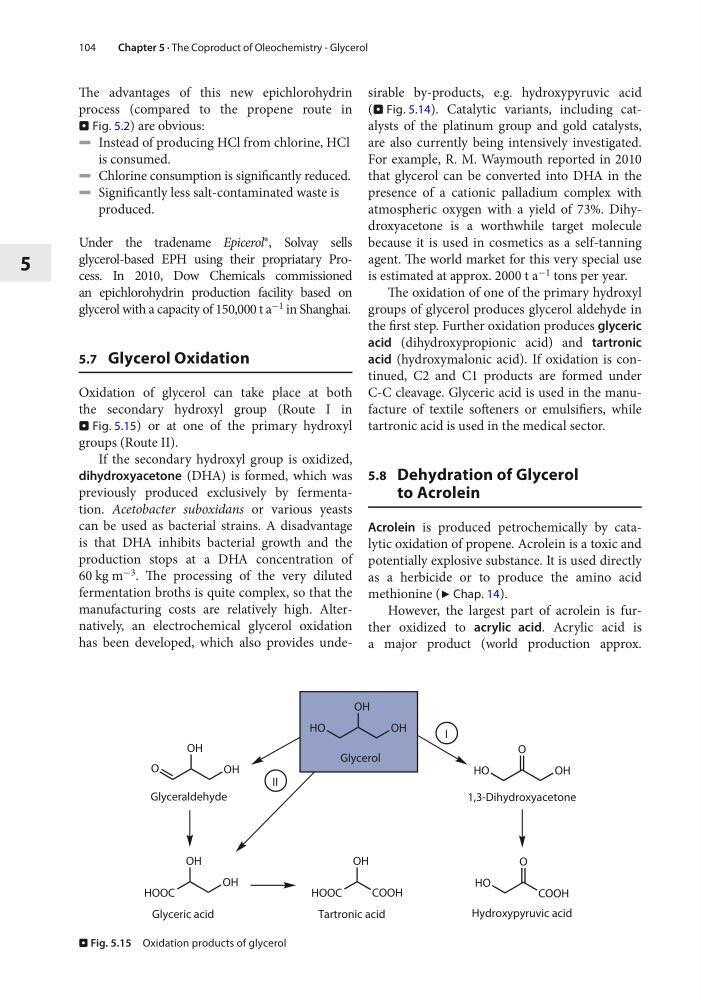
The oxidation of one of the primary hydroxyl
groups of glycerol produces glycerol aldehyde in
the first step. Further oxidation produces glyceric
acid (dihydroxypropionic acid) and tartronic
acid (hydroxymalonic acid). If oxidation is continued, C2 and C1 products are formed under
C-C cleavage. Glyceric acid is used in the manufacture of textile softeners or emulsifiers, while
tartronic acid is used in the medical sector.
5.8 Dehydration of Glycerol
to Acrolein
Acrolein is produced petrochemically by catalytic oxidation of propene. Acrolein is a toxic and
potentially explosive substance. It is used directly
as a herbicide or to produce the amino acid
methionine (7 Chap. 14).
However, the largest part of acrolein is further oxidized to acrylic acid. Acrylic acid is
a major product (world production approx.
The advantages of this new epichlorohydrin
process (compared to the propene route in
. Fig. 5.2) are obvious:
5 Instead of producing HCl from chlorine, HCl
is consumed.
5 Chlorine consumption is significantly reduced.
5 Significantly less salt-contaminated waste is
produced.
Under the tradename Epicerol®, Solvay sells
glycerol-based EPH using their propriatary Process. In 2010, Dow Chemicals commissioned
an epichlorohydrin production facility based on
glycerol with a capacity of 150,000 t a −1 in Shanghai.
5.7 Glycerol Oxidation
Oxidation of glycerol can take place at both
the secondary hydroxyl group (Route I in
. Fig. 5.15) or at one of the primary hydroxyl
groups (Route II).
If the secondary hydroxyl group is oxidized,
dihydroxyacetone (DHA) is formed, which was
previously produced exclusively by fermentation. Acetobacter suboxidans or various yeasts
can be used as bacterial strains. A disadvantage
is that DHA inhibits bacterial growth and the
production stops at a DHA concentration of
60 kg m −3 . The processing of the very diluted
fermentation broths is quite complex, so that the
manufacturing costs are relatively high. Alternatively, an electrochemical glycerol oxidation
has been developed, which also provides undeOH
HO
OH
OH
O
OH
OH
HO
O
HOOC
OH
OH
HOOC
COOH
OH
COOH
HO
O
Glycerol
Glyceraldehyde
Glyceric acid
Tartronic acid
Hydroxypyruvic acid
1,3-Dihydroxyacetone
II
I
. Fig. 5.15 Oxidation products of glycerol
Chapter 5 · The Coproduct of Oleochemistry - Glycerol
5
sirable by-products, e.g. hydroxypyruvic acid
(. Fig. 5.14). Catalytic variants, including catalysts of the platinum group and gold catalysts,
are also currently being intensively investigated.
For example, R. M. Waymouth reported in 2010
that glycerol can be converted into DHA in the
presence of a cationic palladium complex with
atmospheric oxygen with a yield of 73%. Dihydroxyacetone is a worthwhile target molecule
because it is used in cosmetics as a self-tanning
agent. The world market for this very special use
is estimated at approx. 2000 t a −1 tons per year.
The oxidation of one of the primary hydroxyl
groups of glycerol produces glycerol aldehyde in
the first step. Further oxidation produces glyceric
acid (dihydroxypropionic acid) and tartronic
acid (hydroxymalonic acid). If oxidation is continued, C2 and C1 products are formed under
C-C cleavage. Glyceric acid is used in the manufacture of textile softeners or emulsifiers, while
tartronic acid is used in the medical sector.
5.8 Dehydration of Glycerol
to Acrolein
Acrolein is produced petrochemically by catalytic oxidation of propene. Acrolein is a toxic and
potentially explosive substance. It is used directly
as a herbicide or to produce the amino acid
methionine (7 Chap. 14).
However, the largest part of acrolein is further oxidized to acrylic acid. Acrylic acid is
a major product (world production approx.
The advantages of this new epichlorohydrin
process (compared to the propene route in
. Fig. 5.2) are obvious:
5 Instead of producing HCl from chlorine, HCl
is consumed.
5 Chlorine consumption is significantly reduced.
5 Significantly less salt-contaminated waste is
produced.
Under the tradename Epicerol®, Solvay sells
glycerol-based EPH using their propriatary Process. In 2010, Dow Chemicals commissioned
an epichlorohydrin production facility based on
glycerol with a capacity of 150,000 t a −1 in Shanghai.
5.7 Glycerol Oxidation
Oxidation of glycerol can take place at both
the secondary hydroxyl group (Route I in
. Fig. 5.15) or at one of the primary hydroxyl
groups (Route II).
If the secondary hydroxyl group is oxidized,
dihydroxyacetone (DHA) is formed, which was
previously produced exclusively by fermentation. Acetobacter suboxidans or various yeasts
can be used as bacterial strains. A disadvantage
is that DHA inhibits bacterial growth and the
production stops at a DHA concentration of
60 kg m −3 . The processing of the very diluted
fermentation broths is quite complex, so that the
manufacturing costs are relatively high. Alternatively, an electrochemical glycerol oxidation
has been developed, which also provides undeOH
HO
OH
OH
O
OH
OH
HO
O
HOOC
OH
OH
HOOC
COOH
OH
COOH
HO
O
Glycerol
Glyceraldehyde
Glyceric acid
Tartronic acid
Hydroxypyruvic acid
1,3-Dihydroxyacetone
II
I
. Fig. 5.15 Oxidation products of glycerol