

105
5
Synthesis gas is a worthwhile target for the
utilization of surplus glycerol, because synthesis
gas can be used in many ways:
5 Synthesis gas is converted into methanol on
an industrial scale. Methanol has an extensive downstream chemistry and can, for
instance, be converted into gasoline, alkenes
or aromatics. Methanol is also needed for the
production of biodiesel. A fatty acid methyl
ester produced with “bio-methanol” would
then be based exclusively on renewable raw
materials.
5 Alkenes are converted to aldehydes or alcohols
with synthesis gas in hydroformylation.
5 The carbon monoxide in the synthesis gas
can also be catalytically converted with water
into carbon dioxide (Water–gas shift reaction,
WGSR) and then separated. Pure hydrogen
remains, which can be used, for instance, in
ammonia production or in fuel cells.
5 Synthesis gas can also be catalytically converted in the Fischer–Tropsch reaction into
liquid hydrocarbons, which can be used as
fuels.
In . Fig. 5.17, the most important applications of
synthesis gas are briefly summarized once again.
The conversion of glycerol into synthesis gas
is called reforming. In this reaction, one equivalent of glycerol is split into a hydrogen–carbon
monoxide mixture with a molar ratio of 1.33:1
(Eq. 5.6).
If more (or even exclusively) hydrogen is desired,
an additional conversion with water (water–gas
shift reaction, Eq. 5.7) has to be carried out.
(5.6)
C 3 H 8 O 3 → 3CO + 4H 2
3.4 × 10 6 t a −1 ) because it is required for the production of polyacrylic acid and polyacrylates. As
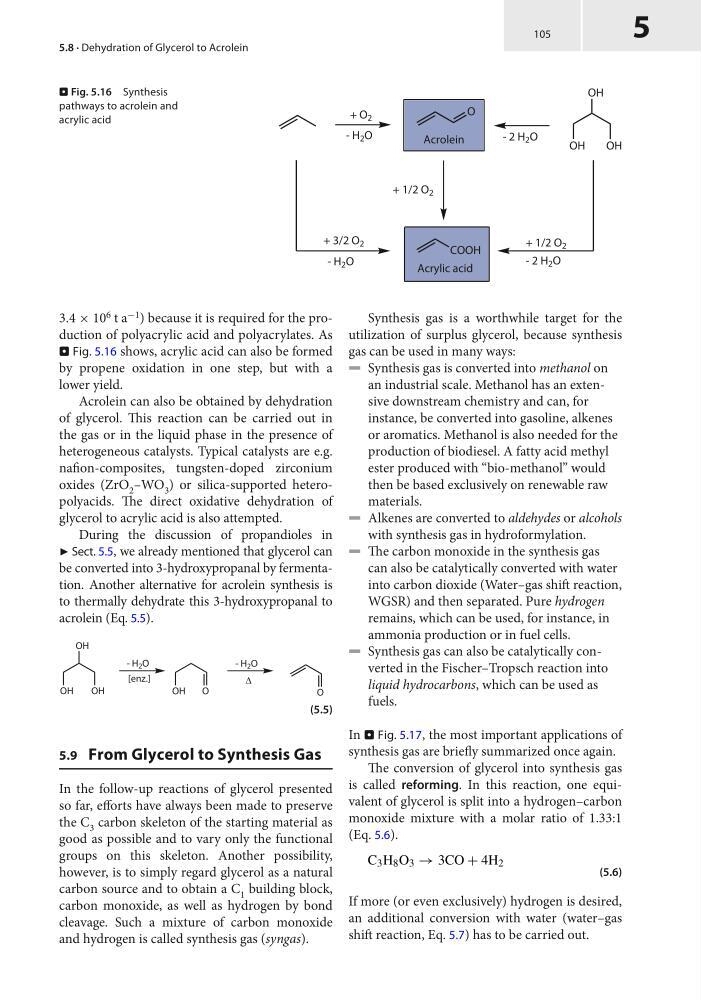
. Fig. 5.16 shows, acrylic acid can also be formed
by propene oxidation in one step, but with a
lower yield.
Acrolein can also be obtained by dehydration
of glycerol. This reaction can be carried out in
the gas or in the liquid phase in the presence of
heterogeneous catalysts. Typical catalysts are e.g.
nafion-composites, tungsten-doped zirconium
oxides (ZrO 2 –WO 3 ) or silica-supported heteropolyacids. The direct oxidative dehydration of
glycerol to acrylic acid is also attempted.
During the discussion of propandioles in
7 Sect. 5.5, we already mentioned that glycerol can
be converted into 3-hydroxypropanal by fermentation. Another alternative for acrolein synthesis is
to thermally dehydrate this 3-hydroxypropanal to
acrolein (Eq. 5.5).
5.9 From Glycerol to Synthesis Gas
In the follow-up reactions of glycerol presented
so far, efforts have always been made to preserve
the C 3 carbon skeleton of the starting material as
good as possible and to vary only the functional
groups on this skeleton. Another possibility,
however, is to simply regard glycerol as a natural
carbon source and to obtain a C 1 building block,
carbon monoxide, as well as hydrogen by bond
cleavage. Such a mixture of carbon monoxide
and hydrogen is called synthesis gas (syngas).
(5.5)
OH
OH
OH
[enz.]
OH
O
O
- H 2 O
- H 2 O
'
. Fig. 5.16 Synthesis
pathways to acrolein and
acrylic acid
O
Acrolein
+ O 2
- H 2 O
- 2 H 2 O
OH
OH
OH
COOH
Acrylic acid
+ 3/2 O 2
+ 1/2 O 2
- H 2 O
- 2 H 2 O
+ 1/2 O 2
5.8 · Dehydration of Glycerol to Acrolein
5
Synthesis gas is a worthwhile target for the
utilization of surplus glycerol, because synthesis
gas can be used in many ways:
5 Synthesis gas is converted into methanol on
an industrial scale. Methanol has an extensive downstream chemistry and can, for
instance, be converted into gasoline, alkenes
or aromatics. Methanol is also needed for the
production of biodiesel. A fatty acid methyl
ester produced with “bio-methanol” would
then be based exclusively on renewable raw
materials.
5 Alkenes are converted to aldehydes or alcohols
with synthesis gas in hydroformylation.
5 The carbon monoxide in the synthesis gas
can also be catalytically converted with water
into carbon dioxide (Water–gas shift reaction,
WGSR) and then separated. Pure hydrogen
remains, which can be used, for instance, in
ammonia production or in fuel cells.
5 Synthesis gas can also be catalytically converted in the Fischer–Tropsch reaction into
liquid hydrocarbons, which can be used as
fuels.
In . Fig. 5.17, the most important applications of
synthesis gas are briefly summarized once again.
The conversion of glycerol into synthesis gas
is called reforming. In this reaction, one equivalent of glycerol is split into a hydrogen–carbon
monoxide mixture with a molar ratio of 1.33:1
(Eq. 5.6).
If more (or even exclusively) hydrogen is desired,
an additional conversion with water (water–gas
shift reaction, Eq. 5.7) has to be carried out.
(5.6)
C 3 H 8 O 3 → 3CO + 4H 2
3.4 × 10 6 t a −1 ) because it is required for the production of polyacrylic acid and polyacrylates. As
. Fig. 5.16 shows, acrylic acid can also be formed
by propene oxidation in one step, but with a
lower yield.
Acrolein can also be obtained by dehydration
of glycerol. This reaction can be carried out in
the gas or in the liquid phase in the presence of
heterogeneous catalysts. Typical catalysts are e.g.
nafion-composites, tungsten-doped zirconium
oxides (ZrO 2 –WO 3 ) or silica-supported heteropolyacids. The direct oxidative dehydration of
glycerol to acrylic acid is also attempted.
During the discussion of propandioles in
7 Sect. 5.5, we already mentioned that glycerol can
be converted into 3-hydroxypropanal by fermentation. Another alternative for acrolein synthesis is
to thermally dehydrate this 3-hydroxypropanal to
acrolein (Eq. 5.5).
5.9 From Glycerol to Synthesis Gas
In the follow-up reactions of glycerol presented
so far, efforts have always been made to preserve
the C 3 carbon skeleton of the starting material as
good as possible and to vary only the functional
groups on this skeleton. Another possibility,
however, is to simply regard glycerol as a natural
carbon source and to obtain a C 1 building block,
carbon monoxide, as well as hydrogen by bond
cleavage. Such a mixture of carbon monoxide
and hydrogen is called synthesis gas (syngas).
(5.5)
OH
OH
OH
[enz.]
OH
O
O
- H 2 O
- H 2 O
'
. Fig. 5.16 Synthesis
pathways to acrolein and
acrylic acid
O
Acrolein
+ O 2
- H 2 O
- 2 H 2 O
OH
OH
OH
COOH
Acrylic acid
+ 3/2 O 2
+ 1/2 O 2
- H 2 O
- 2 H 2 O
+ 1/2 O 2
5.8 · Dehydration of Glycerol to Acrolein