

103
5
meantime, the market situation has changed so
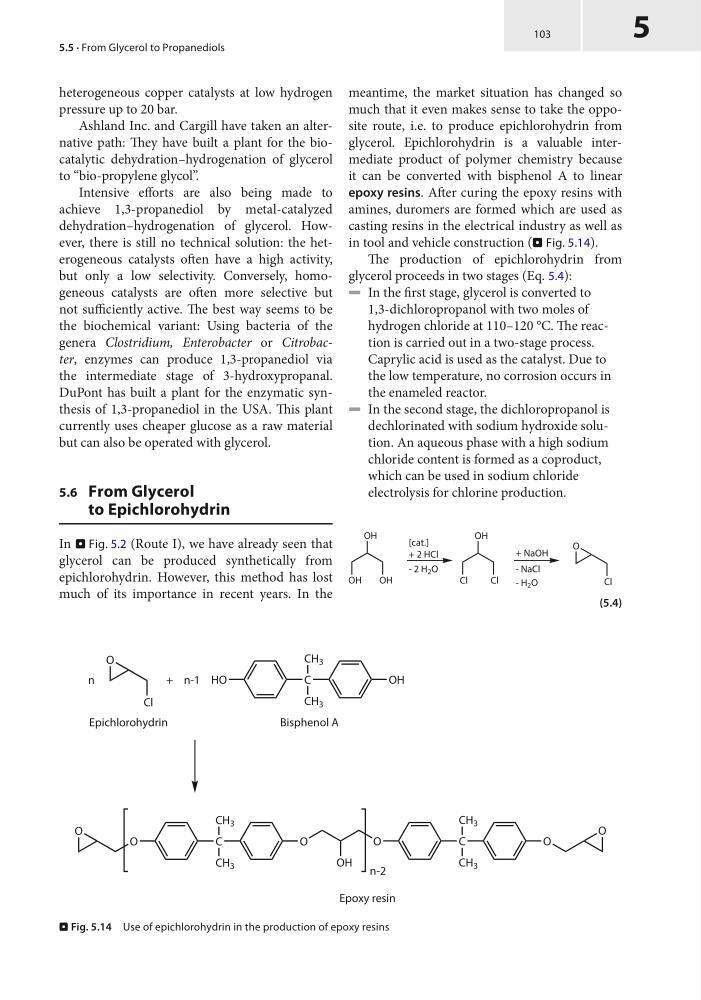
much that it even makes sense to take the opposite route, i.e. to produce epichlorohydrin from
glycerol. Epichlorohydrin is a valuable intermediate product of polymer chemistry because
it can be converted with bisphenol A to linear
epoxy resins. After curing the epoxy resins with
amines, duromers are formed which are used as
casting resins in the electrical industry as well as
in tool and vehicle construction (. Fig. 5.14).
The production of epichlorohydrin from
glycerol proceeds in two stages (Eq. 5.4):
5 In the first stage, glycerol is converted to
1,3-dichloropropanol with two moles of
hydrogen chloride at 110–120 °C. The reaction is carried out in a two-stage process.
Caprylic acid is used as the catalyst. Due to
the low temperature, no corrosion occurs in
the enameled reactor.
5 In the second stage, the dichloropropanol is
dechlorinated with sodium hydroxide solution. An aqueous phase with a high sodium
chloride content is formed as a coproduct,
which can be used in sodium chloride
electrolysis for chlorine production.
(5.4)
OH
OH
OH
- 2 H 2 O
[cat.]
+ 2 HCl
OH
Cl
Cl
- NaCl
- H 2 O
+ NaOH
Cl
O
heterogeneous copper catalysts at low hydrogen
pressure up to 20 bar.
Ashland Inc. and Cargill have taken an alternative path: They have built a plant for the biocatalytic dehydration–hydrogenation of glycerol
to “bio-propylene glycol”.
Intensive efforts are also being made to
achieve 1,3-propanediol by metal-catalyzed
dehydration–hydrogenation of glycerol. However, there is still no technical solution: the heterogeneous catalysts often have a high activity,
but only a low selectivity. Conversely, homogeneous catalysts are often more selective but
not sufficiently active. The best way seems to be
the biochemical variant: Using bacteria of the
genera Clostridium, Enterobacter or Citrobacter, enzymes can produce 1,3-propanediol via
the intermediate stage of 3-hydroxypropanal.
DuPont has built a plant for the enzymatic synthesis of 1,3-propanediol in the USA. This plant
currently uses cheaper glucose as a raw material
but can also be operated with glycerol.
5.6 From Glycerol
to Epichlorohydrin
In . Fig. 5.2 (Route I), we have already seen that
glycerol can be produced synthetically from
epichlorohydrin. However, this method has lost
much of its importance in recent years. In the
O
Cl
HO
C
CH 3
CH 3
OH
+ n-1
O
O
C
CH 3
CH 3
O
OH
O
C
CH 3
CH 3
O
O
n
Epichlorohydrin
Bisphenol A
Epoxy resin
n-2
. Fig. 5.14 Use of epichlorohydrin in the production of epoxy resins
5.5 · From Glycerol to Propanediols
5
meantime, the market situation has changed so
much that it even makes sense to take the opposite route, i.e. to produce epichlorohydrin from
glycerol. Epichlorohydrin is a valuable intermediate product of polymer chemistry because
it can be converted with bisphenol A to linear
epoxy resins. After curing the epoxy resins with
amines, duromers are formed which are used as
casting resins in the electrical industry as well as
in tool and vehicle construction (. Fig. 5.14).
The production of epichlorohydrin from
glycerol proceeds in two stages (Eq. 5.4):
5 In the first stage, glycerol is converted to
1,3-dichloropropanol with two moles of
hydrogen chloride at 110–120 °C. The reaction is carried out in a two-stage process.
Caprylic acid is used as the catalyst. Due to
the low temperature, no corrosion occurs in
the enameled reactor.
5 In the second stage, the dichloropropanol is
dechlorinated with sodium hydroxide solution. An aqueous phase with a high sodium
chloride content is formed as a coproduct,
which can be used in sodium chloride
electrolysis for chlorine production.
(5.4)
OH
OH
OH
- 2 H 2 O
[cat.]
+ 2 HCl
OH
Cl
Cl
- NaCl
- H 2 O
+ NaOH
Cl
O
heterogeneous copper catalysts at low hydrogen
pressure up to 20 bar.
Ashland Inc. and Cargill have taken an alternative path: They have built a plant for the biocatalytic dehydration–hydrogenation of glycerol
to “bio-propylene glycol”.
Intensive efforts are also being made to
achieve 1,3-propanediol by metal-catalyzed
dehydration–hydrogenation of glycerol. However, there is still no technical solution: the heterogeneous catalysts often have a high activity,
but only a low selectivity. Conversely, homogeneous catalysts are often more selective but
not sufficiently active. The best way seems to be
the biochemical variant: Using bacteria of the
genera Clostridium, Enterobacter or Citrobacter, enzymes can produce 1,3-propanediol via
the intermediate stage of 3-hydroxypropanal.
DuPont has built a plant for the enzymatic synthesis of 1,3-propanediol in the USA. This plant
currently uses cheaper glucose as a raw material
but can also be operated with glycerol.
5.6 From Glycerol
to Epichlorohydrin
In . Fig. 5.2 (Route I), we have already seen that
glycerol can be produced synthetically from
epichlorohydrin. However, this method has lost
much of its importance in recent years. In the
O
Cl
HO
C
CH 3
CH 3
OH
+ n-1
O
O
C
CH 3
CH 3
O
OH
O
C
CH 3
CH 3
O
O
n
Epichlorohydrin
Bisphenol A
Epoxy resin
n-2
. Fig. 5.14 Use of epichlorohydrin in the production of epoxy resins
5.5 · From Glycerol to Propanediols