

102
Chapter 5 · The Coproduct of Oleochemistry - Glycerol
5
with terephthalic acid produces polyester
fibers known on the market under the
trade names Sorona (DuPont) and Corterra
(Shell).
In order to obtain 1,2-propanediol from glycerol, a primary hydroxyl group of glycerol
must be removed. This can be achieved by dehydration–hydrogenation, which can be either
metal-catalyzed or biocatalyzed. For the hydrogenation, both homogeneous and heterogeneous
catalysts can be used. If heterogeneous copper,
cobalt or manganese catalysts are used, high
hydrogen pressures of up to 250 bar and temperatures of up to 300 °C are usually required.
Under these drastic conditions, however, the
selectivity to 1,2-propanediol is only low. However, recent research results, e.g. from Davy
Process Technology, show that good selectivities to 1,2-propanediol can be achieved with
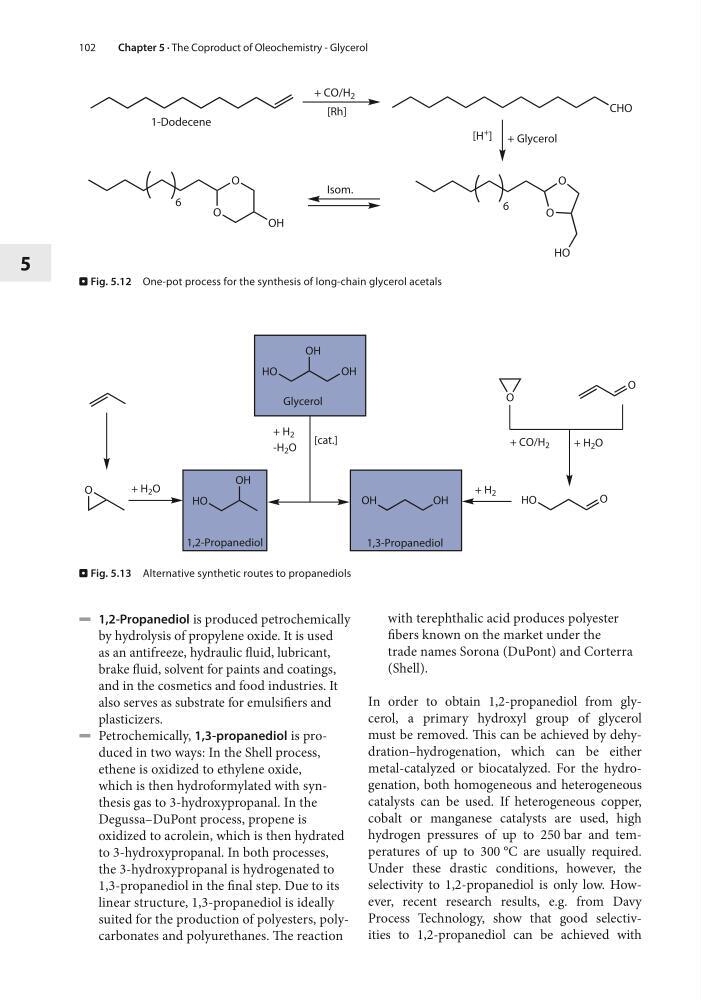
5 1,2-Propanediol is produced petrochemically
by hydrolysis of propylene oxide. It is used
as an antifreeze, hydraulic fluid, lubricant,
brake fluid, solvent for paints and coatings,
and in the cosmetics and food industries. It
also serves as substrate for emulsifiers and
plasticizers.
5 Petrochemically, 1,3-propanediol is produced in two ways: In the Shell process,
ethene is oxidized to ethylene oxide,
which is then hydroformylated with synthesis gas to 3-hydroxypropanal. In the
Degussa–DuPont process, propene is
oxidized to acrolein, which is then hydrated
to 3-hydroxypropanal. In both processes,
the 3-hydroxypropanal is hydrogenated to
1,3-propanediol in the final step. Due to its
linear structure, 1,3-propanediol is ideally
suited for the production of polyesters, polycarbonates and polyurethanes. The reaction
HO
OH
OH
HO
OH
O
+ H 2 O
OH
OH
HO
O
O
O
+ H 2
+ CO/H 2
+ H 2 O
+ H 2
-H 2 O
[cat.]
1,3-Propanediol
1,2-Propanediol
Glycerol
. Fig. 5.13 Alternative synthetic routes to propanediols
CHO
+ CO/H 2
[Rh]
[H + ] + Glycerol
O
O
O
O
OH
HO
Isom.
6
6
1-Dodecene
. Fig. 5.12 One-pot process for the synthesis of long-chain glycerol acetals
Chapter 5 · The Coproduct of Oleochemistry - Glycerol
5
with terephthalic acid produces polyester
fibers known on the market under the
trade names Sorona (DuPont) and Corterra
(Shell).
In order to obtain 1,2-propanediol from glycerol, a primary hydroxyl group of glycerol
must be removed. This can be achieved by dehydration–hydrogenation, which can be either
metal-catalyzed or biocatalyzed. For the hydrogenation, both homogeneous and heterogeneous
catalysts can be used. If heterogeneous copper,
cobalt or manganese catalysts are used, high
hydrogen pressures of up to 250 bar and temperatures of up to 300 °C are usually required.
Under these drastic conditions, however, the
selectivity to 1,2-propanediol is only low. However, recent research results, e.g. from Davy
Process Technology, show that good selectivities to 1,2-propanediol can be achieved with
5 1,2-Propanediol is produced petrochemically
by hydrolysis of propylene oxide. It is used
as an antifreeze, hydraulic fluid, lubricant,
brake fluid, solvent for paints and coatings,
and in the cosmetics and food industries. It
also serves as substrate for emulsifiers and
plasticizers.
5 Petrochemically, 1,3-propanediol is produced in two ways: In the Shell process,
ethene is oxidized to ethylene oxide,
which is then hydroformylated with synthesis gas to 3-hydroxypropanal. In the
Degussa–DuPont process, propene is
oxidized to acrolein, which is then hydrated
to 3-hydroxypropanal. In both processes,
the 3-hydroxypropanal is hydrogenated to
1,3-propanediol in the final step. Due to its
linear structure, 1,3-propanediol is ideally
suited for the production of polyesters, polycarbonates and polyurethanes. The reaction
HO
OH
OH
HO
OH
O
+ H 2 O
OH
OH
HO
O
O
O
+ H 2
+ CO/H 2
+ H 2 O
+ H 2
-H 2 O
[cat.]
1,3-Propanediol
1,2-Propanediol
Glycerol
. Fig. 5.13 Alternative synthetic routes to propanediols
CHO
+ CO/H 2
[Rh]
[H + ] + Glycerol
O
O
O
O
OH
HO
Isom.
6
6
1-Dodecene
. Fig. 5.12 One-pot process for the synthesis of long-chain glycerol acetals