

Test Methods and Identification of Recycled Polyester
81
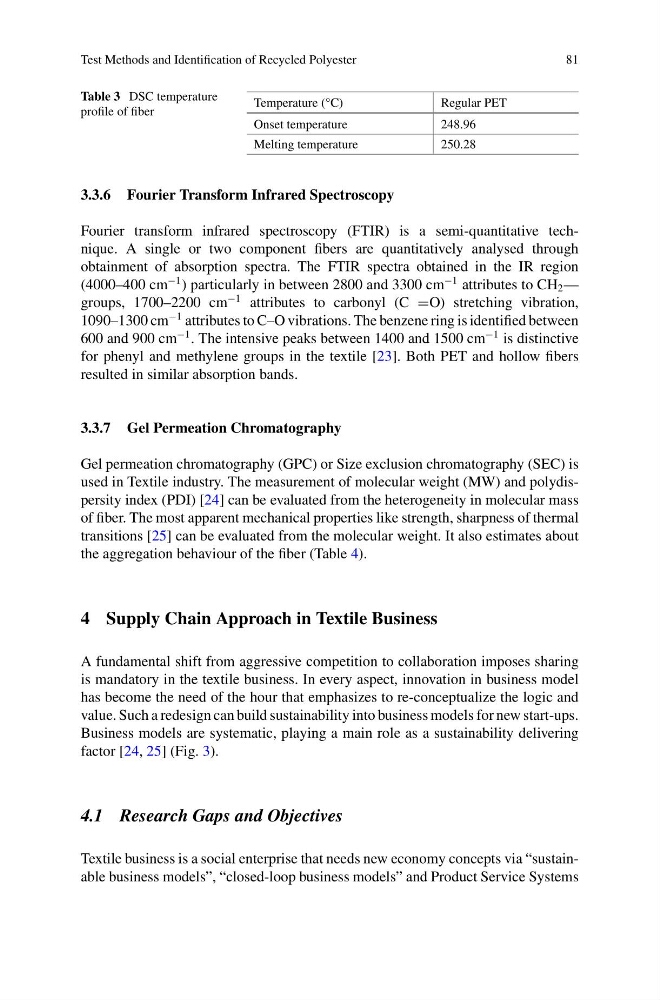
Table 3 DSC temperature
profile of fiber
Temperature (°C)
Regular PET
Onset temperature
248.96
Melting temperature
250.28
3.3.6 Fourier Transform Infrared Spectroscopy
Fourier transform infrared spectroscopy (FTIR) is a semi-quantitative technique. A single or two component fibers are quantitatively analysed through
obtainment of absorption spectra. The FTIR spectra obtained in the IR region
(4000–400 cm
−1 ) particularly in between 2800 and 3300 cm
−1 attributes to CH 2 —
groups, 1700–2200 cm
−1 attributes to carbonyl (C =O) stretching vibration,
1090–1300 cm
−1 attributes to C–O vibrations. The benzene ring is identified between
600 and 900 cm
−1 . The intensive peaks between 1400 and 1500 cm
−1 is distinctive
for phenyl and methylene groups in the textile [23]. Both PET and hollow fibers
resulted in similar absorption bands.
3.3.7 Gel Permeation Chromatography
Gel permeation chromatography (GPC) or Size exclusion chromatography (SEC) is
used in Textile industry. The measurement of molecular weight (MW) and polydispersity index (PDI) [24] can be evaluated from the heterogeneity in molecular mass
of fiber. The most apparent mechanical properties like strength, sharpness of thermal
transitions [25] can be evaluated from the molecular weight. It also estimates about
the aggregation behaviour of the fiber (Table 4).
4 Supply Chain Approach in Textile Business
A fundamental shift from aggressive competition to collaboration imposes sharing
is mandatory in the textile business. In every aspect, innovation in business model
has become the need of the hour that emphasizes to re-conceptualize the logic and
value. Such a redesign can build sustainability into business models for new start-ups.
Business models are systematic, playing a main role as a sustainability delivering
factor [24, 25] (Fig. 3).
4.1 Research Gaps and Objectives
Textile business is a social enterprise that needs new economy concepts via “sustainable business models”, “closed-loop business models” and Product Service Systems
81
Table 3 DSC temperature
profile of fiber
Temperature (°C)
Regular PET
Onset temperature
248.96
Melting temperature
250.28
3.3.6 Fourier Transform Infrared Spectroscopy
Fourier transform infrared spectroscopy (FTIR) is a semi-quantitative technique. A single or two component fibers are quantitatively analysed through
obtainment of absorption spectra. The FTIR spectra obtained in the IR region
(4000–400 cm
−1 ) particularly in between 2800 and 3300 cm
−1 attributes to CH 2 —
groups, 1700–2200 cm
−1 attributes to carbonyl (C =O) stretching vibration,
1090–1300 cm
−1 attributes to C–O vibrations. The benzene ring is identified between
600 and 900 cm
−1 . The intensive peaks between 1400 and 1500 cm
−1 is distinctive
for phenyl and methylene groups in the textile [23]. Both PET and hollow fibers
resulted in similar absorption bands.
3.3.7 Gel Permeation Chromatography
Gel permeation chromatography (GPC) or Size exclusion chromatography (SEC) is
used in Textile industry. The measurement of molecular weight (MW) and polydispersity index (PDI) [24] can be evaluated from the heterogeneity in molecular mass
of fiber. The most apparent mechanical properties like strength, sharpness of thermal
transitions [25] can be evaluated from the molecular weight. It also estimates about
the aggregation behaviour of the fiber (Table 4).
4 Supply Chain Approach in Textile Business
A fundamental shift from aggressive competition to collaboration imposes sharing
is mandatory in the textile business. In every aspect, innovation in business model
has become the need of the hour that emphasizes to re-conceptualize the logic and
value. Such a redesign can build sustainability into business models for new start-ups.
Business models are systematic, playing a main role as a sustainability delivering
factor [24, 25] (Fig. 3).
4.1 Research Gaps and Objectives
Textile business is a social enterprise that needs new economy concepts via “sustainable business models”, “closed-loop business models” and Product Service Systems