

56
Y. Qin et al.
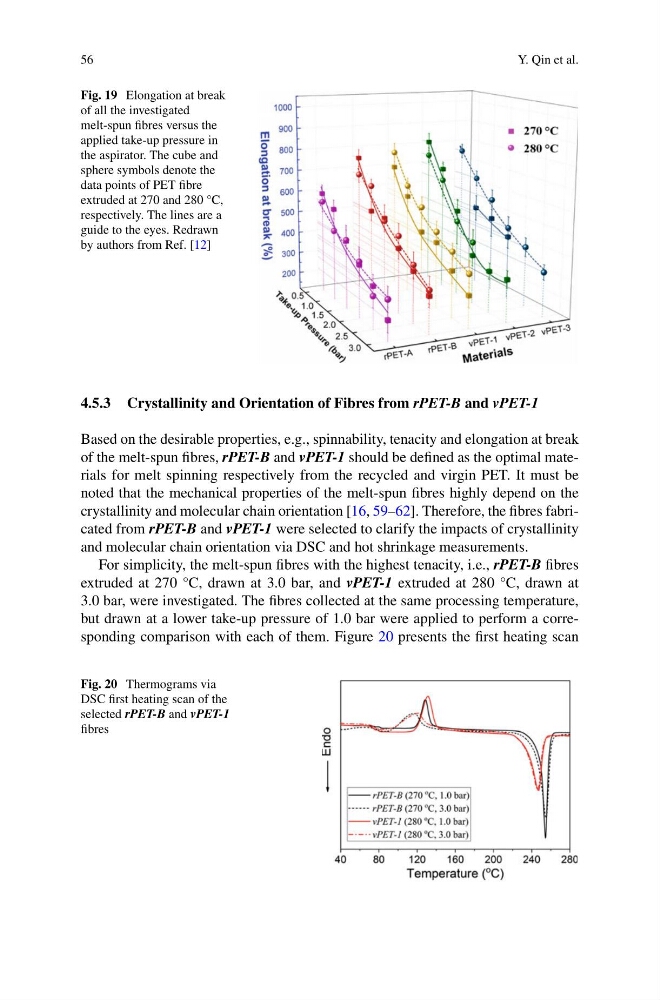
Fig. 19 Elongation at break
of all the investigated
melt-spun fibres versus the
applied take-up pressure in
the aspirator. The cube and
sphere symbols denote the
data points of PET fibre
extruded at 270 and 280 °C,
respectively. The lines are a
guide to the eyes. Redrawn
by authors from Ref. [12]
4.5.3 Crystallinity and Orientation of Fibres from rPET-B and vPET-1
Based on the desirable properties, e.g., spinnability, tenacity and elongation at break
of the melt-spun fibres, rPET-B and vPET-1 should be defined as the optimal materials for melt spinning respectively from the recycled and virgin PET. It must be
noted that the mechanical properties of the melt-spun fibres highly depend on the
crystallinity and molecular chain orientation [16, 59–62]. Therefore, the fibres fabricated from rPET-B and vPET-1 were selected to clarify the impacts of crystallinity
and molecular chain orientation via DSC and hot shrinkage measurements.
For simplicity, the melt-spun fibres with the highest tenacity, i.e., rPET-B fibres
extruded at 270 °C, drawn at 3.0 bar, and vPET-1 extruded at 280 °C, drawn at
3.0 bar, were investigated. The fibres collected at the same processing temperature,
but drawn at a lower take-up pressure of 1.0 bar were applied to perform a corresponding comparison with each of them. Figure 20 presents the first heating scan
Fig. 20 Thermograms via
DSC first heating scan of the
selected rPET-B and vPET-1
fibres
Y. Qin et al.
Fig. 19 Elongation at break
of all the investigated
melt-spun fibres versus the
applied take-up pressure in
the aspirator. The cube and
sphere symbols denote the
data points of PET fibre
extruded at 270 and 280 °C,
respectively. The lines are a
guide to the eyes. Redrawn
by authors from Ref. [12]
4.5.3 Crystallinity and Orientation of Fibres from rPET-B and vPET-1
Based on the desirable properties, e.g., spinnability, tenacity and elongation at break
of the melt-spun fibres, rPET-B and vPET-1 should be defined as the optimal materials for melt spinning respectively from the recycled and virgin PET. It must be
noted that the mechanical properties of the melt-spun fibres highly depend on the
crystallinity and molecular chain orientation [16, 59–62]. Therefore, the fibres fabricated from rPET-B and vPET-1 were selected to clarify the impacts of crystallinity
and molecular chain orientation via DSC and hot shrinkage measurements.
For simplicity, the melt-spun fibres with the highest tenacity, i.e., rPET-B fibres
extruded at 270 °C, drawn at 3.0 bar, and vPET-1 extruded at 280 °C, drawn at
3.0 bar, were investigated. The fibres collected at the same processing temperature,
but drawn at a lower take-up pressure of 1.0 bar were applied to perform a corresponding comparison with each of them. Figure 20 presents the first heating scan
Fig. 20 Thermograms via
DSC first heating scan of the
selected rPET-B and vPET-1
fibres