

Studies on Recycled Polyester
55
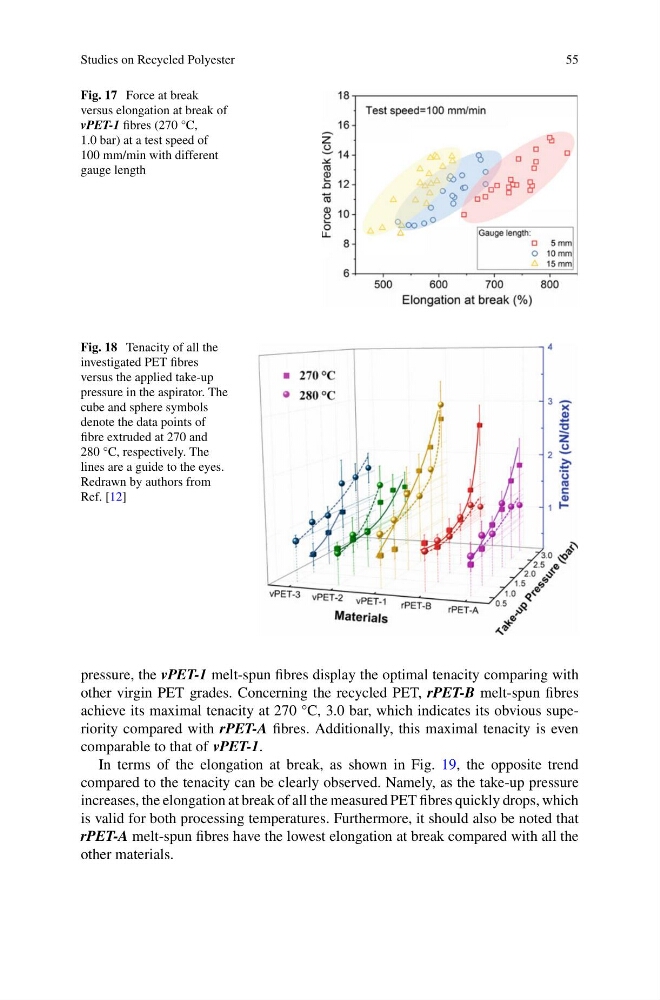
Fig. 17 Force at break
versus elongation at break of
vPET-1 fibres (270 °C,
1.0 bar) at a test speed of
100 mm/min with different
gauge length
Fig. 18 Tenacity of all the
investigated PET fibres
versus the applied take-up
pressure in the aspirator. The
cube and sphere symbols
denote the data points of
fibre extruded at 270 and
280 °C, respectively. The
lines are a guide to the eyes.
Redrawn by authors from
Ref. [12]
pressure, the vPET-1 melt-spun fibres display the optimal tenacity comparing with
other virgin PET grades. Concerning the recycled PET, rPET-B melt-spun fibres
achieve its maximal tenacity at 270 °C, 3.0 bar, which indicates its obvious superiority compared with rPET-A fibres. Additionally, this maximal tenacity is even
comparable to that of vPET-1.
In terms of the elongation at break, as shown in Fig. 19, the opposite trend
compared to the tenacity can be clearly observed. Namely, as the take-up pressure
increases, the elongation at break of all the measured PET fibres quickly drops, which
is valid for both processing temperatures. Furthermore, it should also be noted that
rPET-A melt-spun fibres have the lowest elongation at break compared with all the
other materials.
55
Fig. 17 Force at break
versus elongation at break of
vPET-1 fibres (270 °C,
1.0 bar) at a test speed of
100 mm/min with different
gauge length
Fig. 18 Tenacity of all the
investigated PET fibres
versus the applied take-up
pressure in the aspirator. The
cube and sphere symbols
denote the data points of
fibre extruded at 270 and
280 °C, respectively. The
lines are a guide to the eyes.
Redrawn by authors from
Ref. [12]
pressure, the vPET-1 melt-spun fibres display the optimal tenacity comparing with
other virgin PET grades. Concerning the recycled PET, rPET-B melt-spun fibres
achieve its maximal tenacity at 270 °C, 3.0 bar, which indicates its obvious superiority compared with rPET-A fibres. Additionally, this maximal tenacity is even
comparable to that of vPET-1.
In terms of the elongation at break, as shown in Fig. 19, the opposite trend
compared to the tenacity can be clearly observed. Namely, as the take-up pressure
increases, the elongation at break of all the measured PET fibres quickly drops, which
is valid for both processing temperatures. Furthermore, it should also be noted that
rPET-A melt-spun fibres have the lowest elongation at break compared with all the
other materials.