

Studies on Recycled Polyester
57
Table 9 DSC data derived from Fig. 20 and shrinkage ratio (S R) of the selected rPET-B and
vPET-1 fibres
Fibres
T g
(°C)
T c,onset
(°C)
T c (°C) H c
(J/g)
T m
(°C)
H m
(J/g)
X c (%) SR (%)
rPET-B
(270 °C,
1.0 bar)
74.6
120.1
131.6
23.3
247.0
35.5
9.0
10.0 ±
4.3
rPET-B
(270 °C,
3.0 bar)
74.2
95.1
120.8
21.2
246.4
36.7
11.4
51.6 ±
9.3
vPET-1
(280 °C,
1.0 bar)
81.1
120.7
128.7
15.4
254.4
41.4
19.1
11.5 ±
2.3
vPET-1
(280 °C,
3.0 bar)
80.1
94.4
116.9
20.2
254.9
43.6
17.2
39.3 ±
5.5
Rearranged by authors from Ref. [12]
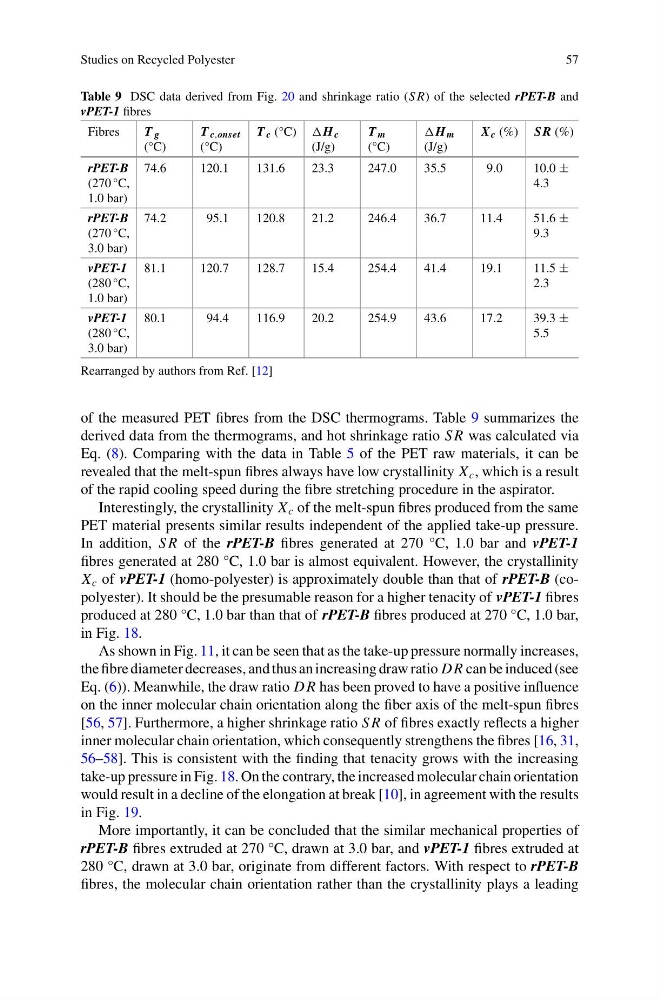
of the measured PET fibres from the DSC thermograms. Table 9 summarizes the
derived data from the thermograms, and hot shrinkage ratio S R was calculated via
Eq. (8). Comparing with the data in Table 5 of the PET raw materials, it can be
revealed that the melt-spun fibres always have low crystallinity X c , which is a result
of the rapid cooling speed during the fibre stretching procedure in the aspirator.
Interestingly, the crystallinity X c of the melt-spun fibres produced from the same
PET material presents similar results independent of the applied take-up pressure.
In addition, S R of the rPET-B fibres generated at 270 °C, 1.0 bar and vPET-1
fibres generated at 280 °C, 1.0 bar is almost equivalent. However, the crystallinity
X c of vPET-1 (homo-polyester) is approximately double than that of rPET-B (copolyester). It should be the presumable reason for a higher tenacity of vPET-1 fibres
produced at 280 °C, 1.0 bar than that of rPET-B fibres produced at 270 °C, 1.0 bar,
in Fig. 18.
As shown in Fig. 11, it can be seen that as the take-up pressure normally increases,
the fibre diameter decreases, and thus an increasing draw ratio D R can be induced (see
Eq. (6)). Meanwhile, the draw ratio D R has been proved to have a positive influence
on the inner molecular chain orientation along the fiber axis of the melt-spun fibres
[56, 57]. Furthermore, a higher shrinkage ratio S R of fibres exactly reflects a higher
inner molecular chain orientation, which consequently strengthens the fibres [16, 31,
56–58]. This is consistent with the finding that tenacity grows with the increasing
take-up pressure in Fig. 18. On the contrary, the increased molecular chain orientation
would result in a decline of the elongation at break [10], in agreement with the results
in Fig. 19.
More importantly, it can be concluded that the similar mechanical properties of
rPET-B fibres extruded at 270 °C, drawn at 3.0 bar, and vPET-1 fibres extruded at
280 °C, drawn at 3.0 bar, originate from different factors. With respect to rPET-B
fibres, the molecular chain orientation rather than the crystallinity plays a leading
57
Table 9 DSC data derived from Fig. 20 and shrinkage ratio (S R) of the selected rPET-B and
vPET-1 fibres
Fibres
T g
(°C)
T c,onset
(°C)
T c (°C) H c
(J/g)
T m
(°C)
H m
(J/g)
X c (%) SR (%)
rPET-B
(270 °C,
1.0 bar)
74.6
120.1
131.6
23.3
247.0
35.5
9.0
10.0 ±
4.3
rPET-B
(270 °C,
3.0 bar)
74.2
95.1
120.8
21.2
246.4
36.7
11.4
51.6 ±
9.3
vPET-1
(280 °C,
1.0 bar)
81.1
120.7
128.7
15.4
254.4
41.4
19.1
11.5 ±
2.3
vPET-1
(280 °C,
3.0 bar)
80.1
94.4
116.9
20.2
254.9
43.6
17.2
39.3 ±
5.5
Rearranged by authors from Ref. [12]
of the measured PET fibres from the DSC thermograms. Table 9 summarizes the
derived data from the thermograms, and hot shrinkage ratio S R was calculated via
Eq. (8). Comparing with the data in Table 5 of the PET raw materials, it can be
revealed that the melt-spun fibres always have low crystallinity X c , which is a result
of the rapid cooling speed during the fibre stretching procedure in the aspirator.
Interestingly, the crystallinity X c of the melt-spun fibres produced from the same
PET material presents similar results independent of the applied take-up pressure.
In addition, S R of the rPET-B fibres generated at 270 °C, 1.0 bar and vPET-1
fibres generated at 280 °C, 1.0 bar is almost equivalent. However, the crystallinity
X c of vPET-1 (homo-polyester) is approximately double than that of rPET-B (copolyester). It should be the presumable reason for a higher tenacity of vPET-1 fibres
produced at 280 °C, 1.0 bar than that of rPET-B fibres produced at 270 °C, 1.0 bar,
in Fig. 18.
As shown in Fig. 11, it can be seen that as the take-up pressure normally increases,
the fibre diameter decreases, and thus an increasing draw ratio D R can be induced (see
Eq. (6)). Meanwhile, the draw ratio D R has been proved to have a positive influence
on the inner molecular chain orientation along the fiber axis of the melt-spun fibres
[56, 57]. Furthermore, a higher shrinkage ratio S R of fibres exactly reflects a higher
inner molecular chain orientation, which consequently strengthens the fibres [16, 31,
56–58]. This is consistent with the finding that tenacity grows with the increasing
take-up pressure in Fig. 18. On the contrary, the increased molecular chain orientation
would result in a decline of the elongation at break [10], in agreement with the results
in Fig. 19.
More importantly, it can be concluded that the similar mechanical properties of
rPET-B fibres extruded at 270 °C, drawn at 3.0 bar, and vPET-1 fibres extruded at
280 °C, drawn at 3.0 bar, originate from different factors. With respect to rPET-B
fibres, the molecular chain orientation rather than the crystallinity plays a leading