

Studies on Recycled Polyester
53
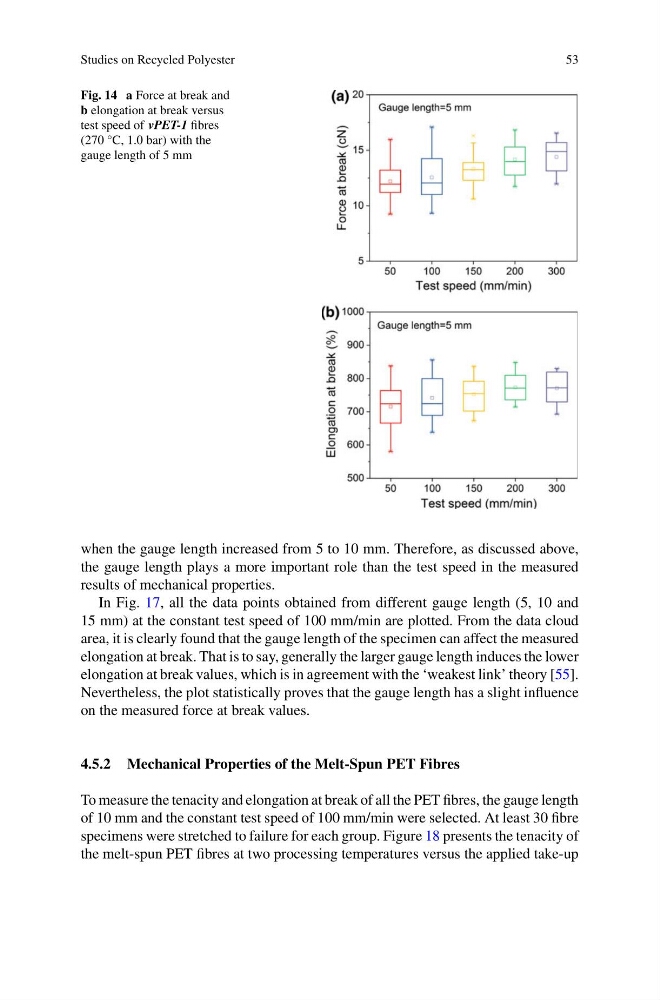
Fig. 14 a Force at break and
b elongation at break versus
test speed of vPET-1 fibres
(270 °C, 1.0 bar) with the
gauge length of 5 mm
when the gauge length increased from 5 to 10 mm. Therefore, as discussed above,
the gauge length plays a more important role than the test speed in the measured
results of mechanical properties.
In Fig. 17, all the data points obtained from different gauge length (5, 10 and
15 mm) at the constant test speed of 100 mm/min are plotted. From the data cloud
area, it is clearly found that the gauge length of the specimen can affect the measured
elongation at break. That is to say, generally the larger gauge length induces the lower
elongation at break values, which is in agreement with the ‘weakest link’ theory [55].
Nevertheless, the plot statistically proves that the gauge length has a slight influence
on the measured force at break values.
4.5.2 Mechanical Properties of the Melt-Spun PET Fibres
To measure the tenacity and elongation at break of all the PET fibres, the gauge length
of 10 mm and the constant test speed of 100 mm/min were selected. At least 30 fibre
specimens were stretched to failure for each group. Figure 18 presents the tenacity of
the melt-spun PET fibres at two processing temperatures versus the applied take-up
53
Fig. 14 a Force at break and
b elongation at break versus
test speed of vPET-1 fibres
(270 °C, 1.0 bar) with the
gauge length of 5 mm
when the gauge length increased from 5 to 10 mm. Therefore, as discussed above,
the gauge length plays a more important role than the test speed in the measured
results of mechanical properties.
In Fig. 17, all the data points obtained from different gauge length (5, 10 and
15 mm) at the constant test speed of 100 mm/min are plotted. From the data cloud
area, it is clearly found that the gauge length of the specimen can affect the measured
elongation at break. That is to say, generally the larger gauge length induces the lower
elongation at break values, which is in agreement with the ‘weakest link’ theory [55].
Nevertheless, the plot statistically proves that the gauge length has a slight influence
on the measured force at break values.
4.5.2 Mechanical Properties of the Melt-Spun PET Fibres
To measure the tenacity and elongation at break of all the PET fibres, the gauge length
of 10 mm and the constant test speed of 100 mm/min were selected. At least 30 fibre
specimens were stretched to failure for each group. Figure 18 presents the tenacity of
the melt-spun PET fibres at two processing temperatures versus the applied take-up