

52
Y. Qin et al.
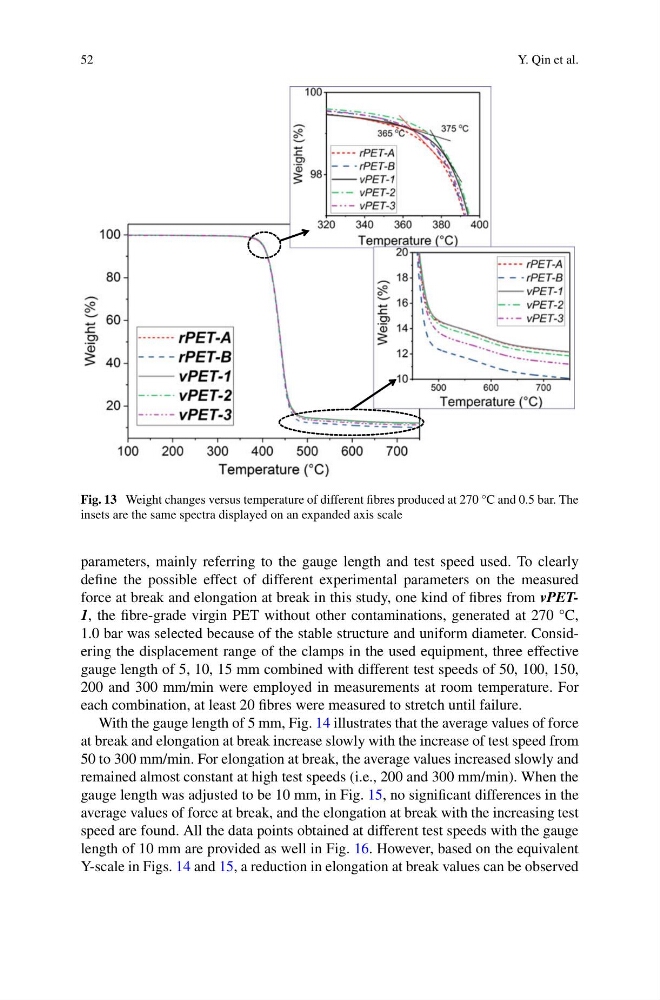
Fig. 13 Weight changes versus temperature of different fibres produced at 270 °C and 0.5 bar. The
insets are the same spectra displayed on an expanded axis scale
parameters, mainly referring to the gauge length and test speed used. To clearly
define the possible effect of different experimental parameters on the measured
force at break and elongation at break in this study, one kind of fibres from vPET1, the fibre-grade virgin PET without other contaminations, generated at 270 °C,
1.0 bar was selected because of the stable structure and uniform diameter. Considering the displacement range of the clamps in the used equipment, three effective
gauge length of 5, 10, 15 mm combined with different test speeds of 50, 100, 150,
200 and 300 mm/min were employed in measurements at room temperature. For
each combination, at least 20 fibres were measured to stretch until failure.
With the gauge length of 5 mm, Fig. 14 illustrates that the average values of force
at break and elongation at break increase slowly with the increase of test speed from
50 to 300 mm/min. For elongation at break, the average values increased slowly and
remained almost constant at high test speeds (i.e., 200 and 300 mm/min). When the
gauge length was adjusted to be 10 mm, in Fig. 15, no significant differences in the
average values of force at break, and the elongation at break with the increasing test
speed are found. All the data points obtained at different test speeds with the gauge
length of 10 mm are provided as well in Fig. 16. However, based on the equivalent
Y-scale in Figs. 14 and 15, a reduction in elongation at break values can be observed
Y. Qin et al.
Fig. 13 Weight changes versus temperature of different fibres produced at 270 °C and 0.5 bar. The
insets are the same spectra displayed on an expanded axis scale
parameters, mainly referring to the gauge length and test speed used. To clearly
define the possible effect of different experimental parameters on the measured
force at break and elongation at break in this study, one kind of fibres from vPET1, the fibre-grade virgin PET without other contaminations, generated at 270 °C,
1.0 bar was selected because of the stable structure and uniform diameter. Considering the displacement range of the clamps in the used equipment, three effective
gauge length of 5, 10, 15 mm combined with different test speeds of 50, 100, 150,
200 and 300 mm/min were employed in measurements at room temperature. For
each combination, at least 20 fibres were measured to stretch until failure.
With the gauge length of 5 mm, Fig. 14 illustrates that the average values of force
at break and elongation at break increase slowly with the increase of test speed from
50 to 300 mm/min. For elongation at break, the average values increased slowly and
remained almost constant at high test speeds (i.e., 200 and 300 mm/min). When the
gauge length was adjusted to be 10 mm, in Fig. 15, no significant differences in the
average values of force at break, and the elongation at break with the increasing test
speed are found. All the data points obtained at different test speeds with the gauge
length of 10 mm are provided as well in Fig. 16. However, based on the equivalent
Y-scale in Figs. 14 and 15, a reduction in elongation at break values can be observed