

Studies on Recycled Polyester
51
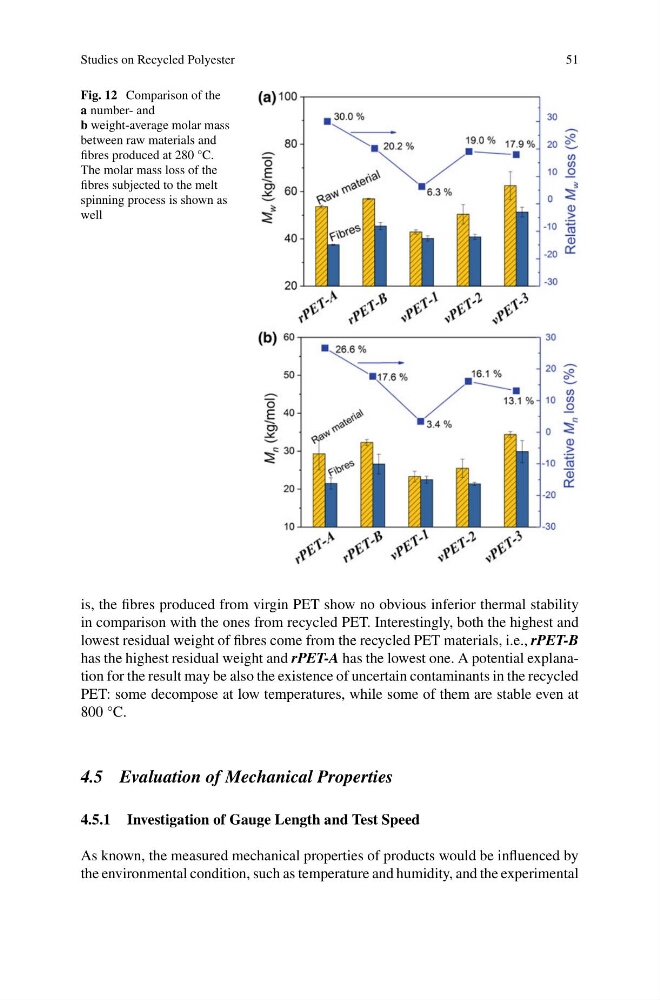
Fig. 12 Comparison of the
a number- and
b weight-average molar mass
between raw materials and
fibres produced at 280 °C.
The molar mass loss of the
fibres subjected to the melt
spinning process is shown as
well
is, the fibres produced from virgin PET show no obvious inferior thermal stability
in comparison with the ones from recycled PET. Interestingly, both the highest and
lowest residual weight of fibres come from the recycled PET materials, i.e., rPET-B
has the highest residual weight and rPET-A has the lowest one. A potential explanation for the result may be also the existence of uncertain contaminants in the recycled
PET: some decompose at low temperatures, while some of them are stable even at
800 °C.
4.5 Evaluation of Mechanical Properties
4.5.1 Investigation of Gauge Length and Test Speed
As known, the measured mechanical properties of products would be influenced by
the environmental condition, such as temperature and humidity, and the experimental
51
Fig. 12 Comparison of the
a number- and
b weight-average molar mass
between raw materials and
fibres produced at 280 °C.
The molar mass loss of the
fibres subjected to the melt
spinning process is shown as
well
is, the fibres produced from virgin PET show no obvious inferior thermal stability
in comparison with the ones from recycled PET. Interestingly, both the highest and
lowest residual weight of fibres come from the recycled PET materials, i.e., rPET-B
has the highest residual weight and rPET-A has the lowest one. A potential explanation for the result may be also the existence of uncertain contaminants in the recycled
PET: some decompose at low temperatures, while some of them are stable even at
800 °C.
4.5 Evaluation of Mechanical Properties
4.5.1 Investigation of Gauge Length and Test Speed
As known, the measured mechanical properties of products would be influenced by
the environmental condition, such as temperature and humidity, and the experimental