

46
Y. Qin et al.
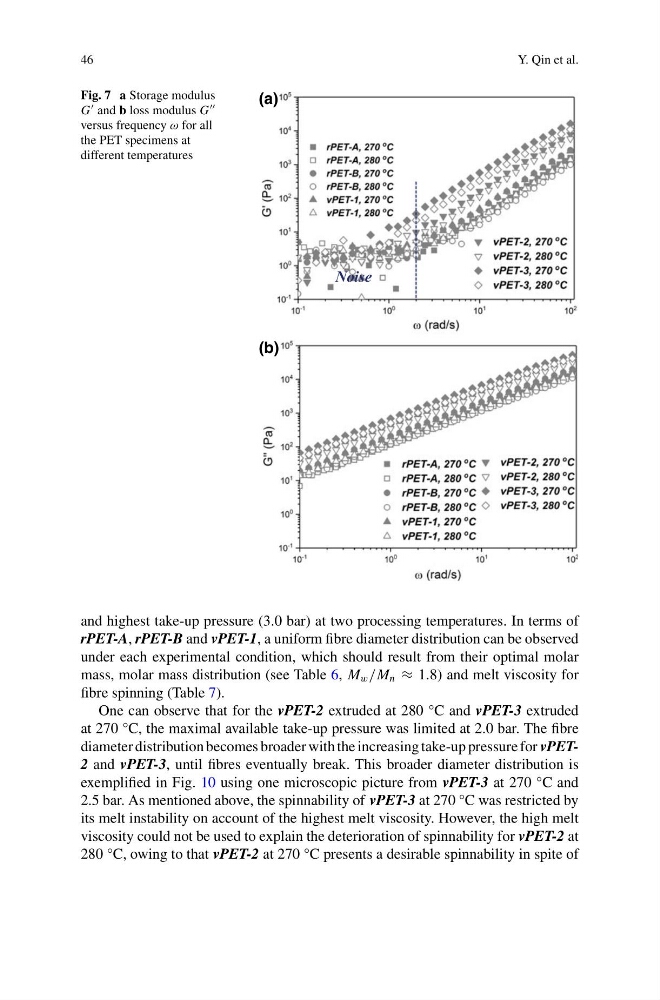
Fig. 7 a Storage modulus
G and b loss modulus G
versus frequency ω for all
the PET specimens at
different temperatures
Noise
(a)
(b)
and highest take-up pressure (3.0 bar) at two processing temperatures. In terms of
rPET-A, rPET-B and vPET-1, a uniform fibre diameter distribution can be observed
under each experimental condition, which should result from their optimal molar
mass, molar mass distribution (see Table 6, M w /M n ≈ 1.8) and melt viscosity for
fibre spinning (Table 7).
One can observe that for the vPET-2 extruded at 280 °C and vPET-3 extruded
at 270 °C, the maximal available take-up pressure was limited at 2.0 bar. The fibre
diameter distribution becomes broader with the increasing take-up pressure for vPET2 and vPET-3, until fibres eventually break. This broader diameter distribution is
exemplified in Fig. 10 using one microscopic picture from vPET-3 at 270 °C and
2.5 bar. As mentioned above, the spinnability of vPET-3 at 270 °C was restricted by
its melt instability on account of the highest melt viscosity. However, the high melt
viscosity could not be used to explain the deterioration of spinnability for vPET-2 at
280 °C, owing to that vPET-2 at 270 °C presents a desirable spinnability in spite of
Y. Qin et al.
Fig. 7 a Storage modulus
G and b loss modulus G
versus frequency ω for all
the PET specimens at
different temperatures
Noise
(a)
(b)
and highest take-up pressure (3.0 bar) at two processing temperatures. In terms of
rPET-A, rPET-B and vPET-1, a uniform fibre diameter distribution can be observed
under each experimental condition, which should result from their optimal molar
mass, molar mass distribution (see Table 6, M w /M n ≈ 1.8) and melt viscosity for
fibre spinning (Table 7).
One can observe that for the vPET-2 extruded at 280 °C and vPET-3 extruded
at 270 °C, the maximal available take-up pressure was limited at 2.0 bar. The fibre
diameter distribution becomes broader with the increasing take-up pressure for vPET2 and vPET-3, until fibres eventually break. This broader diameter distribution is
exemplified in Fig. 10 using one microscopic picture from vPET-3 at 270 °C and
2.5 bar. As mentioned above, the spinnability of vPET-3 at 270 °C was restricted by
its melt instability on account of the highest melt viscosity. However, the high melt
viscosity could not be used to explain the deterioration of spinnability for vPET-2 at
280 °C, owing to that vPET-2 at 270 °C presents a desirable spinnability in spite of