

Studies on Recycled Polyester
45
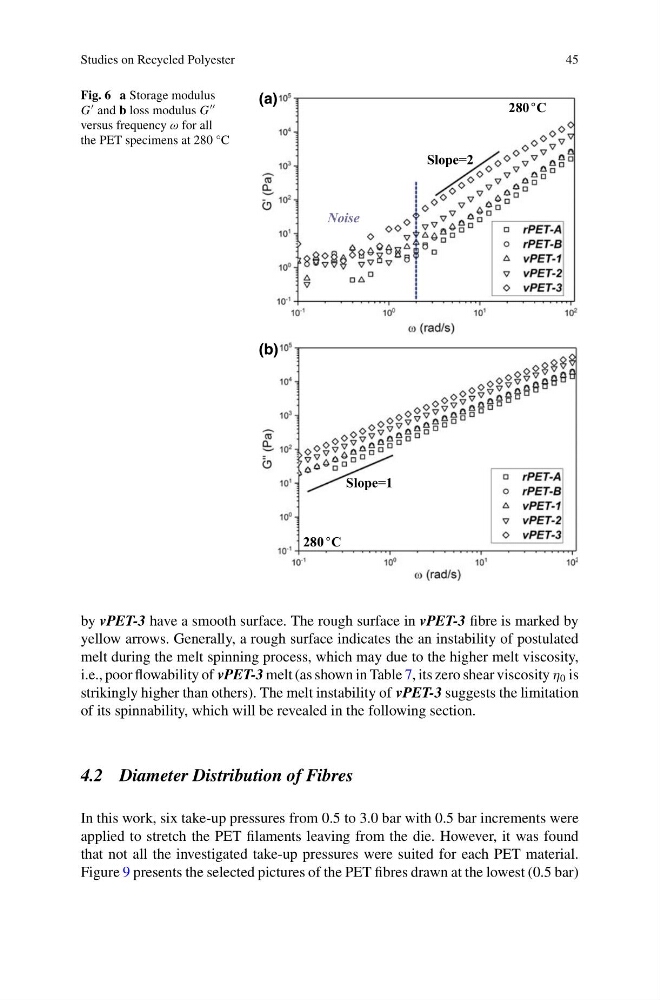
Fig. 6 a Storage modulus
G and b loss modulus G
versus frequency ω for all
the PET specimens at 280 °C
280 °C
280 °C
Slope=1
Slope=2
Noise
(a)
(b)
by vPET-3 have a smooth surface. The rough surface in vPET-3 fibre is marked by
yellow arrows. Generally, a rough surface indicates the an instability of postulated
melt during the melt spinning process, which may due to the higher melt viscosity,
i.e., poor flowability of vPET-3 melt (as shown in Table 7, its zero shear viscosity η 0 is
strikingly higher than others). The melt instability of vPET-3 suggests the limitation
of its spinnability, which will be revealed in the following section.
4.2 Diameter Distribution of Fibres
In this work, six take-up pressures from 0.5 to 3.0 bar with 0.5 bar increments were
applied to stretch the PET filaments leaving from the die. However, it was found
that not all the investigated take-up pressures were suited for each PET material.
Figure 9 presents the selected pictures of the PET fibres drawn at the lowest (0.5 bar)
45
Fig. 6 a Storage modulus
G and b loss modulus G
versus frequency ω for all
the PET specimens at 280 °C
280 °C
280 °C
Slope=1
Slope=2
Noise
(a)
(b)
by vPET-3 have a smooth surface. The rough surface in vPET-3 fibre is marked by
yellow arrows. Generally, a rough surface indicates the an instability of postulated
melt during the melt spinning process, which may due to the higher melt viscosity,
i.e., poor flowability of vPET-3 melt (as shown in Table 7, its zero shear viscosity η 0 is
strikingly higher than others). The melt instability of vPET-3 suggests the limitation
of its spinnability, which will be revealed in the following section.
4.2 Diameter Distribution of Fibres
In this work, six take-up pressures from 0.5 to 3.0 bar with 0.5 bar increments were
applied to stretch the PET filaments leaving from the die. However, it was found
that not all the investigated take-up pressures were suited for each PET material.
Figure 9 presents the selected pictures of the PET fibres drawn at the lowest (0.5 bar)