

44
Y. Qin et al.
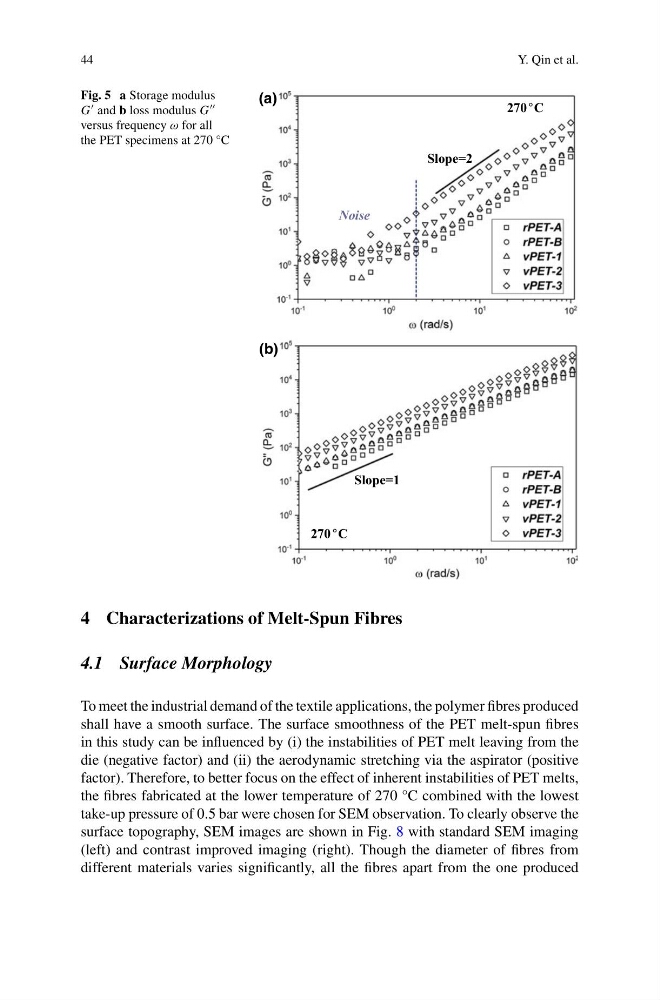
Fig. 5 a Storage modulus
G and b loss modulus G
versus frequency ω for all
the PET specimens at 270 °C
270 °C
270 °C
Slope=1
Slope=2
Noise
(a)
(b)
4 Characterizations of Melt-Spun Fibres
4.1 Surface Morphology
To meet the industrial demand of the textile applications, the polymer fibres produced
shall have a smooth surface. The surface smoothness of the PET melt-spun fibres
in this study can be influenced by (i) the instabilities of PET melt leaving from the
die (negative factor) and (ii) the aerodynamic stretching via the aspirator (positive
factor). Therefore, to better focus on the effect of inherent instabilities of PET melts,
the fibres fabricated at the lower temperature of 270 °C combined with the lowest
take-up pressure of 0.5 bar were chosen for SEM observation. To clearly observe the
surface topography, SEM images are shown in Fig. 8 with standard SEM imaging
(left) and contrast improved imaging (right). Though the diameter of fibres from
different materials varies significantly, all the fibres apart from the one produced
Y. Qin et al.
Fig. 5 a Storage modulus
G and b loss modulus G
versus frequency ω for all
the PET specimens at 270 °C
270 °C
270 °C
Slope=1
Slope=2
Noise
(a)
(b)
4 Characterizations of Melt-Spun Fibres
4.1 Surface Morphology
To meet the industrial demand of the textile applications, the polymer fibres produced
shall have a smooth surface. The surface smoothness of the PET melt-spun fibres
in this study can be influenced by (i) the instabilities of PET melt leaving from the
die (negative factor) and (ii) the aerodynamic stretching via the aspirator (positive
factor). Therefore, to better focus on the effect of inherent instabilities of PET melts,
the fibres fabricated at the lower temperature of 270 °C combined with the lowest
take-up pressure of 0.5 bar were chosen for SEM observation. To clearly observe the
surface topography, SEM images are shown in Fig. 8 with standard SEM imaging
(left) and contrast improved imaging (right). Though the diameter of fibres from
different materials varies significantly, all the fibres apart from the one produced