

Studies on Recycled Polyester
41
3.3 Rheological Characterization
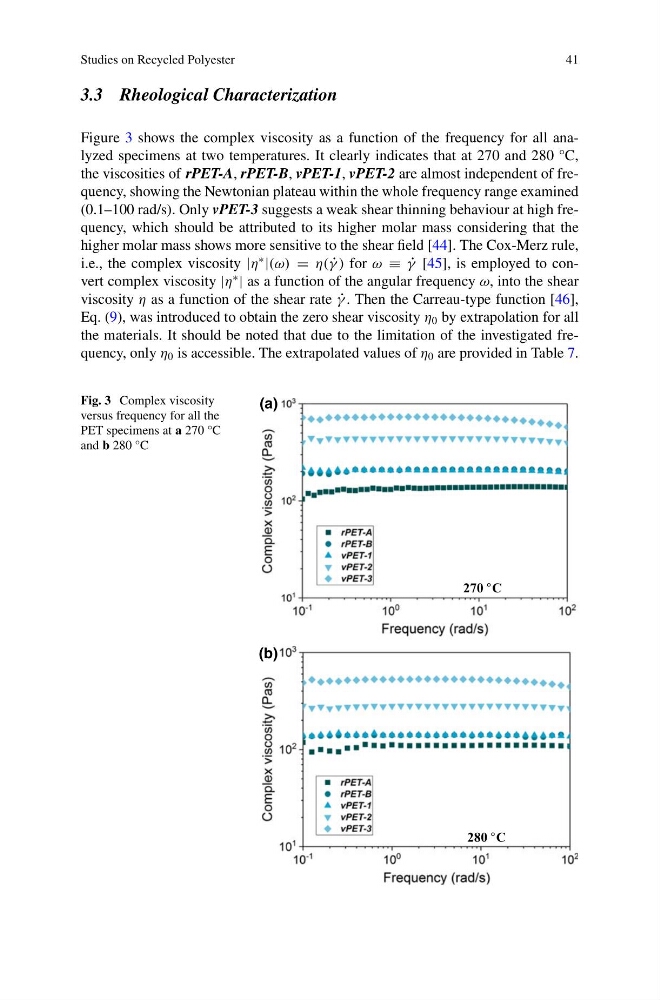
Figure 3 shows the complex viscosity as a function of the frequency for all analyzed specimens at two temperatures. It clearly indicates that at 270 and 280 °C,
the viscosities of rPET-A, rPET-B, vPET-1, vPET-2 are almost independent of frequency, showing the Newtonian plateau within the whole frequency range examined
(0.1–100 rad/s). Only vPET-3 suggests a weak shear thinning behaviour at high frequency, which should be attributed to its higher molar mass considering that the
higher molar mass shows more sensitive to the shear field [44]. The Cox-Merz rule,
i.e., the complex viscosity |η
∗
|(ω) = η( ˙
γ ) for ω ≡ ˙
γ [45], is employed to convert complex viscosity |η
∗
| as a function of the angular frequency ω, into the shear
viscosity η as a function of the shear rate ˙
γ . Then the Carreau-type function [46],
Eq. (9), was introduced to obtain the zero shear viscosity η 0 by extrapolation for all
the materials. It should be noted that due to the limitation of the investigated frequency, only η 0 is accessible. The extrapolated values of η 0 are provided in Table 7.
Fig. 3 Complex viscosity
versus frequency for all the
PET specimens at a 270 °C
and b 280 °C
270 °C
280 °C
(a)
(b)
41
3.3 Rheological Characterization
Figure 3 shows the complex viscosity as a function of the frequency for all analyzed specimens at two temperatures. It clearly indicates that at 270 and 280 °C,
the viscosities of rPET-A, rPET-B, vPET-1, vPET-2 are almost independent of frequency, showing the Newtonian plateau within the whole frequency range examined
(0.1–100 rad/s). Only vPET-3 suggests a weak shear thinning behaviour at high frequency, which should be attributed to its higher molar mass considering that the
higher molar mass shows more sensitive to the shear field [44]. The Cox-Merz rule,
i.e., the complex viscosity |η
∗
|(ω) = η( ˙
γ ) for ω ≡ ˙
γ [45], is employed to convert complex viscosity |η
∗
| as a function of the angular frequency ω, into the shear
viscosity η as a function of the shear rate ˙
γ . Then the Carreau-type function [46],
Eq. (9), was introduced to obtain the zero shear viscosity η 0 by extrapolation for all
the materials. It should be noted that due to the limitation of the investigated frequency, only η 0 is accessible. The extrapolated values of η 0 are provided in Table 7.
Fig. 3 Complex viscosity
versus frequency for all the
PET specimens at a 270 °C
and b 280 °C
270 °C
280 °C
(a)
(b)