

42
Y. Qin et al.
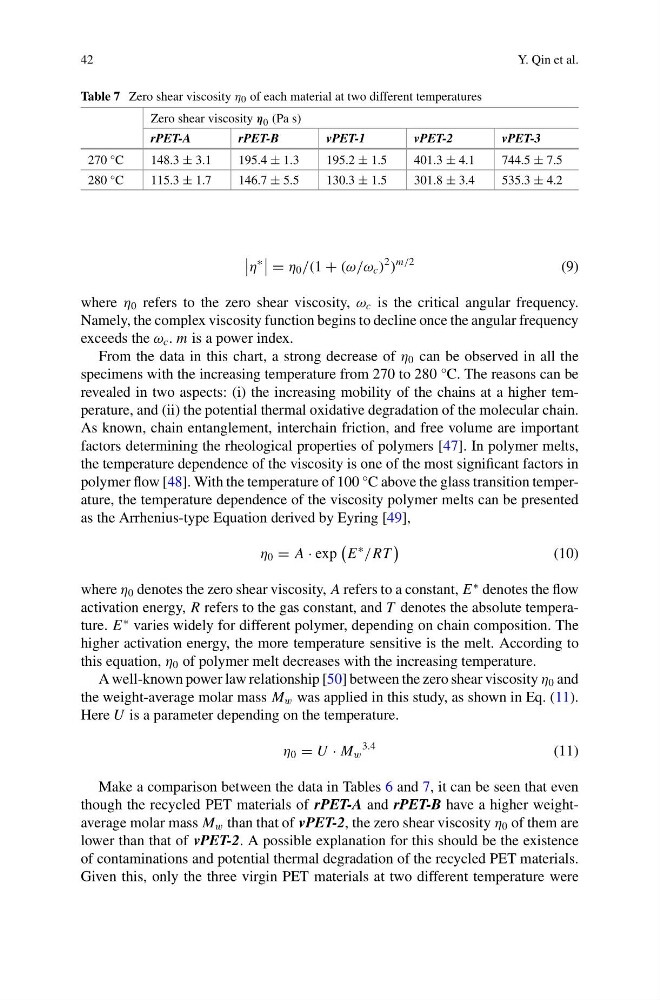
Table 7 Zero shear viscosity η 0 of each material at two different temperatures
Zero shear viscosity η 0 (Pa s)
rPET-A
rPET-B
vPET-1
vPET-2
vPET-3
270 °C
148.3 ± 3.1
195.4 ± 1.3
195.2 ± 1.5
401.3 ± 4.1
744.5 ± 7.5
280 °C
115.3 ± 1.7
146.7 ± 5.5
130.3 ± 1.5
301.8 ± 3.4
535.3 ± 4.2
η
∗
= η 0 /(1 + (ω/ω c )
2
)
m/2
(9)
where η 0 refers to the zero shear viscosity, ω c is the critical angular frequency.
Namely, the complex viscosity function begins to decline once the angular frequency
exceeds the ω c . m is a power index.
From the data in this chart, a strong decrease of η 0 can be observed in all the
specimens with the increasing temperature from 270 to 280 °C. The reasons can be
revealed in two aspects: (i) the increasing mobility of the chains at a higher temperature, and (ii) the potential thermal oxidative degradation of the molecular chain.
As known, chain entanglement, interchain friction, and free volume are important
factors determining the rheological properties of polymers [47]. In polymer melts,
the temperature dependence of the viscosity is one of the most significant factors in
polymer flow [48]. With the temperature of 100 °C above the glass transition temperature, the temperature dependence of the viscosity polymer melts can be presented
as the Arrhenius-type Equation derived by Eyring [49],
η 0 = A · exp
E
∗
/RT
(10)
where η 0 denotes the zero shear viscosity, A refers to a constant, E
∗ denotes the flow
activation energy, R refers to the gas constant, and T denotes the absolute temperature. E
∗ varies widely for different polymer, depending on chain composition. The
higher activation energy, the more temperature sensitive is the melt. According to
this equation, η 0 of polymer melt decreases with the increasing temperature.
A well-known power law relationship [50] between the zero shear viscosity η 0 and
the weight-average molar mass M w was applied in this study, as shown in Eq. (11).
Here U is a parameter depending on the temperature.
η 0 = U · M w
3.4
(11)
Make a comparison between the data in Tables 6 and 7, it can be seen that even
though the recycled PET materials of rPET-A and rPET-B have a higher weightaverage molar mass M w than that of vPET-2, the zero shear viscosity η 0 of them are
lower than that of vPET-2. A possible explanation for this should be the existence
of contaminations and potential thermal degradation of the recycled PET materials.
Given this, only the three virgin PET materials at two different temperature were
Y. Qin et al.
Table 7 Zero shear viscosity η 0 of each material at two different temperatures
Zero shear viscosity η 0 (Pa s)
rPET-A
rPET-B
vPET-1
vPET-2
vPET-3
270 °C
148.3 ± 3.1
195.4 ± 1.3
195.2 ± 1.5
401.3 ± 4.1
744.5 ± 7.5
280 °C
115.3 ± 1.7
146.7 ± 5.5
130.3 ± 1.5
301.8 ± 3.4
535.3 ± 4.2
η
∗
= η 0 /(1 + (ω/ω c )
2
)
m/2
(9)
where η 0 refers to the zero shear viscosity, ω c is the critical angular frequency.
Namely, the complex viscosity function begins to decline once the angular frequency
exceeds the ω c . m is a power index.
From the data in this chart, a strong decrease of η 0 can be observed in all the
specimens with the increasing temperature from 270 to 280 °C. The reasons can be
revealed in two aspects: (i) the increasing mobility of the chains at a higher temperature, and (ii) the potential thermal oxidative degradation of the molecular chain.
As known, chain entanglement, interchain friction, and free volume are important
factors determining the rheological properties of polymers [47]. In polymer melts,
the temperature dependence of the viscosity is one of the most significant factors in
polymer flow [48]. With the temperature of 100 °C above the glass transition temperature, the temperature dependence of the viscosity polymer melts can be presented
as the Arrhenius-type Equation derived by Eyring [49],
η 0 = A · exp
E
∗
/RT
(10)
where η 0 denotes the zero shear viscosity, A refers to a constant, E
∗ denotes the flow
activation energy, R refers to the gas constant, and T denotes the absolute temperature. E
∗ varies widely for different polymer, depending on chain composition. The
higher activation energy, the more temperature sensitive is the melt. According to
this equation, η 0 of polymer melt decreases with the increasing temperature.
A well-known power law relationship [50] between the zero shear viscosity η 0 and
the weight-average molar mass M w was applied in this study, as shown in Eq. (11).
Here U is a parameter depending on the temperature.
η 0 = U · M w
3.4
(11)
Make a comparison between the data in Tables 6 and 7, it can be seen that even
though the recycled PET materials of rPET-A and rPET-B have a higher weightaverage molar mass M w than that of vPET-2, the zero shear viscosity η 0 of them are
lower than that of vPET-2. A possible explanation for this should be the existence
of contaminations and potential thermal degradation of the recycled PET materials.
Given this, only the three virgin PET materials at two different temperature were