

17 Carotenoids as Food Additives
435
Lutein is present at a high concentration in the human serum and breast milk. Infant
formulas fortified with lutein and β-carotene were found to be safe, well-tolerated
and supported the physical growth of infants (Kon et al. 2014).
In addition, as an antioxidant agent, lutein was shown to protect against UVinduced oxidative damage in the epidermal and dermal layers of skin (Lee et al.
2004).
17.2.8 Lycopene
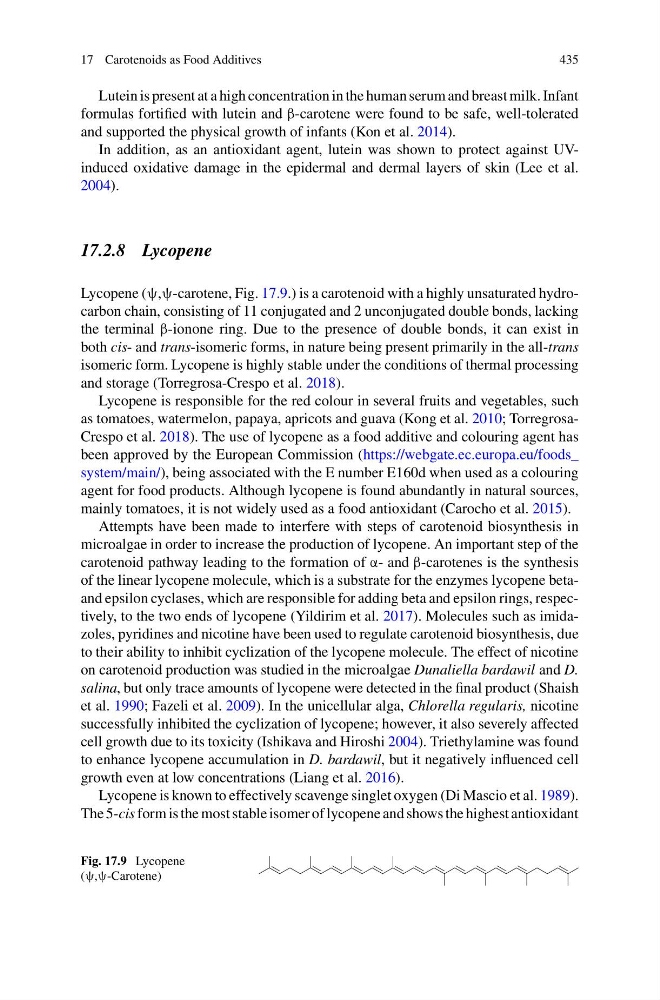
Lycopene (ψ,ψ-carotene, Fig. 17.9.) is a carotenoid with a highly unsaturated hydrocarbon chain, consisting of 11 conjugated and 2 unconjugated double bonds, lacking
the terminal β-ionone ring. Due to the presence of double bonds, it can exist in
both cis- and trans-isomeric forms, in nature being present primarily in the all-trans
isomeric form. Lycopene is highly stable under the conditions of thermal processing
and storage (Torregrosa-Crespo et al. 2018).
Lycopene is responsible for the red colour in several fruits and vegetables, such
as tomatoes, watermelon, papaya, apricots and guava (Kong et al. 2010; TorregrosaCrespo et al. 2018). The use of lycopene as a food additive and colouring agent has
been approved by the European Commission (https://webgate.ec.europa.eu/foods_
system/main/), being associated with the E number E160d when used as a colouring
agent for food products. Although lycopene is found abundantly in natural sources,
mainly tomatoes, it is not widely used as a food antioxidant (Carocho et al. 2015).
Attempts have been made to interfere with steps of carotenoid biosynthesis in
microalgae in order to increase the production of lycopene. An important step of the
carotenoid pathway leading to the formation of α- and β-carotenes is the synthesis
of the linear lycopene molecule, which is a substrate for the enzymes lycopene betaand epsilon cyclases, which are responsible for adding beta and epsilon rings, respectively, to the two ends of lycopene (Yildirim et al. 2017). Molecules such as imidazoles, pyridines and nicotine have been used to regulate carotenoid biosynthesis, due
to their ability to inhibit cyclization of the lycopene molecule. The effect of nicotine
on carotenoid production was studied in the microalgae Dunaliella bardawil and D.
salina, but only trace amounts of lycopene were detected in the final product (Shaish
et al. 1990; Fazeli et al. 2009). In the unicellular alga, Chlorella regularis, nicotine
successfully inhibited the cyclization of lycopene; however, it also severely affected
cell growth due to its toxicity (Ishikava and Hiroshi 2004). Triethylamine was found
to enhance lycopene accumulation in D. bardawil, but it negatively influenced cell
growth even at low concentrations (Liang et al. 2016).
Lycopene is known to effectively scavenge singlet oxygen (Di Mascio et al. 1989).
The 5-cis form is the most stable isomer of lycopene and shows the highest antioxidant
Fig. 17.9 Lycopene
(ψ,ψ-Carotene)
435
Lutein is present at a high concentration in the human serum and breast milk. Infant
formulas fortified with lutein and β-carotene were found to be safe, well-tolerated
and supported the physical growth of infants (Kon et al. 2014).
In addition, as an antioxidant agent, lutein was shown to protect against UVinduced oxidative damage in the epidermal and dermal layers of skin (Lee et al.
2004).
17.2.8 Lycopene
Lycopene (ψ,ψ-carotene, Fig. 17.9.) is a carotenoid with a highly unsaturated hydrocarbon chain, consisting of 11 conjugated and 2 unconjugated double bonds, lacking
the terminal β-ionone ring. Due to the presence of double bonds, it can exist in
both cis- and trans-isomeric forms, in nature being present primarily in the all-trans
isomeric form. Lycopene is highly stable under the conditions of thermal processing
and storage (Torregrosa-Crespo et al. 2018).
Lycopene is responsible for the red colour in several fruits and vegetables, such
as tomatoes, watermelon, papaya, apricots and guava (Kong et al. 2010; TorregrosaCrespo et al. 2018). The use of lycopene as a food additive and colouring agent has
been approved by the European Commission (https://webgate.ec.europa.eu/foods_
system/main/), being associated with the E number E160d when used as a colouring
agent for food products. Although lycopene is found abundantly in natural sources,
mainly tomatoes, it is not widely used as a food antioxidant (Carocho et al. 2015).
Attempts have been made to interfere with steps of carotenoid biosynthesis in
microalgae in order to increase the production of lycopene. An important step of the
carotenoid pathway leading to the formation of α- and β-carotenes is the synthesis
of the linear lycopene molecule, which is a substrate for the enzymes lycopene betaand epsilon cyclases, which are responsible for adding beta and epsilon rings, respectively, to the two ends of lycopene (Yildirim et al. 2017). Molecules such as imidazoles, pyridines and nicotine have been used to regulate carotenoid biosynthesis, due
to their ability to inhibit cyclization of the lycopene molecule. The effect of nicotine
on carotenoid production was studied in the microalgae Dunaliella bardawil and D.
salina, but only trace amounts of lycopene were detected in the final product (Shaish
et al. 1990; Fazeli et al. 2009). In the unicellular alga, Chlorella regularis, nicotine
successfully inhibited the cyclization of lycopene; however, it also severely affected
cell growth due to its toxicity (Ishikava and Hiroshi 2004). Triethylamine was found
to enhance lycopene accumulation in D. bardawil, but it negatively influenced cell
growth even at low concentrations (Liang et al. 2016).
Lycopene is known to effectively scavenge singlet oxygen (Di Mascio et al. 1989).
The 5-cis form is the most stable isomer of lycopene and shows the highest antioxidant
Fig. 17.9 Lycopene
(ψ,ψ-Carotene)