

436
Á. Farkas et al.
activity, followed by the 9-cis, 7-cis, 13-cis, 11-cis and all-trans isomeric forms (Rao
and Rao 2007).
Lycopene was found to exhibit much higher anti-cancer potential than most other
carotenoids, significantly reducing tumour cell growth in various tumour cell lines
(Nishino et al. 2002; Graydon et al. 2007; Schwarz et al. 2008). The protective effect
of lycopene against prostate cancer was demonstrated by Stacewicz-Sapuntzakis and
Bowen (2005), as well as Giovanucci (2011).
In addition, lycopene has prophylactic and/or therapeutic effects in various
central nervous system disorders, such as Alzheimer’s disease, Parkinson’s disease,
Huntington’s disease, cerebal ischemia, epilepsy and depression (Chen et al. 2019).
Supplementing antioxidant micronutrients such as lycopene was reported to
reduce skin roughness (Heinrich et al. 2006). Another study demonstrated that individuals with higher levels of antioxidants, e.g. lycopene, showed fewer furrows and
wrinkles than those with lower levels of antioxidants (Darvin et al. 2008).
17.2.9 Zeaxanthin
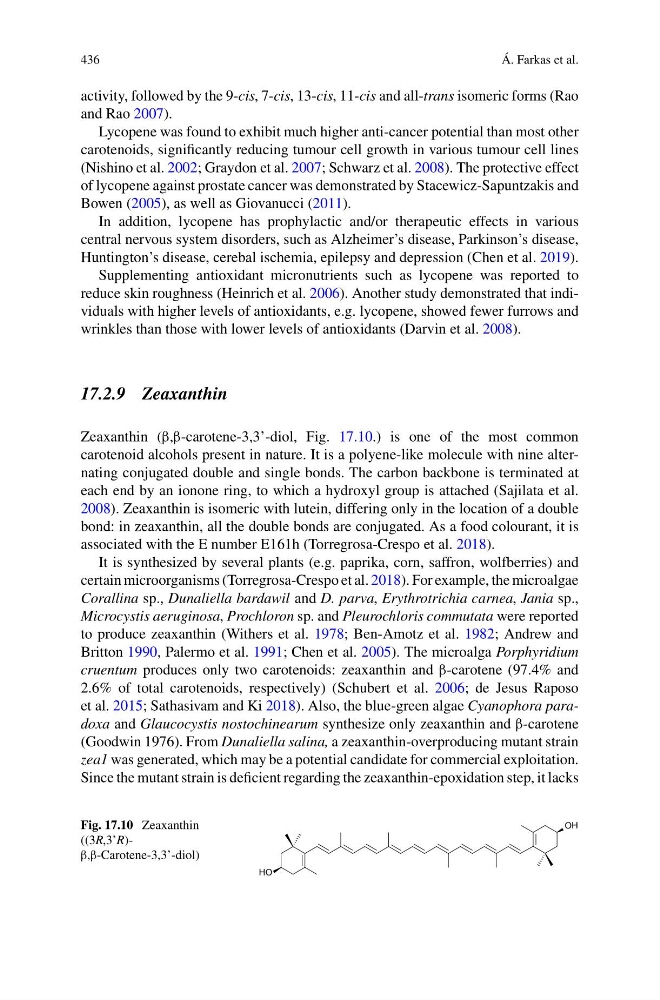
Zeaxanthin (β,β-carotene-3,3’-diol, Fig. 17.10.) is one of the most common
carotenoid alcohols present in nature. It is a polyene-like molecule with nine alternating conjugated double and single bonds. The carbon backbone is terminated at
each end by an ionone ring, to which a hydroxyl group is attached (Sajilata et al.
2008). Zeaxanthin is isomeric with lutein, differing only in the location of a double
bond: in zeaxanthin, all the double bonds are conjugated. As a food colourant, it is
associated with the E number E161h (Torregrosa-Crespo et al. 2018).
It is synthesized by several plants (e.g. paprika, corn, saffron, wolfberries) and
certain microorganisms (Torregrosa-Crespo et al. 2018). For example, the microalgae
Corallina sp., Dunaliella bardawil and D. parva, Erythrotrichia carnea, Jania sp.,
Microcystis aeruginosa, Prochloron sp. and Pleurochloris commutata were reported
to produce zeaxanthin (Withers et al. 1978; Ben-Amotz et al. 1982; Andrew and
Britton 1990, Palermo et al. 1991; Chen et al. 2005). The microalga Porphyridium
cruentum produces only two carotenoids: zeaxanthin and β-carotene (97.4% and
2.6% of total carotenoids, respectively) (Schubert et al. 2006; de Jesus Raposo
et al. 2015; Sathasivam and Ki 2018). Also, the blue-green algae Cyanophora paradoxa and Glaucocystis nostochinearum synthesize only zeaxanthin and β-carotene
(Goodwin 1976). From Dunaliella salina, a zeaxanthin-overproducing mutant strain
zea1 was generated, which may be a potential candidate for commercial exploitation.
Since the mutant strain is deficient regarding the zeaxanthin-epoxidation step, it lacks
Fig. 17.10 Zeaxanthin
((3R,3’R)β,β-Carotene-3,3’-diol)
HO
OH
Á. Farkas et al.
activity, followed by the 9-cis, 7-cis, 13-cis, 11-cis and all-trans isomeric forms (Rao
and Rao 2007).
Lycopene was found to exhibit much higher anti-cancer potential than most other
carotenoids, significantly reducing tumour cell growth in various tumour cell lines
(Nishino et al. 2002; Graydon et al. 2007; Schwarz et al. 2008). The protective effect
of lycopene against prostate cancer was demonstrated by Stacewicz-Sapuntzakis and
Bowen (2005), as well as Giovanucci (2011).
In addition, lycopene has prophylactic and/or therapeutic effects in various
central nervous system disorders, such as Alzheimer’s disease, Parkinson’s disease,
Huntington’s disease, cerebal ischemia, epilepsy and depression (Chen et al. 2019).
Supplementing antioxidant micronutrients such as lycopene was reported to
reduce skin roughness (Heinrich et al. 2006). Another study demonstrated that individuals with higher levels of antioxidants, e.g. lycopene, showed fewer furrows and
wrinkles than those with lower levels of antioxidants (Darvin et al. 2008).
17.2.9 Zeaxanthin
Zeaxanthin (β,β-carotene-3,3’-diol, Fig. 17.10.) is one of the most common
carotenoid alcohols present in nature. It is a polyene-like molecule with nine alternating conjugated double and single bonds. The carbon backbone is terminated at
each end by an ionone ring, to which a hydroxyl group is attached (Sajilata et al.
2008). Zeaxanthin is isomeric with lutein, differing only in the location of a double
bond: in zeaxanthin, all the double bonds are conjugated. As a food colourant, it is
associated with the E number E161h (Torregrosa-Crespo et al. 2018).
It is synthesized by several plants (e.g. paprika, corn, saffron, wolfberries) and
certain microorganisms (Torregrosa-Crespo et al. 2018). For example, the microalgae
Corallina sp., Dunaliella bardawil and D. parva, Erythrotrichia carnea, Jania sp.,
Microcystis aeruginosa, Prochloron sp. and Pleurochloris commutata were reported
to produce zeaxanthin (Withers et al. 1978; Ben-Amotz et al. 1982; Andrew and
Britton 1990, Palermo et al. 1991; Chen et al. 2005). The microalga Porphyridium
cruentum produces only two carotenoids: zeaxanthin and β-carotene (97.4% and
2.6% of total carotenoids, respectively) (Schubert et al. 2006; de Jesus Raposo
et al. 2015; Sathasivam and Ki 2018). Also, the blue-green algae Cyanophora paradoxa and Glaucocystis nostochinearum synthesize only zeaxanthin and β-carotene
(Goodwin 1976). From Dunaliella salina, a zeaxanthin-overproducing mutant strain
zea1 was generated, which may be a potential candidate for commercial exploitation.
Since the mutant strain is deficient regarding the zeaxanthin-epoxidation step, it lacks
Fig. 17.10 Zeaxanthin
((3R,3’R)β,β-Carotene-3,3’-diol)
HO
OH