

434
Á. Farkas et al.
17.2.7 Lutein
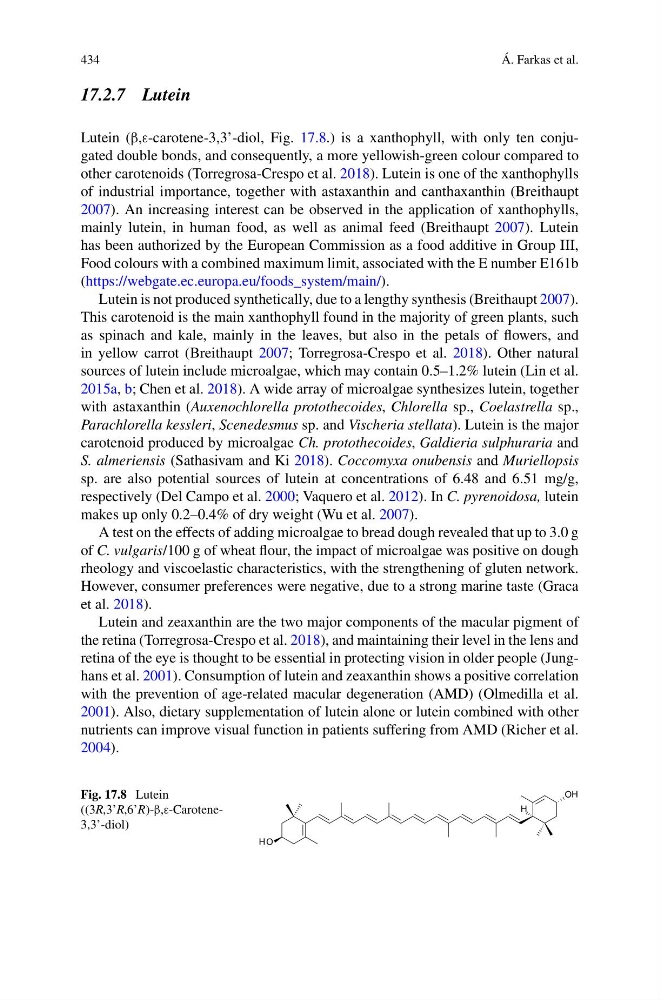
Lutein (β,ε-carotene-3,3’-diol, Fig. 17.8.) is a xanthophyll, with only ten conjugated double bonds, and consequently, a more yellowish-green colour compared to
other carotenoids (Torregrosa-Crespo et al. 2018). Lutein is one of the xanthophylls
of industrial importance, together with astaxanthin and canthaxanthin (Breithaupt
2007). An increasing interest can be observed in the application of xanthophylls,
mainly lutein, in human food, as well as animal feed (Breithaupt 2007). Lutein
has been authorized by the European Commission as a food additive in Group III,
Food colours with a combined maximum limit, associated with the E number E161b
(https://webgate.ec.europa.eu/foods_system/main/).
Lutein is not produced synthetically, due to a lengthy synthesis (Breithaupt 2007).
This carotenoid is the main xanthophyll found in the majority of green plants, such
as spinach and kale, mainly in the leaves, but also in the petals of flowers, and
in yellow carrot (Breithaupt 2007; Torregrosa-Crespo et al. 2018). Other natural
sources of lutein include microalgae, which may contain 0.5–1.2% lutein (Lin et al.
2015a, b; Chen et al. 2018). A wide array of microalgae synthesizes lutein, together
with astaxanthin (Auxenochlorella protothecoides, Chlorella sp., Coelastrella sp.,
Parachlorella kessleri, Scenedesmus sp. and Vischeria stellata). Lutein is the major
carotenoid produced by microalgae Ch. protothecoides, Galdieria sulphuraria and
S. almeriensis (Sathasivam and Ki 2018). Coccomyxa onubensis and Muriellopsis
sp. are also potential sources of lutein at concentrations of 6.48 and 6.51 mg/g,
respectively (Del Campo et al. 2000; Vaquero et al. 2012). In C. pyrenoidosa, lutein
makes up only 0.2–0.4% of dry weight (Wu et al. 2007).
A test on the effects of adding microalgae to bread dough revealed that up to 3.0 g
of C. vulgaris/100 g of wheat flour, the impact of microalgae was positive on dough
rheology and viscoelastic characteristics, with the strengthening of gluten network.
However, consumer preferences were negative, due to a strong marine taste (Graca
et al. 2018).
Lutein and zeaxanthin are the two major components of the macular pigment of
the retina (Torregrosa-Crespo et al. 2018), and maintaining their level in the lens and
retina of the eye is thought to be essential in protecting vision in older people (Junghans et al. 2001). Consumption of lutein and zeaxanthin shows a positive correlation
with the prevention of age-related macular degeneration (AMD) (Olmedilla et al.
2001). Also, dietary supplementation of lutein alone or lutein combined with other
nutrients can improve visual function in patients suffering from AMD (Richer et al.
2004).
Fig. 17.8 Lutein
((3R,3’R,6’R)-β,ε-Carotene3,3’-diol)
HO
H
OH
Á. Farkas et al.
17.2.7 Lutein
Lutein (β,ε-carotene-3,3’-diol, Fig. 17.8.) is a xanthophyll, with only ten conjugated double bonds, and consequently, a more yellowish-green colour compared to
other carotenoids (Torregrosa-Crespo et al. 2018). Lutein is one of the xanthophylls
of industrial importance, together with astaxanthin and canthaxanthin (Breithaupt
2007). An increasing interest can be observed in the application of xanthophylls,
mainly lutein, in human food, as well as animal feed (Breithaupt 2007). Lutein
has been authorized by the European Commission as a food additive in Group III,
Food colours with a combined maximum limit, associated with the E number E161b
(https://webgate.ec.europa.eu/foods_system/main/).
Lutein is not produced synthetically, due to a lengthy synthesis (Breithaupt 2007).
This carotenoid is the main xanthophyll found in the majority of green plants, such
as spinach and kale, mainly in the leaves, but also in the petals of flowers, and
in yellow carrot (Breithaupt 2007; Torregrosa-Crespo et al. 2018). Other natural
sources of lutein include microalgae, which may contain 0.5–1.2% lutein (Lin et al.
2015a, b; Chen et al. 2018). A wide array of microalgae synthesizes lutein, together
with astaxanthin (Auxenochlorella protothecoides, Chlorella sp., Coelastrella sp.,
Parachlorella kessleri, Scenedesmus sp. and Vischeria stellata). Lutein is the major
carotenoid produced by microalgae Ch. protothecoides, Galdieria sulphuraria and
S. almeriensis (Sathasivam and Ki 2018). Coccomyxa onubensis and Muriellopsis
sp. are also potential sources of lutein at concentrations of 6.48 and 6.51 mg/g,
respectively (Del Campo et al. 2000; Vaquero et al. 2012). In C. pyrenoidosa, lutein
makes up only 0.2–0.4% of dry weight (Wu et al. 2007).
A test on the effects of adding microalgae to bread dough revealed that up to 3.0 g
of C. vulgaris/100 g of wheat flour, the impact of microalgae was positive on dough
rheology and viscoelastic characteristics, with the strengthening of gluten network.
However, consumer preferences were negative, due to a strong marine taste (Graca
et al. 2018).
Lutein and zeaxanthin are the two major components of the macular pigment of
the retina (Torregrosa-Crespo et al. 2018), and maintaining their level in the lens and
retina of the eye is thought to be essential in protecting vision in older people (Junghans et al. 2001). Consumption of lutein and zeaxanthin shows a positive correlation
with the prevention of age-related macular degeneration (AMD) (Olmedilla et al.
2001). Also, dietary supplementation of lutein alone or lutein combined with other
nutrients can improve visual function in patients suffering from AMD (Richer et al.
2004).
Fig. 17.8 Lutein
((3R,3’R,6’R)-β,ε-Carotene3,3’-diol)
HO
H
OH