

15 Sustainability Metrics in the Microalgae-Based …
377
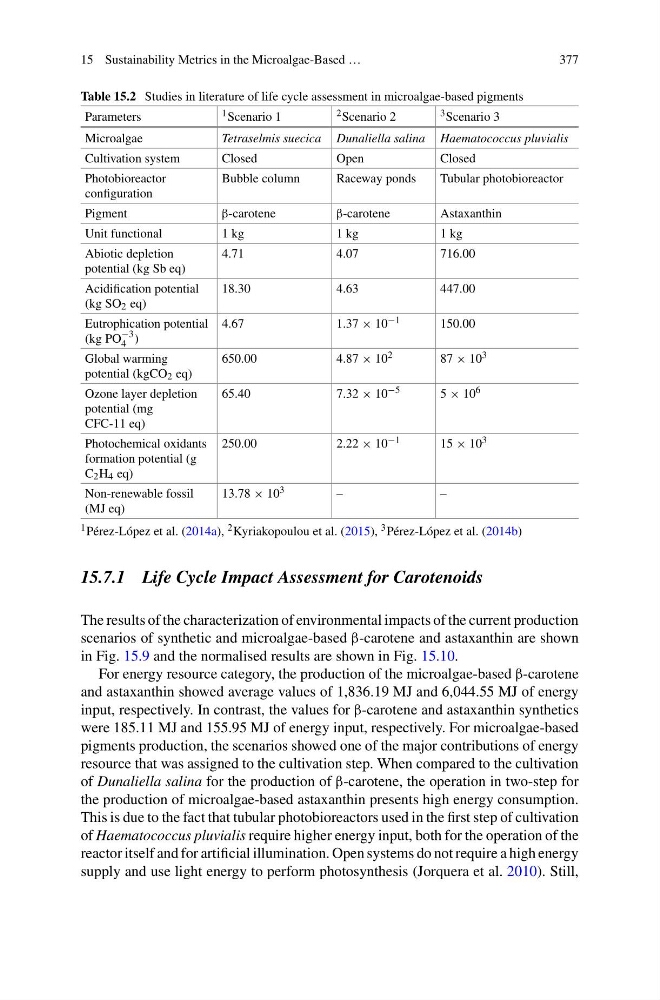
Table 15.2 Studies in literature of life cycle assessment in microalgae-based pigments
Parameters
1 Scenario 1
2 Scenario 2
3 Scenario 3
Microalgae
Tetraselmis suecica Dunaliella salina Haematococcus pluvialis
Cultivation system
Closed
Open
Closed
Photobioreactor
configuration
Bubble column
Raceway ponds
Tubular photobioreactor
Pigment
β-carotene
β-carotene
Astaxanthin
Unit functional
1 kg
1 kg
1 kg
Abiotic depletion
potential (kg Sb eq)
4.71
4.07
716.00
Acidification potential
(kg SO 2 eq)
18.30
4.63
447.00
Eutrophication potential
(kg PO
−3
4 )
4.67
1.37 × 10 −1
150.00
Global warming
potential (kgCO 2 eq)
650.00
4.87 × 10 2
87 × 10 3
Ozone layer depletion
potential (mg
CFC-11 eq)
65.40
7.32 × 10 −5
5 × 10 6
Photochemical oxidants
formation potential (g
C 2 H 4 eq)
250.00
2.22 × 10 −1
15 × 10 3
Non-renewable fossil
(MJ eq)
13.78 × 10 3
–
–
1 Pérez-López et al. (2014a), 2 Kyriakopoulou et al. (2015), 3 Pérez-López et al. (2014b)
15.7.1 Life Cycle Impact Assessment for Carotenoids
The results of the characterization of environmental impacts of the current production
scenarios of synthetic and microalgae-based β-carotene and astaxanthin are shown
in Fig. 15.9 and the normalised results are shown in Fig. 15.10.
For energy resource category, the production of the microalgae-based β-carotene
and astaxanthin showed average values of 1,836.19 MJ and 6,044.55 MJ of energy
input, respectively. In contrast, the values for β-carotene and astaxanthin synthetics
were 185.11 MJ and 155.95 MJ of energy input, respectively. For microalgae-based
pigments production, the scenarios showed one of the major contributions of energy
resource that was assigned to the cultivation step. When compared to the cultivation
of Dunaliella salina for the production of β-carotene, the operation in two-step for
the production of microalgae-based astaxanthin presents high energy consumption.
This is due to the fact that tubular photobioreactors used in the first step of cultivation
of Haematococcus pluvialis require higher energy input, both for the operation of the
reactor itself and for artificial illumination. Open systems do not require a high energy
supply and use light energy to perform photosynthesis (Jorquera et al. 2010). Still,
377
Table 15.2 Studies in literature of life cycle assessment in microalgae-based pigments
Parameters
1 Scenario 1
2 Scenario 2
3 Scenario 3
Microalgae
Tetraselmis suecica Dunaliella salina Haematococcus pluvialis
Cultivation system
Closed
Open
Closed
Photobioreactor
configuration
Bubble column
Raceway ponds
Tubular photobioreactor
Pigment
β-carotene
β-carotene
Astaxanthin
Unit functional
1 kg
1 kg
1 kg
Abiotic depletion
potential (kg Sb eq)
4.71
4.07
716.00
Acidification potential
(kg SO 2 eq)
18.30
4.63
447.00
Eutrophication potential
(kg PO
−3
4 )
4.67
1.37 × 10 −1
150.00
Global warming
potential (kgCO 2 eq)
650.00
4.87 × 10 2
87 × 10 3
Ozone layer depletion
potential (mg
CFC-11 eq)
65.40
7.32 × 10 −5
5 × 10 6
Photochemical oxidants
formation potential (g
C 2 H 4 eq)
250.00
2.22 × 10 −1
15 × 10 3
Non-renewable fossil
(MJ eq)
13.78 × 10 3
–
–
1 Pérez-López et al. (2014a), 2 Kyriakopoulou et al. (2015), 3 Pérez-López et al. (2014b)
15.7.1 Life Cycle Impact Assessment for Carotenoids
The results of the characterization of environmental impacts of the current production
scenarios of synthetic and microalgae-based β-carotene and astaxanthin are shown
in Fig. 15.9 and the normalised results are shown in Fig. 15.10.
For energy resource category, the production of the microalgae-based β-carotene
and astaxanthin showed average values of 1,836.19 MJ and 6,044.55 MJ of energy
input, respectively. In contrast, the values for β-carotene and astaxanthin synthetics
were 185.11 MJ and 155.95 MJ of energy input, respectively. For microalgae-based
pigments production, the scenarios showed one of the major contributions of energy
resource that was assigned to the cultivation step. When compared to the cultivation
of Dunaliella salina for the production of β-carotene, the operation in two-step for
the production of microalgae-based astaxanthin presents high energy consumption.
This is due to the fact that tubular photobioreactors used in the first step of cultivation
of Haematococcus pluvialis require higher energy input, both for the operation of the
reactor itself and for artificial illumination. Open systems do not require a high energy
supply and use light energy to perform photosynthesis (Jorquera et al. 2010). Still,