

378
M. C. Deprá et al.
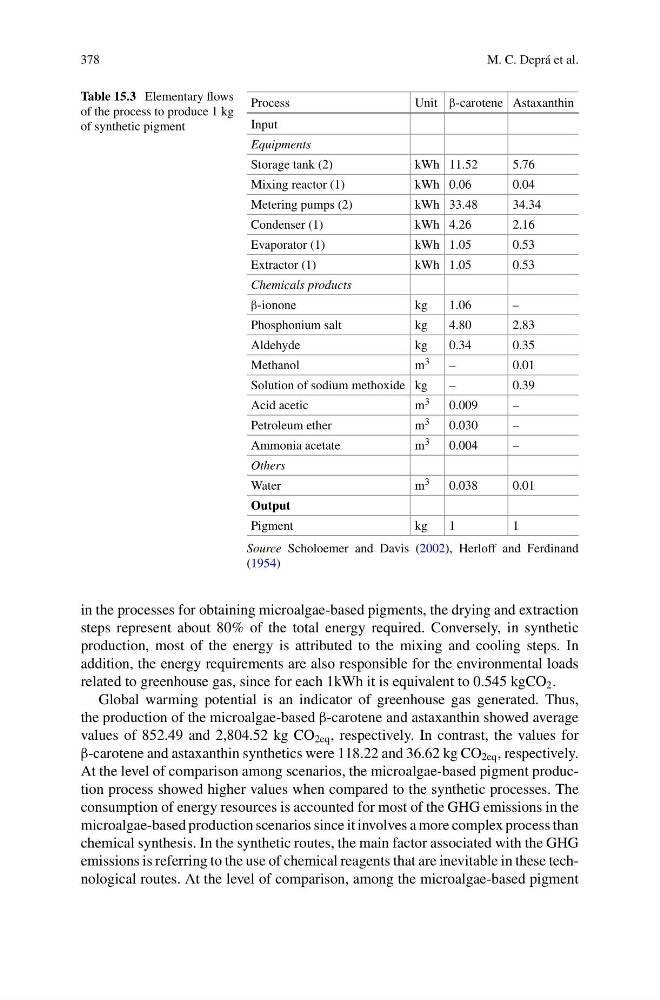
Table 15.3 Elementary flows
of the process to produce 1 kg
of synthetic pigment
Process
Unit β-carotene Astaxanthin
Input
Equipments
Storage tank (2)
kWh 11.52
5.76
Mixing reactor (1)
kWh 0.06
0.04
Metering pumps (2)
kWh 33.48
34.34
Condenser (1)
kWh 4.26
2.16
Evaporator (1)
kWh 1.05
0.53
Extractor (1)
kWh 1.05
0.53
Chemicals products
β-ionone
kg
1.06
–
Phosphonium salt
kg
4.80
2.83
Aldehyde
kg
0.34
0.35
Methanol
m 3
–
0.01
Solution of sodium methoxide kg
–
0.39
Acid acetic
m 3
0.009
–
Petroleum ether
m 3
0.030
–
Ammonia acetate
m 3
0.004
–
Others
Water
m 3
0.038
0.01
Output
Pigment
kg
1
1
Source Scholoemer and Davis (2002), Herloff and Ferdinand
(1954)
in the processes for obtaining microalgae-based pigments, the drying and extraction
steps represent about 80% of the total energy required. Conversely, in synthetic
production, most of the energy is attributed to the mixing and cooling steps. In
addition, the energy requirements are also responsible for the environmental loads
related to greenhouse gas, since for each 1kWh it is equivalent to 0.545 kgCO 2 .
Global warming potential is an indicator of greenhouse gas generated. Thus,
the production of the microalgae-based β-carotene and astaxanthin showed average
values of 852.49 and 2,804.52 kg CO 2eq , respectively. In contrast, the values for
β-carotene and astaxanthin synthetics were 118.22 and 36.62 kg CO 2eq , respectively.
At the level of comparison among scenarios, the microalgae-based pigment production process showed higher values when compared to the synthetic processes. The
consumption of energy resources is accounted for most of the GHG emissions in the
microalgae-based production scenarios since it involves a more complex process than
chemical synthesis. In the synthetic routes, the main factor associated with the GHG
emissions is referring to the use of chemical reagents that are inevitable in these technological routes. At the level of comparison, among the microalgae-based pigment
M. C. Deprá et al.
Table 15.3 Elementary flows
of the process to produce 1 kg
of synthetic pigment
Process
Unit β-carotene Astaxanthin
Input
Equipments
Storage tank (2)
kWh 11.52
5.76
Mixing reactor (1)
kWh 0.06
0.04
Metering pumps (2)
kWh 33.48
34.34
Condenser (1)
kWh 4.26
2.16
Evaporator (1)
kWh 1.05
0.53
Extractor (1)
kWh 1.05
0.53
Chemicals products
β-ionone
kg
1.06
–
Phosphonium salt
kg
4.80
2.83
Aldehyde
kg
0.34
0.35
Methanol
m 3
–
0.01
Solution of sodium methoxide kg
–
0.39
Acid acetic
m 3
0.009
–
Petroleum ether
m 3
0.030
–
Ammonia acetate
m 3
0.004
–
Others
Water
m 3
0.038
0.01
Output
Pigment
kg
1
1
Source Scholoemer and Davis (2002), Herloff and Ferdinand
(1954)
in the processes for obtaining microalgae-based pigments, the drying and extraction
steps represent about 80% of the total energy required. Conversely, in synthetic
production, most of the energy is attributed to the mixing and cooling steps. In
addition, the energy requirements are also responsible for the environmental loads
related to greenhouse gas, since for each 1kWh it is equivalent to 0.545 kgCO 2 .
Global warming potential is an indicator of greenhouse gas generated. Thus,
the production of the microalgae-based β-carotene and astaxanthin showed average
values of 852.49 and 2,804.52 kg CO 2eq , respectively. In contrast, the values for
β-carotene and astaxanthin synthetics were 118.22 and 36.62 kg CO 2eq , respectively.
At the level of comparison among scenarios, the microalgae-based pigment production process showed higher values when compared to the synthetic processes. The
consumption of energy resources is accounted for most of the GHG emissions in the
microalgae-based production scenarios since it involves a more complex process than
chemical synthesis. In the synthetic routes, the main factor associated with the GHG
emissions is referring to the use of chemical reagents that are inevitable in these technological routes. At the level of comparison, among the microalgae-based pigment