

12 Industrial Extraction of Microalgal Pigments
299
Table 12.6
(continued)
Study
Species
Pigment
Biomass state
Cell rupture and
extraction conditions
Maximum
yield/recovery at
optimum conditions
Key findings
Benavides and
Rito-Palomares
(2006)
P. cruentum
B-phycoerythrin
(B-PE)
Centrifuged
concentrate
Ultrasonication followed
by aqueous two-phase
systems (ATPS) partition:
The sonicated concentrate
was gently mixed with a
stock solution of
polyethylene glycol
(PEG) and potassium
phosphate to form the
ATPS system. The ATPS
mixture was placed in a
batch settler to enable
gravity-driven biphasic
separation. B-PE was
recovered in the top
PEG-rich phase
90% of available B-PE
with a purity ratio of
3.2. The final ATPS
system comprised of
29% (w/w) PEG at
1000 g/gmol, 9%
(w/w) potassium
phosphate, 40% (w/w)
crude extract, pH 7.0,
and volume ratio of
top phase: bottom
phase
= 4.5
The dual method
simplified B-PE
recovery as it avoided
a precipitation stage
and combined a debris
removal step with a
B-PE recovery step
Sonication was able to
release 5
× more
B-PE than manual
maceration
Furuki et al.
(2003)
S. platensis
Phycocyanin (PC)
Dried powder
Ultrasonication: biomass
powder was re-suspended
in 0.1 M phosphate buffer
(pH
= 6.8) at the
concentration of 4.8 w/v%
and subjected to
sonication at 80 W,
20 kHz and 10 °C
Almost 100 wt% of
available PC (almost
60 mg PC/g biomass)
with a purity of 80%
PC release during
ultrasonic disruption
followed first-order
kinetics with respect
to irradiation time
Other biological
compounds such as
chlorophyll were also
released during the
ultrasonic disruption
(continued)
299
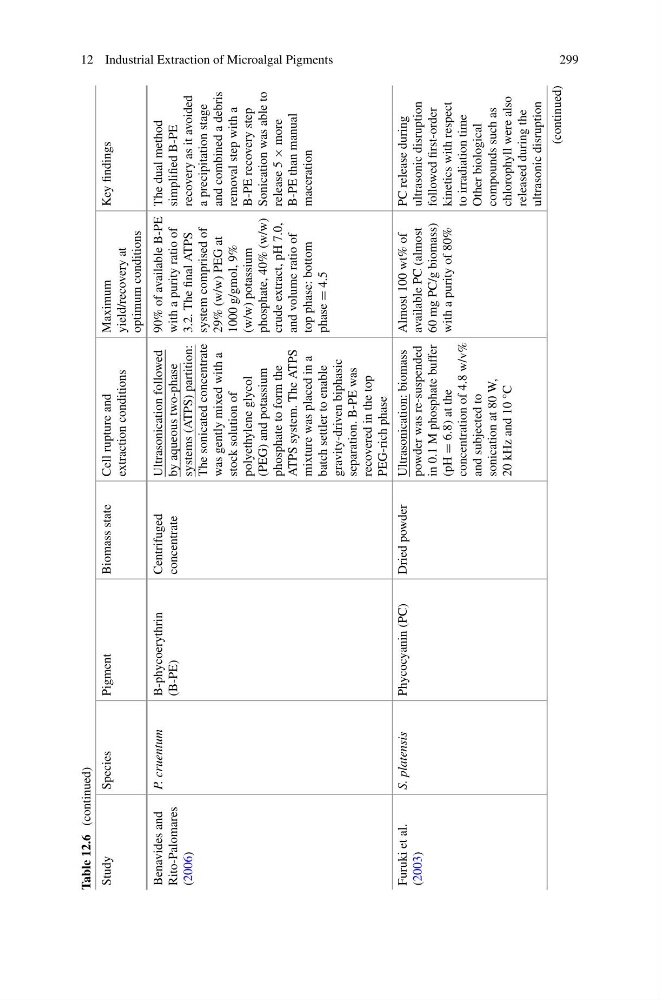
Table 12.6
(continued)
Study
Species
Pigment
Biomass state
Cell rupture and
extraction conditions
Maximum
yield/recovery at
optimum conditions
Key findings
Benavides and
Rito-Palomares
(2006)
P. cruentum
B-phycoerythrin
(B-PE)
Centrifuged
concentrate
Ultrasonication followed
by aqueous two-phase
systems (ATPS) partition:
The sonicated concentrate
was gently mixed with a
stock solution of
polyethylene glycol
(PEG) and potassium
phosphate to form the
ATPS system. The ATPS
mixture was placed in a
batch settler to enable
gravity-driven biphasic
separation. B-PE was
recovered in the top
PEG-rich phase
90% of available B-PE
with a purity ratio of
3.2. The final ATPS
system comprised of
29% (w/w) PEG at
1000 g/gmol, 9%
(w/w) potassium
phosphate, 40% (w/w)
crude extract, pH 7.0,
and volume ratio of
top phase: bottom
phase
= 4.5
The dual method
simplified B-PE
recovery as it avoided
a precipitation stage
and combined a debris
removal step with a
B-PE recovery step
Sonication was able to
release 5
× more
B-PE than manual
maceration
Furuki et al.
(2003)
S. platensis
Phycocyanin (PC)
Dried powder
Ultrasonication: biomass
powder was re-suspended
in 0.1 M phosphate buffer
(pH
= 6.8) at the
concentration of 4.8 w/v%
and subjected to
sonication at 80 W,
20 kHz and 10 °C
Almost 100 wt% of
available PC (almost
60 mg PC/g biomass)
with a purity of 80%
PC release during
ultrasonic disruption
followed first-order
kinetics with respect
to irradiation time
Other biological
compounds such as
chlorophyll were also
released during the
ultrasonic disruption
(continued)