

300
R. Halim
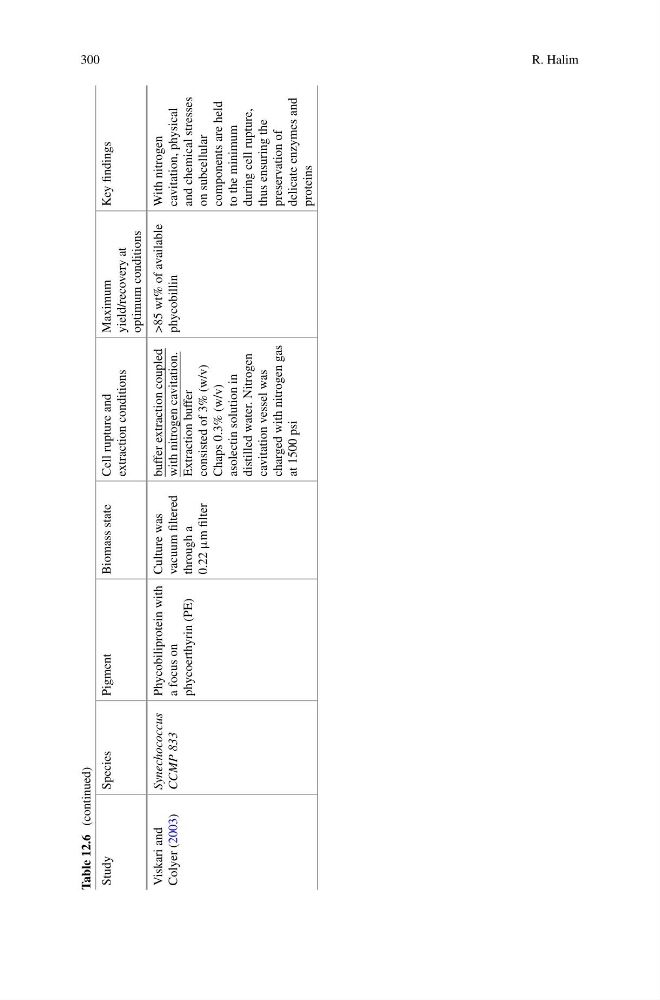
Table 12.6
(continued)
Study
Species
Pigment
Biomass state
Cell rupture and
extraction conditions
Maximum
yield/recovery at
optimum conditions
Key findings
Viskari and
Colyer (2003)
Synechococcus
CCMP 833
Phycobiliprotein with
a focus on
phycoerthyrin (PE)
Culture was
vacuum filtered
through a
0.22
μm filter
buffer extraction coupled
with nitrogen cavitation.
Extraction buffer
consisted of 3% (w/v)
Chaps 0.3% (w/v)
asolectin solution in
distilled water. Nitrogen
cavitation vessel was
charged with nitrogen gas
at 1500 psi
>85 wt% of available
phycobillin
With nitrogen
cavitation, physical
and chemical stresses
on subcellular
components are held
to the minimum
during cell rupture,
thus ensuring the
preservation of
delicate enzymes and
proteins
R. Halim
Table 12.6
(continued)
Study
Species
Pigment
Biomass state
Cell rupture and
extraction conditions
Maximum
yield/recovery at
optimum conditions
Key findings
Viskari and
Colyer (2003)
Synechococcus
CCMP 833
Phycobiliprotein with
a focus on
phycoerthyrin (PE)
Culture was
vacuum filtered
through a
0.22
μm filter
buffer extraction coupled
with nitrogen cavitation.
Extraction buffer
consisted of 3% (w/v)
Chaps 0.3% (w/v)
asolectin solution in
distilled water. Nitrogen
cavitation vessel was
charged with nitrogen gas
at 1500 psi
>85 wt% of available
phycobillin
With nitrogen
cavitation, physical
and chemical stresses
on subcellular
components are held
to the minimum
during cell rupture,
thus ensuring the
preservation of
delicate enzymes and
proteins