

298
R. Halim
Table 12.6
Summary (2nd) of previous studies investigating phycobiliprotein recovery from microalgal and cyanobacterial biomass
Study
Species
Pigment
Biomass state
Cell rupture and
extraction conditions
Maximum
yield/recovery at
optimum conditions
Key findings
Lawrenz et al.
(2011)
R. salina
and
Synechococcus
bacillaris
Phycoerythrin (PE)
from rhodomonas
salina
and
phycocyanin (PC)
from Synechococcus
bacillaris
The culture was
either vacuum
filtered onto a
0.7
μm glass
fiber filter and
frozen at –80 °C
or centrifuged
Various methods
involving phosphate
buffer extraction (0.1 M,
pH 6), freeze-thawing
(−20 °C), lyophilisation,
physical grinding and
ultrasonication (8 W)
100 wt% of available
PE from rhodomonas
salina
with
freeze-thawing and
centrifugation. > 98
wt% of available PC
from Synechococcus
bacillaris
with
freeze-thawing,
ultrasonication and
centrifugation
Extraction performed
on concentrate
harvested by filtration
had a lower efficiency
than that performed on
centrifuged
concentrate (32 vs
54–98 wt% of
available
phycobiliprotein)
Ultrasonication was
more effective in
rupturing cells and
resulted in higher
extraction efficiencies
than grinding
(continued)
R. Halim
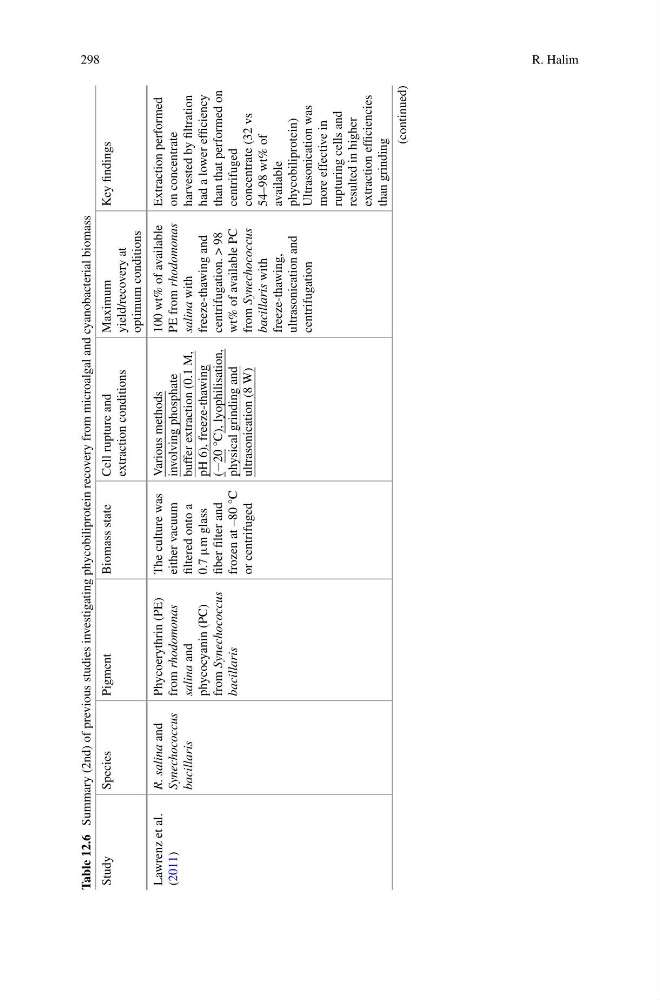
Table 12.6
Summary (2nd) of previous studies investigating phycobiliprotein recovery from microalgal and cyanobacterial biomass
Study
Species
Pigment
Biomass state
Cell rupture and
extraction conditions
Maximum
yield/recovery at
optimum conditions
Key findings
Lawrenz et al.
(2011)
R. salina
and
Synechococcus
bacillaris
Phycoerythrin (PE)
from rhodomonas
salina
and
phycocyanin (PC)
from Synechococcus
bacillaris
The culture was
either vacuum
filtered onto a
0.7
μm glass
fiber filter and
frozen at –80 °C
or centrifuged
Various methods
involving phosphate
buffer extraction (0.1 M,
pH 6), freeze-thawing
(−20 °C), lyophilisation,
physical grinding and
ultrasonication (8 W)
100 wt% of available
PE from rhodomonas
salina
with
freeze-thawing and
centrifugation. > 98
wt% of available PC
from Synechococcus
bacillaris
with
freeze-thawing,
ultrasonication and
centrifugation
Extraction performed
on concentrate
harvested by filtration
had a lower efficiency
than that performed on
centrifuged
concentrate (32 vs
54–98 wt% of
available
phycobiliprotein)
Ultrasonication was
more effective in
rupturing cells and
resulted in higher
extraction efficiencies
than grinding
(continued)