

12 Industrial Extraction of Microalgal Pigments
295
Table 12.5
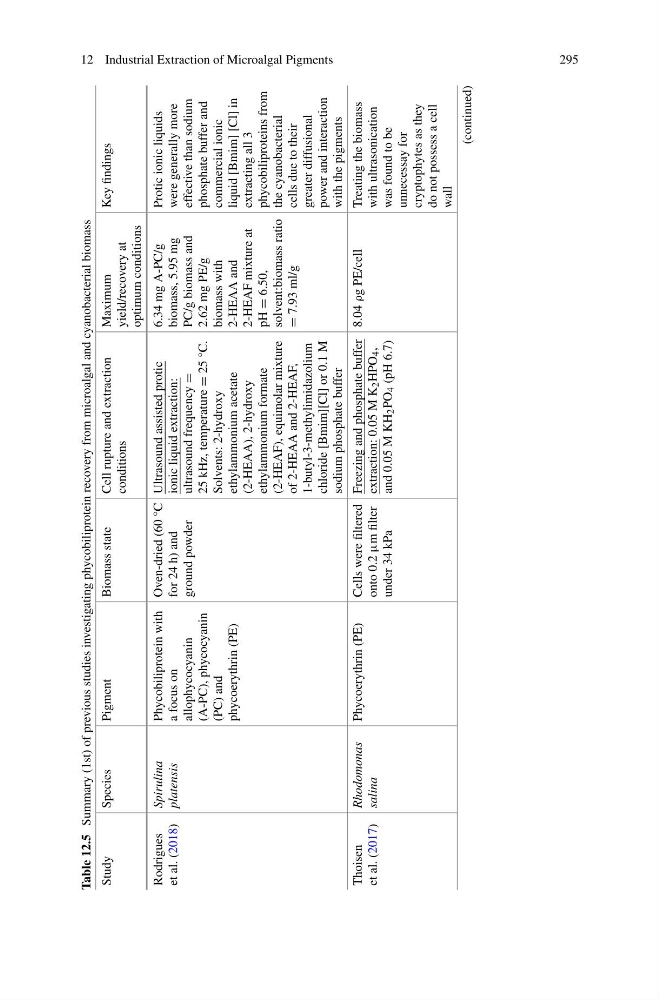
Summary (1st) of previous studies investigating phycobiliprotein recovery from microalgal and cyanobacterial biomass
Study
Species
Pigment
Biomass state
Cell rupture and extraction
conditions
Maximum
yield/recovery at
optimum conditions
Key findings
Rodrigues
et al. (2018)
Spirulina
platensis
Phycobiliprotein with
a focus on
allophycocyanin
(A-PC), phycocyanin
(PC) and
phycoerythrin (PE)
Oven-dried (60 °C
for 24 h) and
ground powder
Ultrasound assisted protic
ionic liquid extraction:
ultrasound frequency
=
25 kHz, temperature
= 25 °C.
Solvents: 2-hydroxy
ethylammonium acetate
(2-HEAA), 2-hydroxy
ethylammonium formate
(2-HEAF), equimolar mixture
of 2-HEAA and 2-HEAF,
1-butyl-3-methylimidazolium
chloride [Bmim][Cl] or 0.1 M
sodium phosphate buffer
6.34 mg A-PC/g
biomass, 5.95 mg
PC/g biomass and
2.62 mg PE/g
biomass with
2-HEAA and
2-HEAF mixture at
pH
= 6.50,
solvent:biomass ratio
= 7.93 ml/g
Protic ionic liquids
were generally more
effective than sodium
phosphate buffer and
commercial ionic
liquid [Bmim] [Cl] in
extracting all 3
phycobiliproteins from
the cyanobacterial
cells due to their
greater diffusional
power and interaction
with the pigments
Thoisen
et al. (2017)
Rhodomonas
salina
Phycoerythrin (PE)
Cells were filtered
onto 0.2
μm filter
under 34 kPa
Freezing and phosphate buffer
extraction: 0.05 M K
2 HPO
4 ,
and 0.05 M KH
2 PO
4 (pH 6.7)
8.04
ρg PE/cell
Treating the biomass
with ultrasonication
was found to be
unnecessay for
cryptophytes as they
do not possess a cell
wall
(continued)
295
Table 12.5
Summary (1st) of previous studies investigating phycobiliprotein recovery from microalgal and cyanobacterial biomass
Study
Species
Pigment
Biomass state
Cell rupture and extraction
conditions
Maximum
yield/recovery at
optimum conditions
Key findings
Rodrigues
et al. (2018)
Spirulina
platensis
Phycobiliprotein with
a focus on
allophycocyanin
(A-PC), phycocyanin
(PC) and
phycoerythrin (PE)
Oven-dried (60 °C
for 24 h) and
ground powder
Ultrasound assisted protic
ionic liquid extraction:
ultrasound frequency
=
25 kHz, temperature
= 25 °C.
Solvents: 2-hydroxy
ethylammonium acetate
(2-HEAA), 2-hydroxy
ethylammonium formate
(2-HEAF), equimolar mixture
of 2-HEAA and 2-HEAF,
1-butyl-3-methylimidazolium
chloride [Bmim][Cl] or 0.1 M
sodium phosphate buffer
6.34 mg A-PC/g
biomass, 5.95 mg
PC/g biomass and
2.62 mg PE/g
biomass with
2-HEAA and
2-HEAF mixture at
pH
= 6.50,
solvent:biomass ratio
= 7.93 ml/g
Protic ionic liquids
were generally more
effective than sodium
phosphate buffer and
commercial ionic
liquid [Bmim] [Cl] in
extracting all 3
phycobiliproteins from
the cyanobacterial
cells due to their
greater diffusional
power and interaction
with the pigments
Thoisen
et al. (2017)
Rhodomonas
salina
Phycoerythrin (PE)
Cells were filtered
onto 0.2
μm filter
under 34 kPa
Freezing and phosphate buffer
extraction: 0.05 M K
2 HPO
4 ,
and 0.05 M KH
2 PO
4 (pH 6.7)
8.04
ρg PE/cell
Treating the biomass
with ultrasonication
was found to be
unnecessay for
cryptophytes as they
do not possess a cell
wall
(continued)