

12 Industrial Extraction of Microalgal Pigments
289
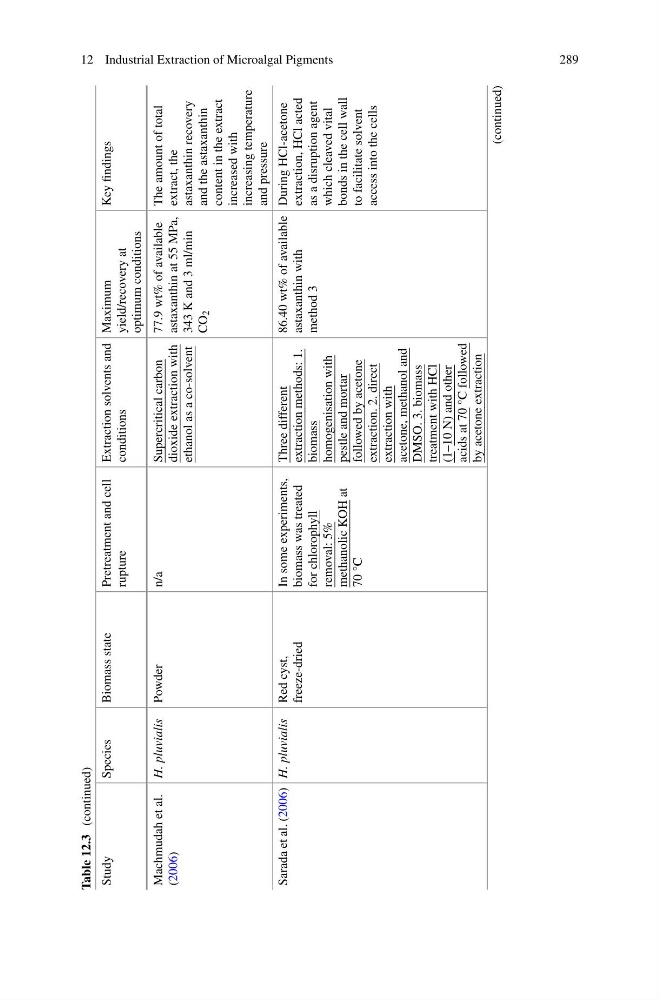
Table 12.3
(continued)
Study
Species
Biomass state
Pretreatment and cell
rupture
Extraction solvents and
conditions
Maximum
yield/recovery at
optimum conditions
Key findings
Machmudah et al.
(2006)
H. pluvialis
Powder
n/a
Supercritical carbon
dioxide extraction with
ethanol as a co-solvent
77.9 wt% of available
astaxanthin at 55 MPa,
343 K and 3 ml/min
CO
2
The amount of total
extract, the
astaxanthin recovery
and the astaxanthin
content in the extract
increased with
increasing temperature
and pressure
Sarada et al. (2006) H. pluvialis
Red cyst,
freeze-dried
In some experiments,
biomass was treated
for
chlorophyll
removal: 5%
methanolic KOH at
70 °C
Three different
extraction methods: 1.
biomass
homogenisation with
pestle and mortar
followed by acetone
extraction. 2. direct
extraction with
acetone, methanol and
DMSO. 3. biomass
treatment with HCl
(1–10 N) and other
acids at 70 °C followed
by acetone extraction
86.40 wt% of available
astaxanthin with
method 3
During HCl-acetone
extraction, HCl acted
as a disruption agent
which cleaved vital
bonds in the cell wall
to facilitate solvent
access into the cells
(continued)
289
Table 12.3
(continued)
Study
Species
Biomass state
Pretreatment and cell
rupture
Extraction solvents and
conditions
Maximum
yield/recovery at
optimum conditions
Key findings
Machmudah et al.
(2006)
H. pluvialis
Powder
n/a
Supercritical carbon
dioxide extraction with
ethanol as a co-solvent
77.9 wt% of available
astaxanthin at 55 MPa,
343 K and 3 ml/min
CO
2
The amount of total
extract, the
astaxanthin recovery
and the astaxanthin
content in the extract
increased with
increasing temperature
and pressure
Sarada et al. (2006) H. pluvialis
Red cyst,
freeze-dried
In some experiments,
biomass was treated
for
chlorophyll
removal: 5%
methanolic KOH at
70 °C
Three different
extraction methods: 1.
biomass
homogenisation with
pestle and mortar
followed by acetone
extraction. 2. direct
extraction with
acetone, methanol and
DMSO. 3. biomass
treatment with HCl
(1–10 N) and other
acids at 70 °C followed
by acetone extraction
86.40 wt% of available
astaxanthin with
method 3
During HCl-acetone
extraction, HCl acted
as a disruption agent
which cleaved vital
bonds in the cell wall
to facilitate solvent
access into the cells
(continued)