

288
R. Halim
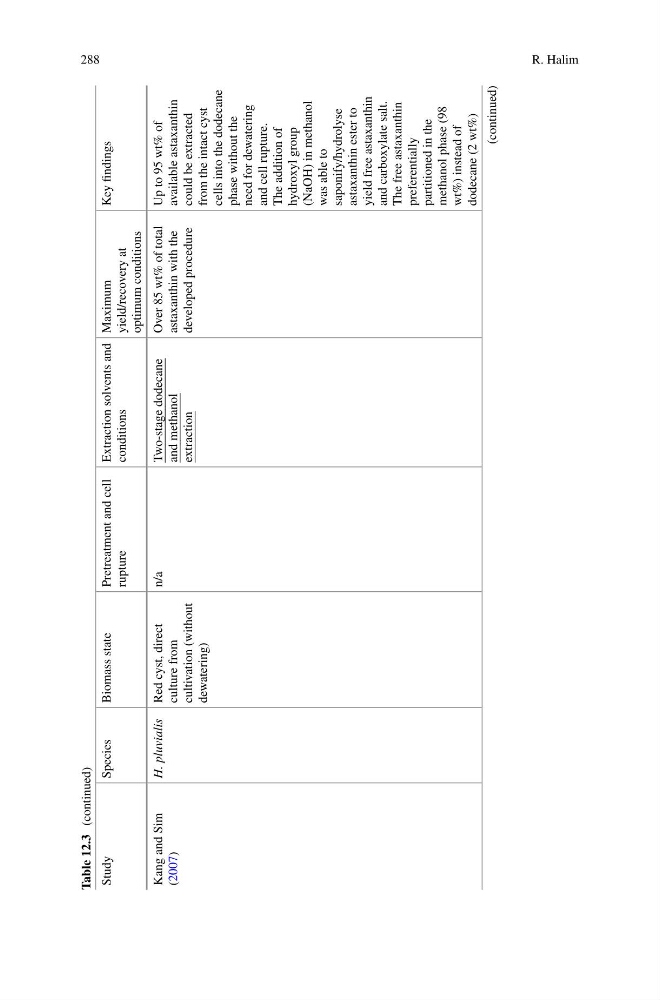
Table 12.3
(continued)
Study
Species
Biomass state
Pretreatment and cell
rupture
Extraction solvents and
conditions
Maximum
yield/recovery at
optimum conditions
Key findings
Kang and Sim
(2007)
H. pluvialis
Red cyst, direct
culture from
cultivation (without
dewatering)
n/a
Two-stage dodecane
and methanol
extraction
Over 85 wt% of total
astaxanthin with the
developed procedure
Up to 95 wt% of
available astaxanthin
could be extracted
from the intact cyst
cells into the dodecane
phase without the
need for dewatering
and cell rupture.
The addition of
hydroxyl group
(NaOH) in methanol
was able to
saponify/hydrolyse
astaxanthin ester to
yield free astaxanthin
and carboxylate salt.
The free astaxanthin
preferentially
partitioned in the
methanol phase (98
wt%) instead of
dodecane (2 wt%)
(continued)
R. Halim
Table 12.3
(continued)
Study
Species
Biomass state
Pretreatment and cell
rupture
Extraction solvents and
conditions
Maximum
yield/recovery at
optimum conditions
Key findings
Kang and Sim
(2007)
H. pluvialis
Red cyst, direct
culture from
cultivation (without
dewatering)
n/a
Two-stage dodecane
and methanol
extraction
Over 85 wt% of total
astaxanthin with the
developed procedure
Up to 95 wt% of
available astaxanthin
could be extracted
from the intact cyst
cells into the dodecane
phase without the
need for dewatering
and cell rupture.
The addition of
hydroxyl group
(NaOH) in methanol
was able to
saponify/hydrolyse
astaxanthin ester to
yield free astaxanthin
and carboxylate salt.
The free astaxanthin
preferentially
partitioned in the
methanol phase (98
wt%) instead of
dodecane (2 wt%)
(continued)