

12 Industrial Extraction of Microalgal Pigments
283
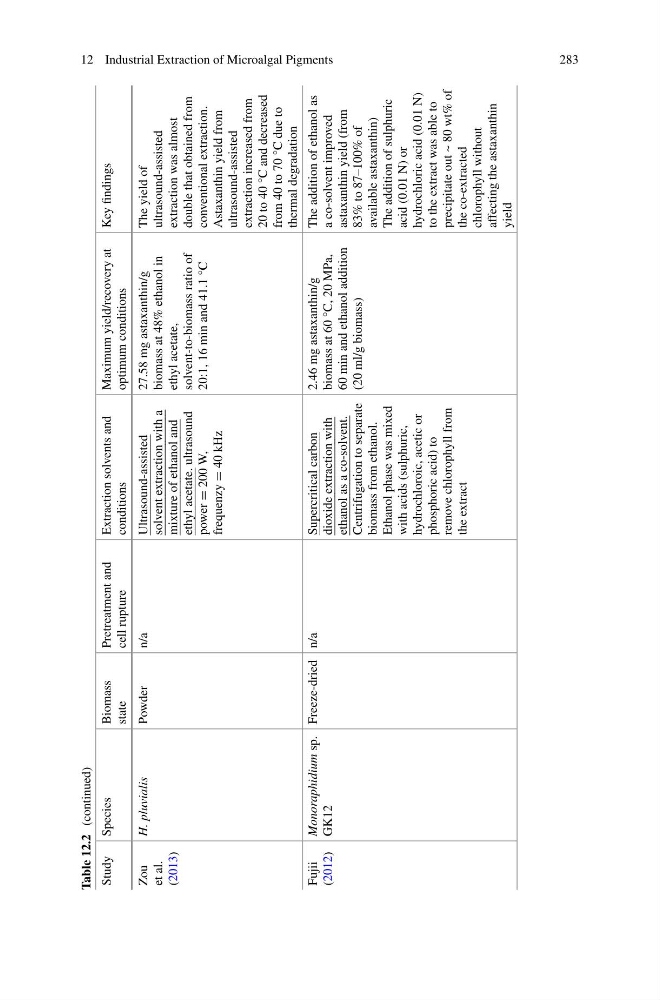
Table 12.2
(continued)
Study
Species
Biomass
state
Pretreatment and
cell rupture
Extraction solvents and
conditions
Maximum yield/recovery at
optimum conditions
Key findings
Zou
et al.
(2013)
H. pluvialis
Powder
n/a
Ultrasound-assisted
solvent extraction with a
mixture of ethanol and
ethyl acetate. ultrasound
power
= 200 W,
frequenzy
= 40 kHz
27.58 mg astaxanthin/g
biomass at 48% ethanol in
ethyl acetate,
solvent-to-biomass ratio of
20:1, 16 min and 41.1 °C
The yield of
ultrasound-assisted
extraction was almost
double that obtained from
conventional extraction.
Astaxanthin yield from
ultrasound-assisted
extraction increased from
20 to 40 °C and decreased
from 40 to 70 °C due to
thermal degradation
Fujii
(2012)
Monoraphidium
sp.
GK12
Freeze-dried n/a
Supercritical carbon
dioxide extraction with
ethanol as a co-solvent.
Centrifugation to separate
biomass from ethanol.
Ethanol phase was mixed
with acids (sulphuric,
hydrochloroic, acetic or
phosphoric acid) to
remove chlorophyll from
the extract
2.46 mg astaxanthin/g
biomass at 60 °C, 20 MPa,
60 min and ethanol addition
(20 ml/g biomass)
The addition of ethanol as
a co-solvent improved
astaxanthin yield (from
83% to 87–100% of
available astaxanthin)
The addition of sulphuric
acid (0.01 N) or
hydrochloric acid (0.01 N)
to the extract was able to
precipitate out ~ 80 wt% of
the co-extracted
chlorophyll without
affecting the astaxanthin
yield
283
Table 12.2
(continued)
Study
Species
Biomass
state
Pretreatment and
cell rupture
Extraction solvents and
conditions
Maximum yield/recovery at
optimum conditions
Key findings
Zou
et al.
(2013)
H. pluvialis
Powder
n/a
Ultrasound-assisted
solvent extraction with a
mixture of ethanol and
ethyl acetate. ultrasound
power
= 200 W,
frequenzy
= 40 kHz
27.58 mg astaxanthin/g
biomass at 48% ethanol in
ethyl acetate,
solvent-to-biomass ratio of
20:1, 16 min and 41.1 °C
The yield of
ultrasound-assisted
extraction was almost
double that obtained from
conventional extraction.
Astaxanthin yield from
ultrasound-assisted
extraction increased from
20 to 40 °C and decreased
from 40 to 70 °C due to
thermal degradation
Fujii
(2012)
Monoraphidium
sp.
GK12
Freeze-dried n/a
Supercritical carbon
dioxide extraction with
ethanol as a co-solvent.
Centrifugation to separate
biomass from ethanol.
Ethanol phase was mixed
with acids (sulphuric,
hydrochloroic, acetic or
phosphoric acid) to
remove chlorophyll from
the extract
2.46 mg astaxanthin/g
biomass at 60 °C, 20 MPa,
60 min and ethanol addition
(20 ml/g biomass)
The addition of ethanol as
a co-solvent improved
astaxanthin yield (from
83% to 87–100% of
available astaxanthin)
The addition of sulphuric
acid (0.01 N) or
hydrochloric acid (0.01 N)
to the extract was able to
precipitate out ~ 80 wt% of
the co-extracted
chlorophyll without
affecting the astaxanthin
yield