

282
R. Halim
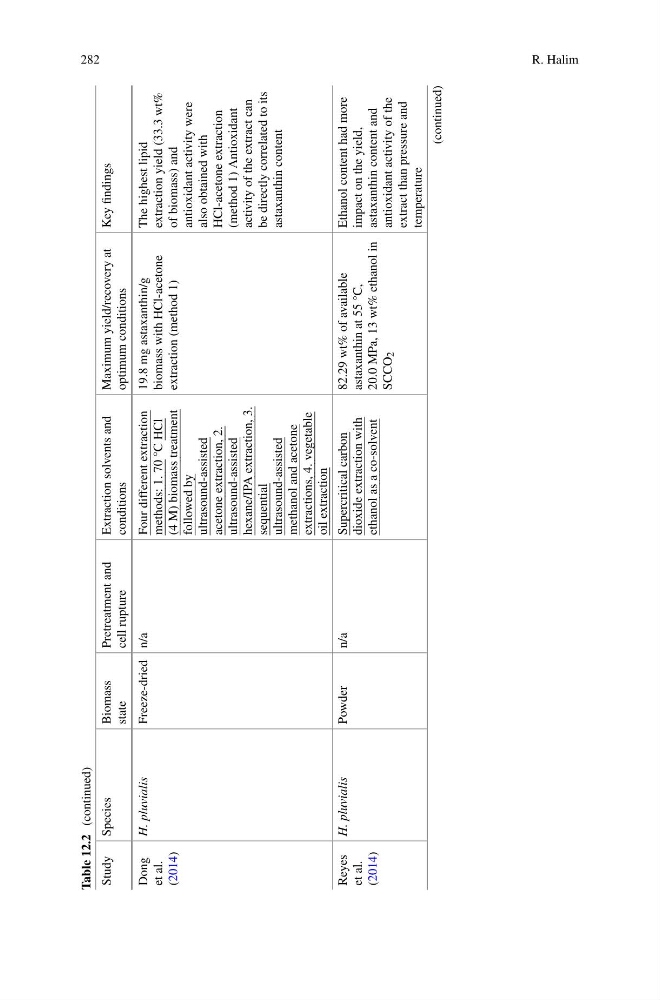
Table 12.2
(continued)
Study
Species
Biomass
state
Pretreatment and
cell rupture
Extraction solvents and
conditions
Maximum yield/recovery at
optimum conditions
Key findings
Dong
et al.
(2014)
H. pluvialis
Freeze-dried n/a
Four different extraction
methods: 1. 70 °C HCl
(4 M) biomass treatment
followed by
ultrasound-assisted
acetone extraction, 2.
ultrasound-assisted
hexane/IPA extraction, 3.
sequential
ultrasound-assisted
methanol and acetone
extractions, 4. vegetable
oil extraction
19.8 mg astaxanthin/g
biomass with HCl-acetone
extraction (method 1)
The highest lipid
extraction yield (33.3 wt%
of biomass) and
antioxidant activity were
also obtained with
HCl-acetone extraction
(method 1) Antioxidant
activity of the extract can
be directly correlated to its
astaxanthin content
Reyes
et al.
(2014)
H. pluvialis
Powder
n/a
Supercritical carbon
dioxide extraction with
ethanol as a co-solvent
82.29 wt% of available
astaxanthin at 55 °C,
20.0 MPa, 13 wt% ethanol in
SCCO
2
Ethanol content had more
impact on the yield,
astaxanthin content and
antioxidant activity of the
extract than pressure and
temperature
(continued)
R. Halim
Table 12.2
(continued)
Study
Species
Biomass
state
Pretreatment and
cell rupture
Extraction solvents and
conditions
Maximum yield/recovery at
optimum conditions
Key findings
Dong
et al.
(2014)
H. pluvialis
Freeze-dried n/a
Four different extraction
methods: 1. 70 °C HCl
(4 M) biomass treatment
followed by
ultrasound-assisted
acetone extraction, 2.
ultrasound-assisted
hexane/IPA extraction, 3.
sequential
ultrasound-assisted
methanol and acetone
extractions, 4. vegetable
oil extraction
19.8 mg astaxanthin/g
biomass with HCl-acetone
extraction (method 1)
The highest lipid
extraction yield (33.3 wt%
of biomass) and
antioxidant activity were
also obtained with
HCl-acetone extraction
(method 1) Antioxidant
activity of the extract can
be directly correlated to its
astaxanthin content
Reyes
et al.
(2014)
H. pluvialis
Powder
n/a
Supercritical carbon
dioxide extraction with
ethanol as a co-solvent
82.29 wt% of available
astaxanthin at 55 °C,
20.0 MPa, 13 wt% ethanol in
SCCO
2
Ethanol content had more
impact on the yield,
astaxanthin content and
antioxidant activity of the
extract than pressure and
temperature
(continued)