

12 Industrial Extraction of Microalgal Pigments
281
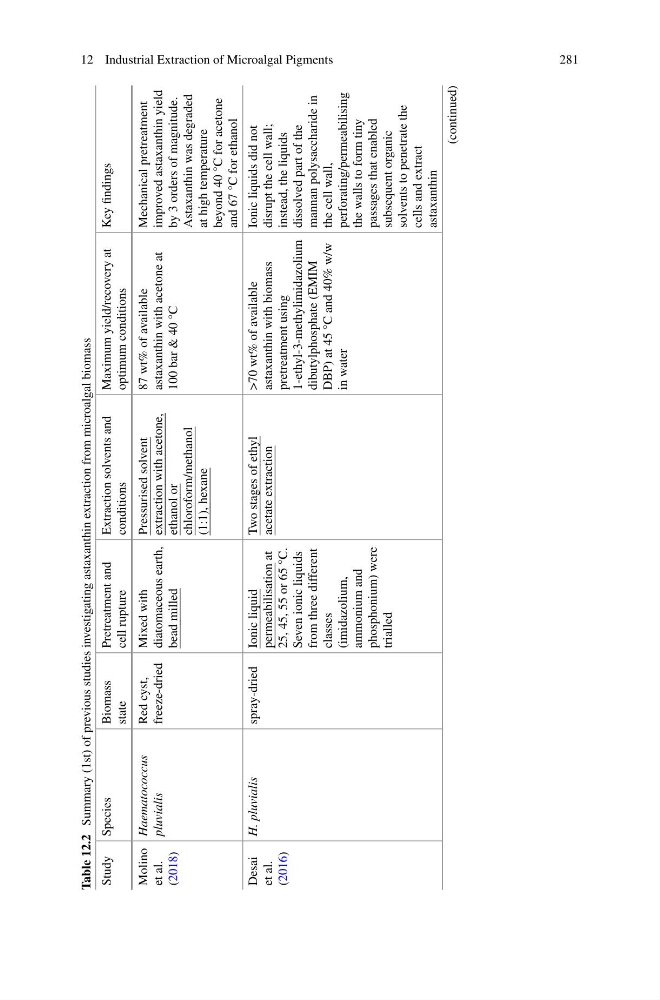
Table 12.2
Summary (1st) of previous studies investigating astaxanthin extraction from microalgal biomass
Study
Species
Biomass
state
Pretreatment and
cell rupture
Extraction solvents and
conditions
Maximum yield/recovery at
optimum conditions
Key findings
Molino
et al.
(2018)
Haematococcus
pluvialis
Red cyst,
freeze-dried
Mixed with
diatomaceous earth,
bead milled
Pressurised solvent
extraction with acetone,
ethanol or
chloroform/methanol
(1:1), hexane
87 wt% of available
astaxanthin with acetone at
100 bar & 40 °C
Mechanical pretreatment
improved astaxanthin yield
by 3 orders of magnitude.
Astaxanthin was degraded
at high temperature
beyond 40 °C for acetone
and 67 °C for ethanol
Desai
et al.
(2016)
H. pluvialis
spray-dried Ionic liquid
permeabilisation at
25, 45, 55 or 65 °C.
Seven ionic liquids
from three different
classes
(imidazolium,
ammonium and
phosphonium) were
trialled
Two stages of ethyl
acetate extraction
>70 wt% of available
astaxanthin with biomass
pretreatment using
1-ethyl-3-methylimidazolium
dibutylphosphate (EMIM
DBP) at 45 °C and 40% w/w
in water
Ionic liquids did not
disrupt the cell wall;
instead, the liquids
dissolved part of the
mannan polysaccharide in
the cell wall,
perforating/permeabilising
the walls to form tiny
passages that enabled
subsequent organic
solvents to penetrate the
cells and extract
astaxanthin
(continued)
281
Table 12.2
Summary (1st) of previous studies investigating astaxanthin extraction from microalgal biomass
Study
Species
Biomass
state
Pretreatment and
cell rupture
Extraction solvents and
conditions
Maximum yield/recovery at
optimum conditions
Key findings
Molino
et al.
(2018)
Haematococcus
pluvialis
Red cyst,
freeze-dried
Mixed with
diatomaceous earth,
bead milled
Pressurised solvent
extraction with acetone,
ethanol or
chloroform/methanol
(1:1), hexane
87 wt% of available
astaxanthin with acetone at
100 bar & 40 °C
Mechanical pretreatment
improved astaxanthin yield
by 3 orders of magnitude.
Astaxanthin was degraded
at high temperature
beyond 40 °C for acetone
and 67 °C for ethanol
Desai
et al.
(2016)
H. pluvialis
spray-dried Ionic liquid
permeabilisation at
25, 45, 55 or 65 °C.
Seven ionic liquids
from three different
classes
(imidazolium,
ammonium and
phosphonium) were
trialled
Two stages of ethyl
acetate extraction
>70 wt% of available
astaxanthin with biomass
pretreatment using
1-ethyl-3-methylimidazolium
dibutylphosphate (EMIM
DBP) at 45 °C and 40% w/w
in water
Ionic liquids did not
disrupt the cell wall;
instead, the liquids
dissolved part of the
mannan polysaccharide in
the cell wall,
perforating/permeabilising
the walls to form tiny
passages that enabled
subsequent organic
solvents to penetrate the
cells and extract
astaxanthin
(continued)