

218
T. Casagrande do Nascimento et al.
ROO •
AAPH
Fluorescein
ANTIOXIDANTH
FLUORESCENCE LOSS
ROOH
Oxidation
Excitation: 493 nm
Emission: 515 nm
37ºC
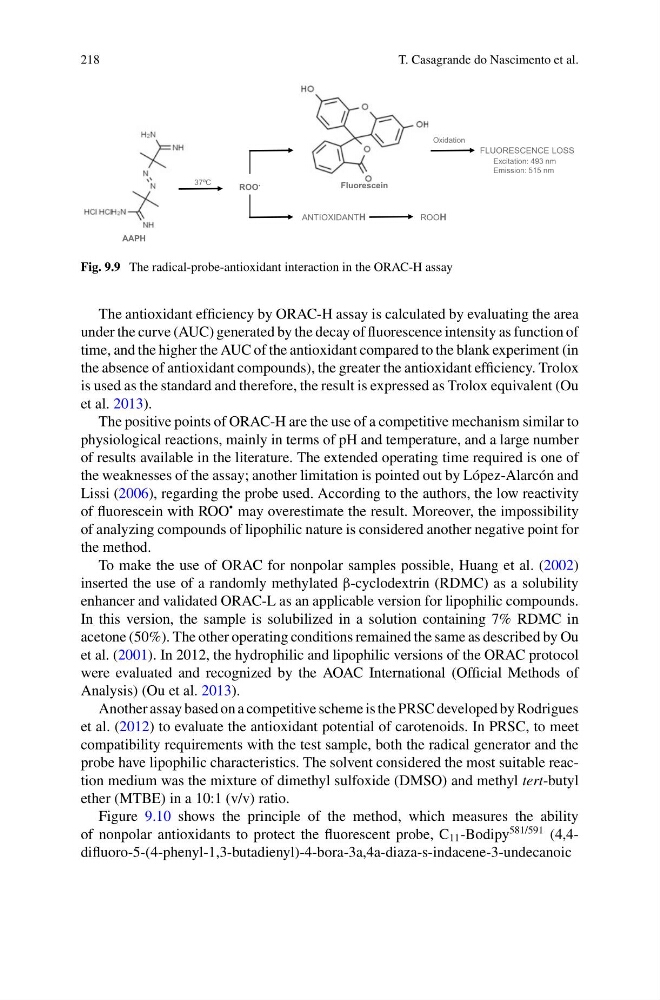
Fig. 9.9 The radical-probe-antioxidant interaction in the ORAC-H assay
The antioxidant efficiency by ORAC-H assay is calculated by evaluating the area
under the curve (AUC) generated by the decay of fluorescence intensity as function of
time, and the higher the AUC of the antioxidant compared to the blank experiment (in
the absence of antioxidant compounds), the greater the antioxidant efficiency. Trolox
is used as the standard and therefore, the result is expressed as Trolox equivalent (Ou
et al. 2013).
The positive points of ORAC-H are the use of a competitive mechanism similar to
physiological reactions, mainly in terms of pH and temperature, and a large number
of results available in the literature. The extended operating time required is one of
the weaknesses of the assay; another limitation is pointed out by López-Alarcón and
Lissi (2006), regarding the probe used. According to the authors, the low reactivity
of fluorescein with ROO
• may overestimate the result. Moreover, the impossibility
of analyzing compounds of lipophilic nature is considered another negative point for
the method.
To make the use of ORAC for nonpolar samples possible, Huang et al. (2002)
inserted the use of a randomly methylated β-cyclodextrin (RDMC) as a solubility
enhancer and validated ORAC-L as an applicable version for lipophilic compounds.
In this version, the sample is solubilized in a solution containing 7% RDMC in
acetone (50%). The other operating conditions remained the same as described by Ou
et al. (2001). In 2012, the hydrophilic and lipophilic versions of the ORAC protocol
were evaluated and recognized by the AOAC International (Official Methods of
Analysis) (Ou et al. 2013).
Another assay based on a competitive scheme is the PRSC developed by Rodrigues
et al. (2012) to evaluate the antioxidant potential of carotenoids. In PRSC, to meet
compatibility requirements with the test sample, both the radical generator and the
probe have lipophilic characteristics. The solvent considered the most suitable reaction medium was the mixture of dimethyl sulfoxide (DMSO) and methyl tert-butyl
ether (MTBE) in a 10:1 (v/v) ratio.
Figure 9.10 shows the principle of the method, which measures the ability
of nonpolar antioxidants to protect the fluorescent probe, C 11 -Bodipy
581/591 (4,4difluoro-5-(4-phenyl-1,3-butadienyl)-4-bora-3a,4a-diaza-s-indacene-3-undecanoic
T. Casagrande do Nascimento et al.
ROO •
AAPH
Fluorescein
ANTIOXIDANTH
FLUORESCENCE LOSS
ROOH
Oxidation
Excitation: 493 nm
Emission: 515 nm
37ºC
Fig. 9.9 The radical-probe-antioxidant interaction in the ORAC-H assay
The antioxidant efficiency by ORAC-H assay is calculated by evaluating the area
under the curve (AUC) generated by the decay of fluorescence intensity as function of
time, and the higher the AUC of the antioxidant compared to the blank experiment (in
the absence of antioxidant compounds), the greater the antioxidant efficiency. Trolox
is used as the standard and therefore, the result is expressed as Trolox equivalent (Ou
et al. 2013).
The positive points of ORAC-H are the use of a competitive mechanism similar to
physiological reactions, mainly in terms of pH and temperature, and a large number
of results available in the literature. The extended operating time required is one of
the weaknesses of the assay; another limitation is pointed out by López-Alarcón and
Lissi (2006), regarding the probe used. According to the authors, the low reactivity
of fluorescein with ROO
• may overestimate the result. Moreover, the impossibility
of analyzing compounds of lipophilic nature is considered another negative point for
the method.
To make the use of ORAC for nonpolar samples possible, Huang et al. (2002)
inserted the use of a randomly methylated β-cyclodextrin (RDMC) as a solubility
enhancer and validated ORAC-L as an applicable version for lipophilic compounds.
In this version, the sample is solubilized in a solution containing 7% RDMC in
acetone (50%). The other operating conditions remained the same as described by Ou
et al. (2001). In 2012, the hydrophilic and lipophilic versions of the ORAC protocol
were evaluated and recognized by the AOAC International (Official Methods of
Analysis) (Ou et al. 2013).
Another assay based on a competitive scheme is the PRSC developed by Rodrigues
et al. (2012) to evaluate the antioxidant potential of carotenoids. In PRSC, to meet
compatibility requirements with the test sample, both the radical generator and the
probe have lipophilic characteristics. The solvent considered the most suitable reaction medium was the mixture of dimethyl sulfoxide (DMSO) and methyl tert-butyl
ether (MTBE) in a 10:1 (v/v) ratio.
Figure 9.10 shows the principle of the method, which measures the ability
of nonpolar antioxidants to protect the fluorescent probe, C 11 -Bodipy
581/591 (4,4difluoro-5-(4-phenyl-1,3-butadienyl)-4-bora-3a,4a-diaza-s-indacene-3-undecanoic