

9 Analytical Protocols in Antioxidant Capacity Measurement
217
Solution with molybdate and tungstate
Folin-Ciocalteu Reagent
(Yellow color)
ANTIOXIDANT +
Reduction
(pH 11.0)
Blue oxides
Absorption: 765 nm
+
+
+
+
+
+
+
+
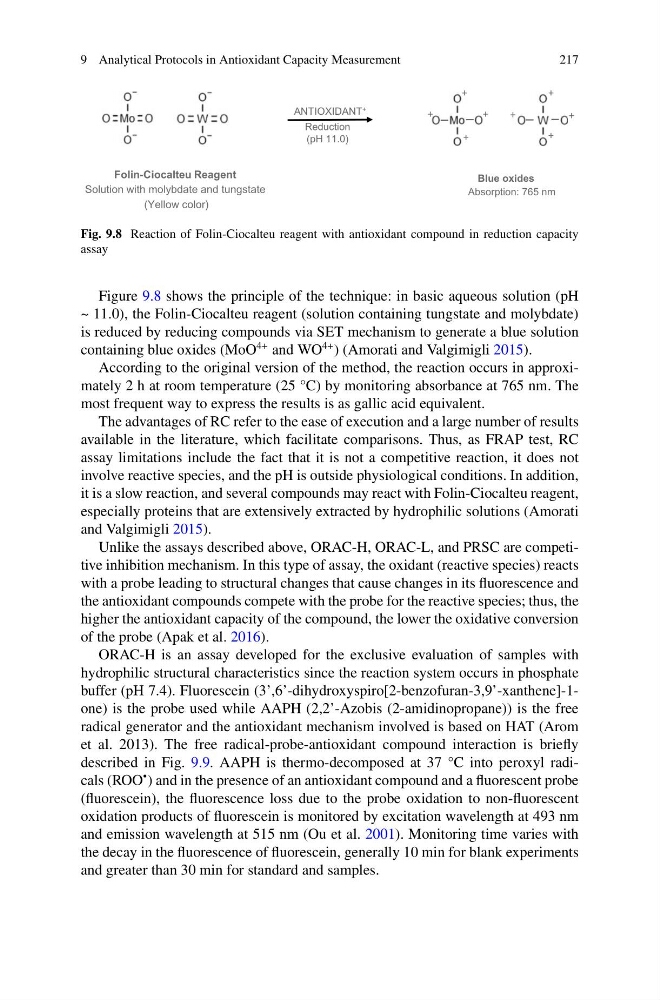
Fig. 9.8 Reaction of Folin-Ciocalteu reagent with antioxidant compound in reduction capacity
assay
Figure 9.8 shows the principle of the technique: in basic aqueous solution (pH
~ 11.0), the Folin-Ciocalteu reagent (solution containing tungstate and molybdate)
is reduced by reducing compounds via SET mechanism to generate a blue solution
containing blue oxides (MoO
4+ and WO
4+ ) (Amorati and Valgimigli 2015).
According to the original version of the method, the reaction occurs in approximately 2 h at room temperature (25 °C) by monitoring absorbance at 765 nm. The
most frequent way to express the results is as gallic acid equivalent.
The advantages of RC refer to the ease of execution and a large number of results
available in the literature, which facilitate comparisons. Thus, as FRAP test, RC
assay limitations include the fact that it is not a competitive reaction, it does not
involve reactive species, and the pH is outside physiological conditions. In addition,
it is a slow reaction, and several compounds may react with Folin-Ciocalteu reagent,
especially proteins that are extensively extracted by hydrophilic solutions (Amorati
and Valgimigli 2015).
Unlike the assays described above, ORAC-H, ORAC-L, and PRSC are competitive inhibition mechanism. In this type of assay, the oxidant (reactive species) reacts
with a probe leading to structural changes that cause changes in its fluorescence and
the antioxidant compounds compete with the probe for the reactive species; thus, the
higher the antioxidant capacity of the compound, the lower the oxidative conversion
of the probe (Apak et al. 2016).
ORAC-H is an assay developed for the exclusive evaluation of samples with
hydrophilic structural characteristics since the reaction system occurs in phosphate
buffer (pH 7.4). Fluorescein (3’,6’-dihydroxyspiro[2-benzofuran-3,9’-xanthene]-1one) is the probe used while AAPH (2,2’-Azobis (2-amidinopropane)) is the free
radical generator and the antioxidant mechanism involved is based on HAT (Arom
et al. 2013). The free radical-probe-antioxidant compound interaction is briefly
described in Fig. 9.9. AAPH is thermo-decomposed at 37 °C into peroxyl radicals (ROO
• ) and in the presence of an antioxidant compound and a fluorescent probe
(fluorescein), the fluorescence loss due to the probe oxidation to non-fluorescent
oxidation products of fluorescein is monitored by excitation wavelength at 493 nm
and emission wavelength at 515 nm (Ou et al. 2001). Monitoring time varies with
the decay in the fluorescence of fluorescein, generally 10 min for blank experiments
and greater than 30 min for standard and samples.
217
Solution with molybdate and tungstate
Folin-Ciocalteu Reagent
(Yellow color)
ANTIOXIDANT +
Reduction
(pH 11.0)
Blue oxides
Absorption: 765 nm
+
+
+
+
+
+
+
+
Fig. 9.8 Reaction of Folin-Ciocalteu reagent with antioxidant compound in reduction capacity
assay
Figure 9.8 shows the principle of the technique: in basic aqueous solution (pH
~ 11.0), the Folin-Ciocalteu reagent (solution containing tungstate and molybdate)
is reduced by reducing compounds via SET mechanism to generate a blue solution
containing blue oxides (MoO
4+ and WO
4+ ) (Amorati and Valgimigli 2015).
According to the original version of the method, the reaction occurs in approximately 2 h at room temperature (25 °C) by monitoring absorbance at 765 nm. The
most frequent way to express the results is as gallic acid equivalent.
The advantages of RC refer to the ease of execution and a large number of results
available in the literature, which facilitate comparisons. Thus, as FRAP test, RC
assay limitations include the fact that it is not a competitive reaction, it does not
involve reactive species, and the pH is outside physiological conditions. In addition,
it is a slow reaction, and several compounds may react with Folin-Ciocalteu reagent,
especially proteins that are extensively extracted by hydrophilic solutions (Amorati
and Valgimigli 2015).
Unlike the assays described above, ORAC-H, ORAC-L, and PRSC are competitive inhibition mechanism. In this type of assay, the oxidant (reactive species) reacts
with a probe leading to structural changes that cause changes in its fluorescence and
the antioxidant compounds compete with the probe for the reactive species; thus, the
higher the antioxidant capacity of the compound, the lower the oxidative conversion
of the probe (Apak et al. 2016).
ORAC-H is an assay developed for the exclusive evaluation of samples with
hydrophilic structural characteristics since the reaction system occurs in phosphate
buffer (pH 7.4). Fluorescein (3’,6’-dihydroxyspiro[2-benzofuran-3,9’-xanthene]-1one) is the probe used while AAPH (2,2’-Azobis (2-amidinopropane)) is the free
radical generator and the antioxidant mechanism involved is based on HAT (Arom
et al. 2013). The free radical-probe-antioxidant compound interaction is briefly
described in Fig. 9.9. AAPH is thermo-decomposed at 37 °C into peroxyl radicals (ROO
• ) and in the presence of an antioxidant compound and a fluorescent probe
(fluorescein), the fluorescence loss due to the probe oxidation to non-fluorescent
oxidation products of fluorescein is monitored by excitation wavelength at 493 nm
and emission wavelength at 515 nm (Ou et al. 2001). Monitoring time varies with
the decay in the fluorescence of fluorescein, generally 10 min for blank experiments
and greater than 30 min for standard and samples.