

9 Analytical Protocols in Antioxidant Capacity Measurement
219
ROO •
AIBN
C11-Bodidy 581/591
ANTIOXIDANT +
FLUORESCENCE LOSS
ROO -
Oxidation
DMSO:MTBE (10:1 v/v)
Excitation: 540 nm
Emission: 600 nm
42ºC
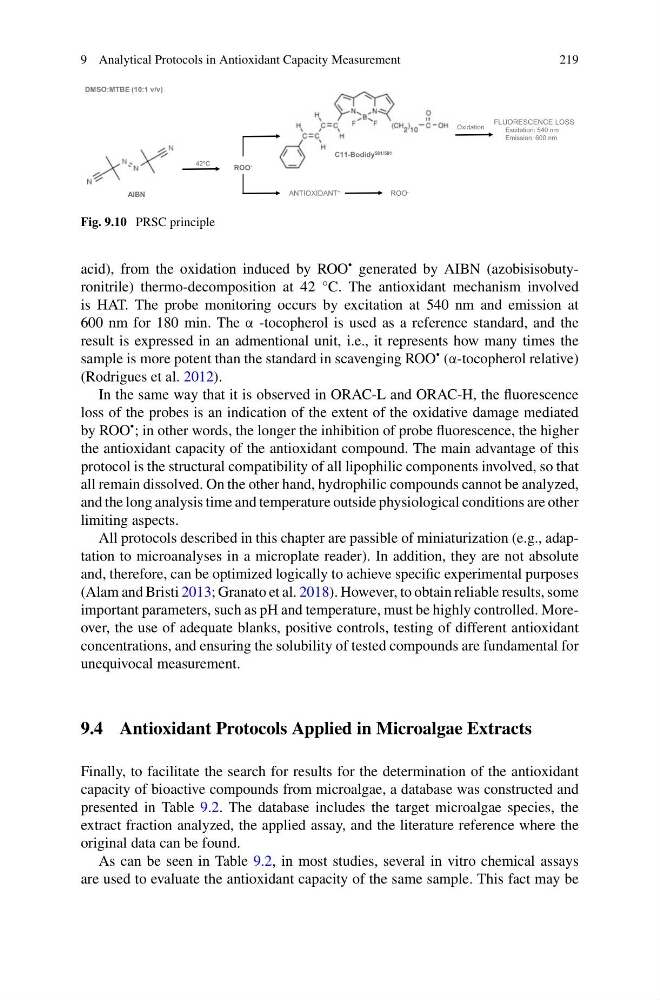
Fig. 9.10 PRSC principle
acid), from the oxidation induced by ROO
• generated by AIBN (azobisisobutyronitrile) thermo-decomposition at 42 °C. The antioxidant mechanism involved
is HAT. The probe monitoring occurs by excitation at 540 nm and emission at
600 nm for 180 min. The α -tocopherol is used as a reference standard, and the
result is expressed in an admentional unit, i.e., it represents how many times the
sample is more potent than the standard in scavenging ROO
• (α-tocopherol relative)
(Rodrigues et al. 2012).
In the same way that it is observed in ORAC-L and ORAC-H, the fluorescence
loss of the probes is an indication of the extent of the oxidative damage mediated
by ROO
• ; in other words, the longer the inhibition of probe fluorescence, the higher
the antioxidant capacity of the antioxidant compound. The main advantage of this
protocol is the structural compatibility of all lipophilic components involved, so that
all remain dissolved. On the other hand, hydrophilic compounds cannot be analyzed,
and the long analysis time and temperature outside physiological conditions are other
limiting aspects.
All protocols described in this chapter are passible of miniaturization (e.g., adaptation to microanalyses in a microplate reader). In addition, they are not absolute
and, therefore, can be optimized logically to achieve specific experimental purposes
(Alam and Bristi 2013; Granato et al. 2018). However, to obtain reliable results, some
important parameters, such as pH and temperature, must be highly controlled. Moreover, the use of adequate blanks, positive controls, testing of different antioxidant
concentrations, and ensuring the solubility of tested compounds are fundamental for
unequivocal measurement.
9.4 Antioxidant Protocols Applied in Microalgae Extracts
Finally, to facilitate the search for results for the determination of the antioxidant
capacity of bioactive compounds from microalgae, a database was constructed and
presented in Table 9.2. The database includes the target microalgae species, the
extract fraction analyzed, the applied assay, and the literature reference where the
original data can be found.
As can be seen in Table 9.2, in most studies, several in vitro chemical assays
are used to evaluate the antioxidant capacity of the same sample. This fact may be
219
ROO •
AIBN
C11-Bodidy 581/591
ANTIOXIDANT +
FLUORESCENCE LOSS
ROO -
Oxidation
DMSO:MTBE (10:1 v/v)
Excitation: 540 nm
Emission: 600 nm
42ºC
Fig. 9.10 PRSC principle
acid), from the oxidation induced by ROO
• generated by AIBN (azobisisobutyronitrile) thermo-decomposition at 42 °C. The antioxidant mechanism involved
is HAT. The probe monitoring occurs by excitation at 540 nm and emission at
600 nm for 180 min. The α -tocopherol is used as a reference standard, and the
result is expressed in an admentional unit, i.e., it represents how many times the
sample is more potent than the standard in scavenging ROO
• (α-tocopherol relative)
(Rodrigues et al. 2012).
In the same way that it is observed in ORAC-L and ORAC-H, the fluorescence
loss of the probes is an indication of the extent of the oxidative damage mediated
by ROO
• ; in other words, the longer the inhibition of probe fluorescence, the higher
the antioxidant capacity of the antioxidant compound. The main advantage of this
protocol is the structural compatibility of all lipophilic components involved, so that
all remain dissolved. On the other hand, hydrophilic compounds cannot be analyzed,
and the long analysis time and temperature outside physiological conditions are other
limiting aspects.
All protocols described in this chapter are passible of miniaturization (e.g., adaptation to microanalyses in a microplate reader). In addition, they are not absolute
and, therefore, can be optimized logically to achieve specific experimental purposes
(Alam and Bristi 2013; Granato et al. 2018). However, to obtain reliable results, some
important parameters, such as pH and temperature, must be highly controlled. Moreover, the use of adequate blanks, positive controls, testing of different antioxidant
concentrations, and ensuring the solubility of tested compounds are fundamental for
unequivocal measurement.
9.4 Antioxidant Protocols Applied in Microalgae Extracts
Finally, to facilitate the search for results for the determination of the antioxidant
capacity of bioactive compounds from microalgae, a database was constructed and
presented in Table 9.2. The database includes the target microalgae species, the
extract fraction analyzed, the applied assay, and the literature reference where the
original data can be found.
As can be seen in Table 9.2, in most studies, several in vitro chemical assays
are used to evaluate the antioxidant capacity of the same sample. This fact may be