

214
T. Casagrande do Nascimento et al.
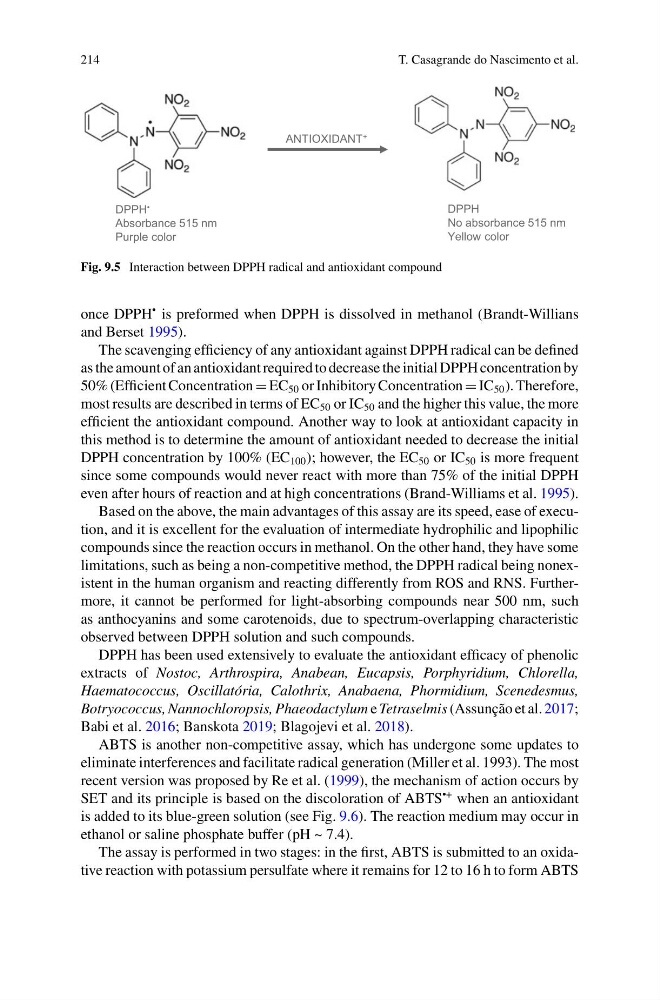
DPPH •
Absorbance 515 nm
Purple color
DPPH
No absorbance 515 nm
Yellow color
ANTIOXIDANT +
Fig. 9.5 Interaction between DPPH radical and antioxidant compound
once DPPH
• is preformed when DPPH is dissolved in methanol (Brandt-Willians
and Berset 1995).
The scavenging efficiency of any antioxidant against DPPH radical can be defined
as the amount of an antioxidant required to decrease the initial DPPH concentration by
50% (Efficient Concentration = EC 50 or Inhibitory Concentration = IC 50 ). Therefore,
most results are described in terms of EC 50 or IC 50 and the higher this value, the more
efficient the antioxidant compound. Another way to look at antioxidant capacity in
this method is to determine the amount of antioxidant needed to decrease the initial
DPPH concentration by 100% (EC 100 ); however, the EC 50 or IC 50 is more frequent
since some compounds would never react with more than 75% of the initial DPPH
even after hours of reaction and at high concentrations (Brand-Williams et al. 1995).
Based on the above, the main advantages of this assay are its speed, ease of execution, and it is excellent for the evaluation of intermediate hydrophilic and lipophilic
compounds since the reaction occurs in methanol. On the other hand, they have some
limitations, such as being a non-competitive method, the DPPH radical being nonexistent in the human organism and reacting differently from ROS and RNS. Furthermore, it cannot be performed for light-absorbing compounds near 500 nm, such
as anthocyanins and some carotenoids, due to spectrum-overlapping characteristic
observed between DPPH solution and such compounds.
DPPH has been used extensively to evaluate the antioxidant efficacy of phenolic
extracts of Nostoc, Arthrospira, Anabean, Eucapsis, Porphyridium, Chlorella,
Haematococcus, Oscillatória, Calothrix, Anabaena, Phormidium, Scenedesmus,
Botryococcus, Nannochloropsis, Phaeodactylum e Tetraselmis (Assunção et al. 2017;
Babi et al. 2016; Banskota 2019; Blagojevi et al. 2018).
ABTS is another non-competitive assay, which has undergone some updates to
eliminate interferences and facilitate radical generation (Miller et al. 1993). The most
recent version was proposed by Re et al. (1999), the mechanism of action occurs by
SET and its principle is based on the discoloration of ABTS
•+ when an antioxidant
is added to its blue-green solution (see Fig. 9.6). The reaction medium may occur in
ethanol or saline phosphate buffer (pH ~ 7.4).
The assay is performed in two stages: in the first, ABTS is submitted to an oxidative reaction with potassium persulfate where it remains for 12 to 16 h to form ABTS
T. Casagrande do Nascimento et al.
DPPH •
Absorbance 515 nm
Purple color
DPPH
No absorbance 515 nm
Yellow color
ANTIOXIDANT +
Fig. 9.5 Interaction between DPPH radical and antioxidant compound
once DPPH
• is preformed when DPPH is dissolved in methanol (Brandt-Willians
and Berset 1995).
The scavenging efficiency of any antioxidant against DPPH radical can be defined
as the amount of an antioxidant required to decrease the initial DPPH concentration by
50% (Efficient Concentration = EC 50 or Inhibitory Concentration = IC 50 ). Therefore,
most results are described in terms of EC 50 or IC 50 and the higher this value, the more
efficient the antioxidant compound. Another way to look at antioxidant capacity in
this method is to determine the amount of antioxidant needed to decrease the initial
DPPH concentration by 100% (EC 100 ); however, the EC 50 or IC 50 is more frequent
since some compounds would never react with more than 75% of the initial DPPH
even after hours of reaction and at high concentrations (Brand-Williams et al. 1995).
Based on the above, the main advantages of this assay are its speed, ease of execution, and it is excellent for the evaluation of intermediate hydrophilic and lipophilic
compounds since the reaction occurs in methanol. On the other hand, they have some
limitations, such as being a non-competitive method, the DPPH radical being nonexistent in the human organism and reacting differently from ROS and RNS. Furthermore, it cannot be performed for light-absorbing compounds near 500 nm, such
as anthocyanins and some carotenoids, due to spectrum-overlapping characteristic
observed between DPPH solution and such compounds.
DPPH has been used extensively to evaluate the antioxidant efficacy of phenolic
extracts of Nostoc, Arthrospira, Anabean, Eucapsis, Porphyridium, Chlorella,
Haematococcus, Oscillatória, Calothrix, Anabaena, Phormidium, Scenedesmus,
Botryococcus, Nannochloropsis, Phaeodactylum e Tetraselmis (Assunção et al. 2017;
Babi et al. 2016; Banskota 2019; Blagojevi et al. 2018).
ABTS is another non-competitive assay, which has undergone some updates to
eliminate interferences and facilitate radical generation (Miller et al. 1993). The most
recent version was proposed by Re et al. (1999), the mechanism of action occurs by
SET and its principle is based on the discoloration of ABTS
•+ when an antioxidant
is added to its blue-green solution (see Fig. 9.6). The reaction medium may occur in
ethanol or saline phosphate buffer (pH ~ 7.4).
The assay is performed in two stages: in the first, ABTS is submitted to an oxidative reaction with potassium persulfate where it remains for 12 to 16 h to form ABTS