

9 Analytical Protocols in Antioxidant Capacity Measurement
213
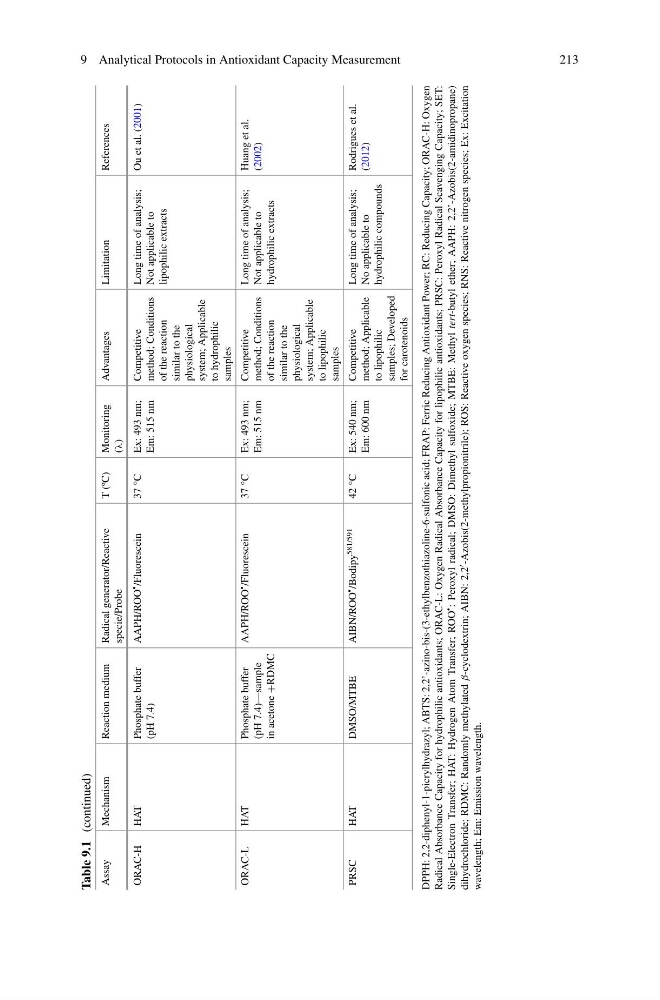
Table 9.1
(continued)
Assay
Mechanism
Reaction medium
Radical generator/Reactive
specie/Probe
T (ºC)
Monitoring
(λ)
Advantages
Limitation
References
ORAC-H
HAT
Phosphate buffer
(pH 7.4)
AAPH/ROO •
/Fluorescein
37 °C
Ex: 493 nm;
Em: 515 nm
Competitive
method; Conditions
of the reaction
similar to the
physiological
system; Applicable
to hydrophilic
samples
Long time of analysis;
Not applicable to
lipophilic extracts
Ou et al. (2001)
ORAC-L
HAT
Phosphate buffer
(pH 7.4)—sample
in acetone
+RDMC
AAPH/ROO •
/Fluorescein
37 °C
Ex: 493 nm;
Em: 515 nm
Competitive
method; Conditions
of the reaction
similar to the
physiological
system; Applicable
to lipophilic
samples
Long time of analysis;
Not applicable to
hydrophilic extracts
Huang et al.
(2002)
PRSC
HAT
DMSO/MTBE
AIBN/ROO •
/Bodipy 581/591
42 °C
Ex: 540 nm;
Em: 600 nm
Competitive
method; Applicable
to lipophilic
samples; Developed
for carotenoids
Long time of analysis;
No applicable to
hydrophilic compounds
Rodrigues et al.
(2012)
DPPH: 2,2-diphenyl-1-picrylhydrazyl; ABTS: 2,2’-azino-bis-(3-ethylbenzothiazoline-6-sulfonic acid; FRAP: Ferric Reducing Antioxidant Power; RC: Reducing Capacity; ORAC-H: Oxygen
Radical Absorbance Capacity for hydrophilic antioxidants; ORAC-L: Oxygen Radical Absorbance Capacity for lipophilic antioxidants; PRSC: Peroxyl Radical Scavenging Capacity; SET:
Single-Electron Transfer; HAT: Hydrogen Atom Transfer; ROO •
: Peroxyl radical; DMSO: Dimethyl sulfoxide; MTBE: Methyl tert-butyl
ether; AAPH: 2,2’-Azobis(2-amidinopropane)
dihydrochloride; RDMC: Randomly methylated
β-cyclodextrin; AIBN: 2,2
-Azobis(2-methylpropionitrile); ROS: Reactive oxygen species; RNS: Reactive nitrogen species; Ex: Excitation
wavelength; Em: Emission wavelength.
213
Table 9.1
(continued)
Assay
Mechanism
Reaction medium
Radical generator/Reactive
specie/Probe
T (ºC)
Monitoring
(λ)
Advantages
Limitation
References
ORAC-H
HAT
Phosphate buffer
(pH 7.4)
AAPH/ROO •
/Fluorescein
37 °C
Ex: 493 nm;
Em: 515 nm
Competitive
method; Conditions
of the reaction
similar to the
physiological
system; Applicable
to hydrophilic
samples
Long time of analysis;
Not applicable to
lipophilic extracts
Ou et al. (2001)
ORAC-L
HAT
Phosphate buffer
(pH 7.4)—sample
in acetone
+RDMC
AAPH/ROO •
/Fluorescein
37 °C
Ex: 493 nm;
Em: 515 nm
Competitive
method; Conditions
of the reaction
similar to the
physiological
system; Applicable
to lipophilic
samples
Long time of analysis;
Not applicable to
hydrophilic extracts
Huang et al.
(2002)
PRSC
HAT
DMSO/MTBE
AIBN/ROO •
/Bodipy 581/591
42 °C
Ex: 540 nm;
Em: 600 nm
Competitive
method; Applicable
to lipophilic
samples; Developed
for carotenoids
Long time of analysis;
No applicable to
hydrophilic compounds
Rodrigues et al.
(2012)
DPPH: 2,2-diphenyl-1-picrylhydrazyl; ABTS: 2,2’-azino-bis-(3-ethylbenzothiazoline-6-sulfonic acid; FRAP: Ferric Reducing Antioxidant Power; RC: Reducing Capacity; ORAC-H: Oxygen
Radical Absorbance Capacity for hydrophilic antioxidants; ORAC-L: Oxygen Radical Absorbance Capacity for lipophilic antioxidants; PRSC: Peroxyl Radical Scavenging Capacity; SET:
Single-Electron Transfer; HAT: Hydrogen Atom Transfer; ROO •
: Peroxyl radical; DMSO: Dimethyl sulfoxide; MTBE: Methyl tert-butyl
ether; AAPH: 2,2’-Azobis(2-amidinopropane)
dihydrochloride; RDMC: Randomly methylated
β-cyclodextrin; AIBN: 2,2
-Azobis(2-methylpropionitrile); ROS: Reactive oxygen species; RNS: Reactive nitrogen species; Ex: Excitation
wavelength; Em: Emission wavelength.