

212
T. Casagrande do Nascimento et al.
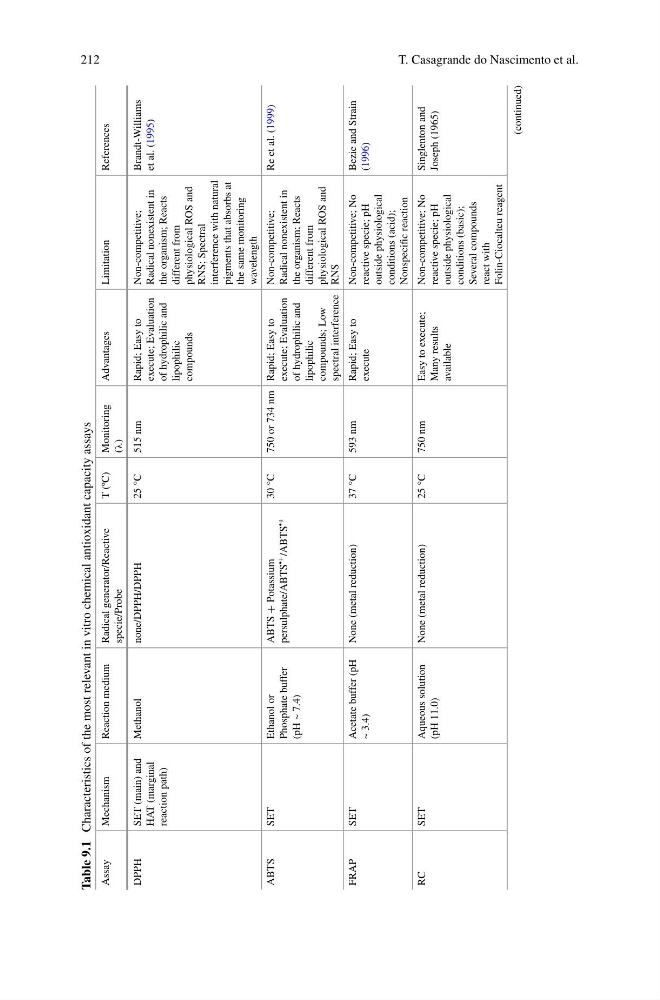
Table 9.1
Characteristics of the most relevant in vitro chemical antioxidant capacity assays
Assay
Mechanism
Reaction medium
Radical generator/Reactive
specie/Probe
T (ºC)
Monitoring
(λ)
Advantages
Limitation
References
DPPH
SET (main) and
HAT (marginal
reaction path)
Methanol
none/DPPH/DPPH
25 °C
515 nm
Rapid; Easy to
execute; Evaluation
of hydrophilic and
lipophilic
compounds
Non-competitive;
Radical nonexistent in
the organism; Reacts
different from
physiological ROS and
RNS; Spectral
interference with natural
pigments that absorbs at
the same monitoring
wavelength
Brandt-Williams
et al. (1995)
ABTS
SET
Ethanol or
Phosphate buffer
(pH ~ 7.4)
ABTS
+ Potassium
persulphate/ABTS •+
/ABTS •+
30 °C
750 or 734 nm Rapid; Easy to
execute; Evaluation
of hydrophilic and
lipophilic
compounds; Low
spectral interference
Non-competitive;
Radical nonexistent in
the organism; Reacts
different from
physiological ROS and
RNS
Re et al. (1999)
FRAP
SET
Acetate buffer (pH
~ 3.4)
None (metal reduction)
37 °C
593 nm
Rapid; Easy to
execute
Non-competitive; No
reactive specie; pH
outside physiological
conditions (acid);
Nonspecific reaction
Bezie and Strain
(1996)
RC
SET
Aqueous solution
(pH 11.0)
None (metal reduction)
25 °C
750 nm
Easy to execute;
Many results
available
Non-competitive; No
reactive specie; pH
outside physiological
conditions (basic);
Several compounds
react with
Folin-Ciocalteu reagent
Singlenton and
Joseph (1965)
(continued)
T. Casagrande do Nascimento et al.
Table 9.1
Characteristics of the most relevant in vitro chemical antioxidant capacity assays
Assay
Mechanism
Reaction medium
Radical generator/Reactive
specie/Probe
T (ºC)
Monitoring
(λ)
Advantages
Limitation
References
DPPH
SET (main) and
HAT (marginal
reaction path)
Methanol
none/DPPH/DPPH
25 °C
515 nm
Rapid; Easy to
execute; Evaluation
of hydrophilic and
lipophilic
compounds
Non-competitive;
Radical nonexistent in
the organism; Reacts
different from
physiological ROS and
RNS; Spectral
interference with natural
pigments that absorbs at
the same monitoring
wavelength
Brandt-Williams
et al. (1995)
ABTS
SET
Ethanol or
Phosphate buffer
(pH ~ 7.4)
ABTS
+ Potassium
persulphate/ABTS •+
/ABTS •+
30 °C
750 or 734 nm Rapid; Easy to
execute; Evaluation
of hydrophilic and
lipophilic
compounds; Low
spectral interference
Non-competitive;
Radical nonexistent in
the organism; Reacts
different from
physiological ROS and
RNS
Re et al. (1999)
FRAP
SET
Acetate buffer (pH
~ 3.4)
None (metal reduction)
37 °C
593 nm
Rapid; Easy to
execute
Non-competitive; No
reactive specie; pH
outside physiological
conditions (acid);
Nonspecific reaction
Bezie and Strain
(1996)
RC
SET
Aqueous solution
(pH 11.0)
None (metal reduction)
25 °C
750 nm
Easy to execute;
Many results
available
Non-competitive; No
reactive specie; pH
outside physiological
conditions (basic);
Several compounds
react with
Folin-Ciocalteu reagent
Singlenton and
Joseph (1965)
(continued)