

72
R. Chen et al.
3.2 Supported Metal Catalysts
Metal nanoparticles have been widely considered as catalytic active centers in
supported catalysts. For catalyst synthesis, ALD processes of Pt, Pd, Ir, Rh, Ru,
Ni, Cu, and Co have been applied to deposit metals onto various supports. The
metal nanoparticle size can be concisely controlled by adjusting the deposition
processes, which relies on the self-limiting nature of surface reactions. To further
obtain improved activity and selectivity of a catalyst, bimetallic catalysts in the form
of core–shell and alloy structures can also be prepared to utilize the synergistic effect
between metals.
3.2.1 ALD Recipes of Metals
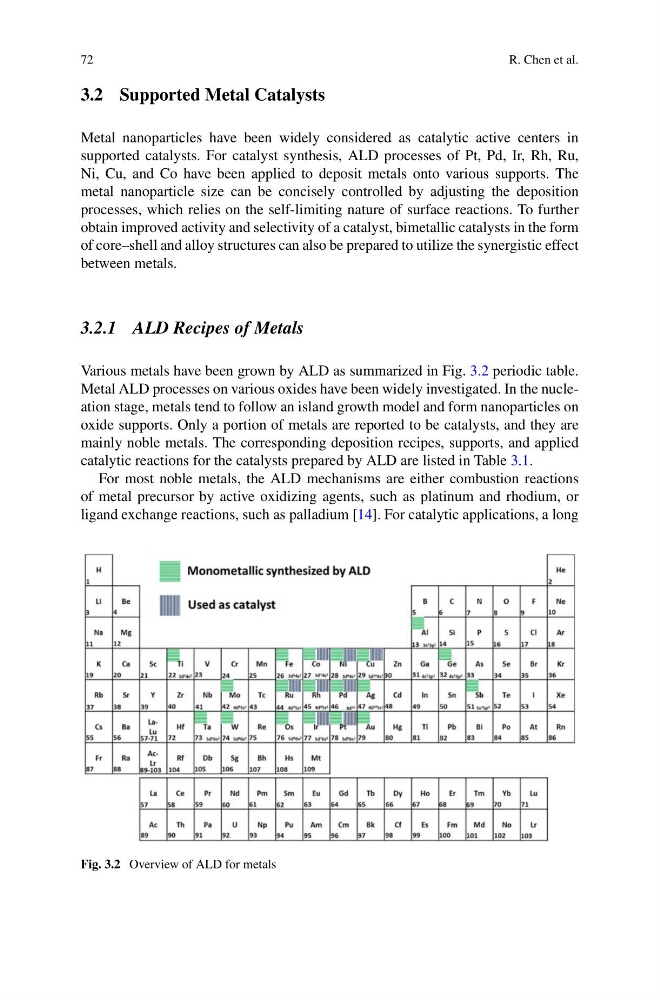
Various metals have been grown by ALD as summarized in Fig. 3.2 periodic table.
Metal ALD processes on various oxides have been widely investigated. In the nucleation stage, metals tend to follow an island growth model and form nanoparticles on
oxide supports. Only a portion of metals are reported to be catalysts, and they are
mainly noble metals. The corresponding deposition recipes, supports, and applied
catalytic reactions for the catalysts prepared by ALD are listed in Table 3.1.
For most noble metals, the ALD mechanisms are either combustion reactions
of metal precursor by active oxidizing agents, such as platinum and rhodium, or
ligand exchange reactions, such as palladium [14]. For catalytic applications, a long
Fig. 3.2 Overview of ALD for metals
R. Chen et al.
3.2 Supported Metal Catalysts
Metal nanoparticles have been widely considered as catalytic active centers in
supported catalysts. For catalyst synthesis, ALD processes of Pt, Pd, Ir, Rh, Ru,
Ni, Cu, and Co have been applied to deposit metals onto various supports. The
metal nanoparticle size can be concisely controlled by adjusting the deposition
processes, which relies on the self-limiting nature of surface reactions. To further
obtain improved activity and selectivity of a catalyst, bimetallic catalysts in the form
of core–shell and alloy structures can also be prepared to utilize the synergistic effect
between metals.
3.2.1 ALD Recipes of Metals
Various metals have been grown by ALD as summarized in Fig. 3.2 periodic table.
Metal ALD processes on various oxides have been widely investigated. In the nucleation stage, metals tend to follow an island growth model and form nanoparticles on
oxide supports. Only a portion of metals are reported to be catalysts, and they are
mainly noble metals. The corresponding deposition recipes, supports, and applied
catalytic reactions for the catalysts prepared by ALD are listed in Table 3.1.
For most noble metals, the ALD mechanisms are either combustion reactions
of metal precursor by active oxidizing agents, such as platinum and rhodium, or
ligand exchange reactions, such as palladium [14]. For catalytic applications, a long
Fig. 3.2 Overview of ALD for metals