

62
S. Li and R. Jin
2.6.3 Cu NC-Catalyzed CO 2 RR
Cu catalysts are attractive for their ability to reduce CO 2 to hydrocarbon products.
However, the mechanisms of CO 2 reduction on nanostructured Cu catalysts are not
well understood yet. In 2017, Tang et al. reported a copper-hydride nanocluster for
CO 2 RR to study the mechanism of Cu catalysts [72]. This Cu 32 H 20 L 12 NC (L =
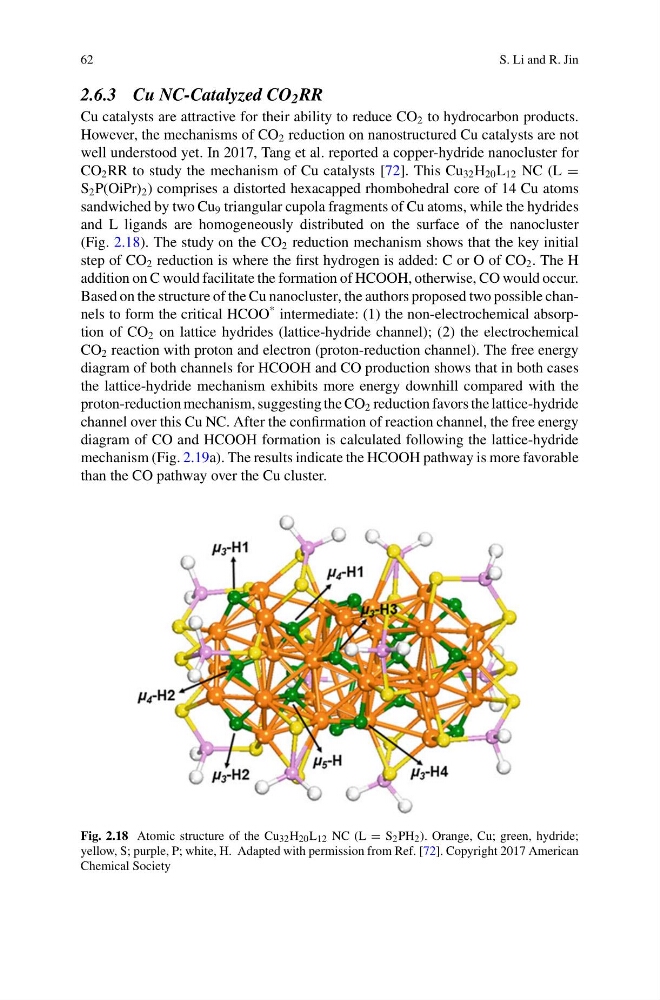
S 2 P(OiPr) 2 ) comprises a distorted hexacapped rhombohedral core of 14 Cu atoms
sandwiched by two Cu 9 triangular cupola fragments of Cu atoms, while the hydrides
and L ligands are homogeneously distributed on the surface of the nanocluster
(Fig. 2.18). The study on the CO 2 reduction mechanism shows that the key initial
step of CO 2 reduction is where the first hydrogen is added: C or O of CO 2 . The H
addition on C would facilitate the formation of HCOOH, otherwise, CO would occur.
Based on the structure of the Cu nanocluster, the authors proposed two possible channels to form the critical HCOO
* intermediate: (1) the non-electrochemical absorption of CO 2 on lattice hydrides (lattice-hydride channel); (2) the electrochemical
CO 2 reaction with proton and electron (proton-reduction channel). The free energy
diagram of both channels for HCOOH and CO production shows that in both cases
the lattice-hydride mechanism exhibits more energy downhill compared with the
proton-reduction mechanism, suggesting the CO 2 reduction favors the lattice-hydride
channel over this Cu NC. After the confirmation of reaction channel, the free energy
diagram of CO and HCOOH formation is calculated following the lattice-hydride
mechanism (Fig. 2.19a). The results indicate the HCOOH pathway is more favorable
than the CO pathway over the Cu cluster.
Fig. 2.18 Atomic structure of the Cu 32 H 20 L 12 NC (L = S 2 PH 2 ). Orange, Cu; green, hydride;
yellow, S; purple, P; white, H. Adapted with permission from Ref. [72]. Copyright 2017 American
Chemical Society
S. Li and R. Jin
2.6.3 Cu NC-Catalyzed CO 2 RR
Cu catalysts are attractive for their ability to reduce CO 2 to hydrocarbon products.
However, the mechanisms of CO 2 reduction on nanostructured Cu catalysts are not
well understood yet. In 2017, Tang et al. reported a copper-hydride nanocluster for
CO 2 RR to study the mechanism of Cu catalysts [72]. This Cu 32 H 20 L 12 NC (L =
S 2 P(OiPr) 2 ) comprises a distorted hexacapped rhombohedral core of 14 Cu atoms
sandwiched by two Cu 9 triangular cupola fragments of Cu atoms, while the hydrides
and L ligands are homogeneously distributed on the surface of the nanocluster
(Fig. 2.18). The study on the CO 2 reduction mechanism shows that the key initial
step of CO 2 reduction is where the first hydrogen is added: C or O of CO 2 . The H
addition on C would facilitate the formation of HCOOH, otherwise, CO would occur.
Based on the structure of the Cu nanocluster, the authors proposed two possible channels to form the critical HCOO
* intermediate: (1) the non-electrochemical absorption of CO 2 on lattice hydrides (lattice-hydride channel); (2) the electrochemical
CO 2 reaction with proton and electron (proton-reduction channel). The free energy
diagram of both channels for HCOOH and CO production shows that in both cases
the lattice-hydride mechanism exhibits more energy downhill compared with the
proton-reduction mechanism, suggesting the CO 2 reduction favors the lattice-hydride
channel over this Cu NC. After the confirmation of reaction channel, the free energy
diagram of CO and HCOOH formation is calculated following the lattice-hydride
mechanism (Fig. 2.19a). The results indicate the HCOOH pathway is more favorable
than the CO pathway over the Cu cluster.
Fig. 2.18 Atomic structure of the Cu 32 H 20 L 12 NC (L = S 2 PH 2 ). Orange, Cu; green, hydride;
yellow, S; purple, P; white, H. Adapted with permission from Ref. [72]. Copyright 2017 American
Chemical Society