

2 Atomically Precise Nanoclusters as Electrocatalysts
63
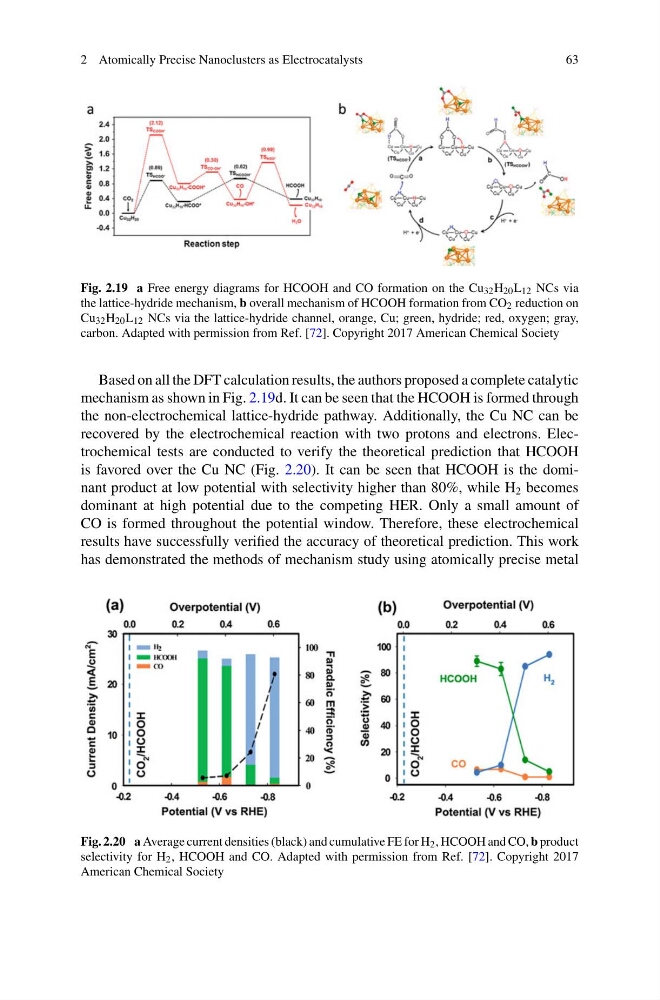
Fig. 2.19 a Free energy diagrams for HCOOH and CO formation on the Cu 32 H 20 L 12 NCs via
the lattice-hydride mechanism, b overall mechanism of HCOOH formation from CO 2 reduction on
Cu 32 H 20 L 12 NCs via the lattice-hydride channel, orange, Cu; green, hydride; red, oxygen; gray,
carbon. Adapted with permission from Ref. [72]. Copyright 2017 American Chemical Society
Based on all the DFT calculation results, the authors proposed a complete catalytic
mechanism as shown in Fig. 2.19d. It can be seen that the HCOOH is formed through
the non-electrochemical lattice-hydride pathway. Additionally, the Cu NC can be
recovered by the electrochemical reaction with two protons and electrons. Electrochemical tests are conducted to verify the theoretical prediction that HCOOH
is favored over the Cu NC (Fig. 2.20). It can be seen that HCOOH is the dominant product at low potential with selectivity higher than 80%, while H 2 becomes
dominant at high potential due to the competing HER. Only a small amount of
CO is formed throughout the potential window. Therefore, these electrochemical
results have successfully verified the accuracy of theoretical prediction. This work
has demonstrated the methods of mechanism study using atomically precise metal
Fig. 2.20 a Average current densities (black) and cumulative FE for H 2 , HCOOH and CO, b product
selectivity for H 2 , HCOOH and CO. Adapted with permission from Ref. [72]. Copyright 2017
American Chemical Society
63
Fig. 2.19 a Free energy diagrams for HCOOH and CO formation on the Cu 32 H 20 L 12 NCs via
the lattice-hydride mechanism, b overall mechanism of HCOOH formation from CO 2 reduction on
Cu 32 H 20 L 12 NCs via the lattice-hydride channel, orange, Cu; green, hydride; red, oxygen; gray,
carbon. Adapted with permission from Ref. [72]. Copyright 2017 American Chemical Society
Based on all the DFT calculation results, the authors proposed a complete catalytic
mechanism as shown in Fig. 2.19d. It can be seen that the HCOOH is formed through
the non-electrochemical lattice-hydride pathway. Additionally, the Cu NC can be
recovered by the electrochemical reaction with two protons and electrons. Electrochemical tests are conducted to verify the theoretical prediction that HCOOH
is favored over the Cu NC (Fig. 2.20). It can be seen that HCOOH is the dominant product at low potential with selectivity higher than 80%, while H 2 becomes
dominant at high potential due to the competing HER. Only a small amount of
CO is formed throughout the potential window. Therefore, these electrochemical
results have successfully verified the accuracy of theoretical prediction. This work
has demonstrated the methods of mechanism study using atomically precise metal
Fig. 2.20 a Average current densities (black) and cumulative FE for H 2 , HCOOH and CO, b product
selectivity for H 2 , HCOOH and CO. Adapted with permission from Ref. [72]. Copyright 2017
American Chemical Society