

60
S. Li and R. Jin
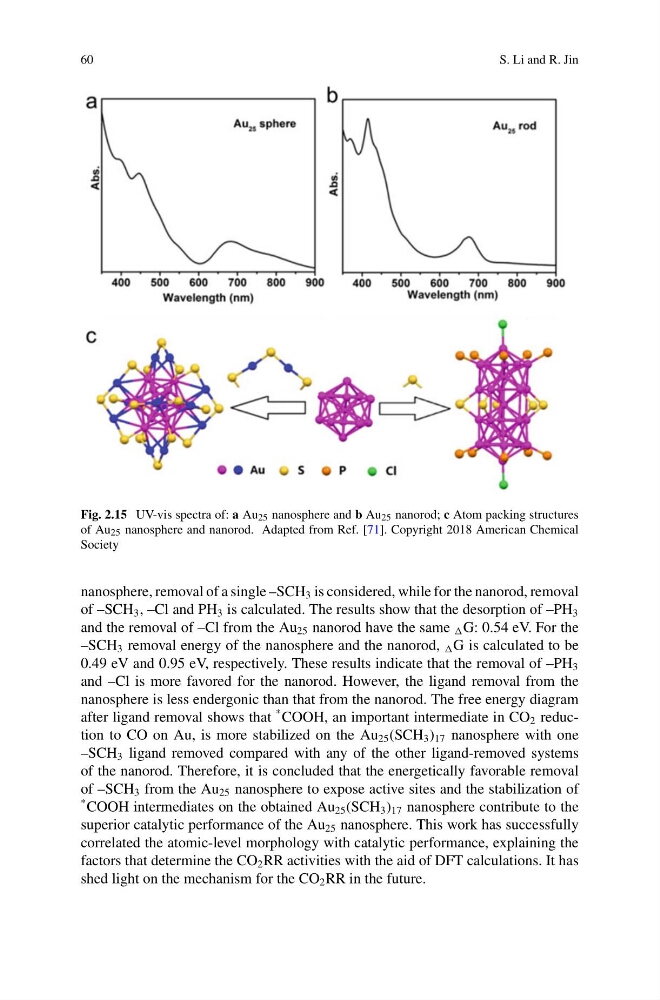
Fig. 2.15 UV-vis spectra of: a Au 25 nanosphere and b Au 25 nanorod; c Atom packing structures
of Au 25 nanosphere and nanorod. Adapted from Ref. [71]. Copyright 2018 American Chemical
Society
nanosphere, removal of a single –SCH 3 is considered, while for the nanorod, removal
of –SCH 3 , –Cl and PH 3 is calculated. The results show that the desorption of –PH 3
and the removal of –Cl from the Au 25 nanorod have the same G: 0.54 eV. For the
–SCH 3 removal energy of the nanosphere and the nanorod, G is calculated to be
0.49 eV and 0.95 eV, respectively. These results indicate that the removal of –PH 3
and –Cl is more favored for the nanorod. However, the ligand removal from the
nanosphere is less endergonic than that from the nanorod. The free energy diagram
after ligand removal shows that
* COOH, an important intermediate in CO 2 reduction to CO on Au, is more stabilized on the Au 25 (SCH 3 ) 17 nanosphere with one
–SCH 3 ligand removed compared with any of the other ligand-removed systems
of the nanorod. Therefore, it is concluded that the energetically favorable removal
of –SCH 3 from the Au 25 nanosphere to expose active sites and the stabilization of
* COOH intermediates on the obtained Au 25 (SCH 3 ) 17 nanosphere contribute to the
superior catalytic performance of the Au 25 nanosphere. This work has successfully
correlated the atomic-level morphology with catalytic performance, explaining the
factors that determine the CO 2 RR activities with the aid of DFT calculations. It has
shed light on the mechanism for the CO 2 RR in the future.
S. Li and R. Jin
Fig. 2.15 UV-vis spectra of: a Au 25 nanosphere and b Au 25 nanorod; c Atom packing structures
of Au 25 nanosphere and nanorod. Adapted from Ref. [71]. Copyright 2018 American Chemical
Society
nanosphere, removal of a single –SCH 3 is considered, while for the nanorod, removal
of –SCH 3 , –Cl and PH 3 is calculated. The results show that the desorption of –PH 3
and the removal of –Cl from the Au 25 nanorod have the same G: 0.54 eV. For the
–SCH 3 removal energy of the nanosphere and the nanorod, G is calculated to be
0.49 eV and 0.95 eV, respectively. These results indicate that the removal of –PH 3
and –Cl is more favored for the nanorod. However, the ligand removal from the
nanosphere is less endergonic than that from the nanorod. The free energy diagram
after ligand removal shows that
* COOH, an important intermediate in CO 2 reduction to CO on Au, is more stabilized on the Au 25 (SCH 3 ) 17 nanosphere with one
–SCH 3 ligand removed compared with any of the other ligand-removed systems
of the nanorod. Therefore, it is concluded that the energetically favorable removal
of –SCH 3 from the Au 25 nanosphere to expose active sites and the stabilization of
* COOH intermediates on the obtained Au 25 (SCH 3 ) 17 nanosphere contribute to the
superior catalytic performance of the Au 25 nanosphere. This work has successfully
correlated the atomic-level morphology with catalytic performance, explaining the
factors that determine the CO 2 RR activities with the aid of DFT calculations. It has
shed light on the mechanism for the CO 2 RR in the future.