

58
S. Li and R. Jin
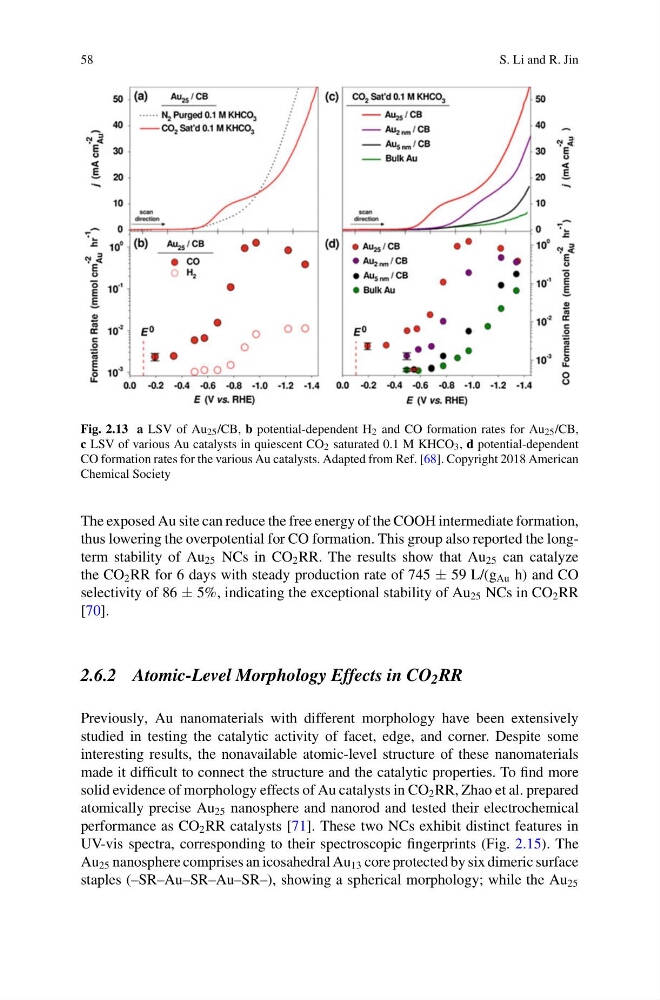
Fig. 2.13 a LSV of Au 25 /CB, b potential-dependent H 2 and CO formation rates for Au 25 /CB,
c LSV of various Au catalysts in quiescent CO 2 saturated 0.1 M KHCO 3 , d potential-dependent
CO formation rates for the various Au catalysts. Adapted from Ref. [68]. Copyright 2018 American
Chemical Society
The exposed Au site can reduce the free energy of the COOH intermediate formation,
thus lowering the overpotential for CO formation. This group also reported the longterm stability of Au 25 NCs in CO 2 RR. The results show that Au 25 can catalyze
the CO 2 RR for 6 days with steady production rate of 745 ± 59 L/(g Au h) and CO
selectivity of 86 ± 5%, indicating the exceptional stability of Au 25 NCs in CO 2 RR
[70].
2.6.2 Atomic-Level Morphology Effects in CO 2 RR
Previously, Au nanomaterials with different morphology have been extensively
studied in testing the catalytic activity of facet, edge, and corner. Despite some
interesting results, the nonavailable atomic-level structure of these nanomaterials
made it difficult to connect the structure and the catalytic properties. To find more
solid evidence of morphology effects of Au catalysts in CO 2 RR, Zhao et al. prepared
atomically precise Au 25 nanosphere and nanorod and tested their electrochemical
performance as CO 2 RR catalysts [71]. These two NCs exhibit distinct features in
UV-vis spectra, corresponding to their spectroscopic fingerprints (Fig. 2.15). The
Au 25 nanosphere comprises an icosahedral Au 13 core protected by six dimeric surface
staples (–SR–Au–SR–Au–SR–), showing a spherical morphology; while the Au 25
S. Li and R. Jin
Fig. 2.13 a LSV of Au 25 /CB, b potential-dependent H 2 and CO formation rates for Au 25 /CB,
c LSV of various Au catalysts in quiescent CO 2 saturated 0.1 M KHCO 3 , d potential-dependent
CO formation rates for the various Au catalysts. Adapted from Ref. [68]. Copyright 2018 American
Chemical Society
The exposed Au site can reduce the free energy of the COOH intermediate formation,
thus lowering the overpotential for CO formation. This group also reported the longterm stability of Au 25 NCs in CO 2 RR. The results show that Au 25 can catalyze
the CO 2 RR for 6 days with steady production rate of 745 ± 59 L/(g Au h) and CO
selectivity of 86 ± 5%, indicating the exceptional stability of Au 25 NCs in CO 2 RR
[70].
2.6.2 Atomic-Level Morphology Effects in CO 2 RR
Previously, Au nanomaterials with different morphology have been extensively
studied in testing the catalytic activity of facet, edge, and corner. Despite some
interesting results, the nonavailable atomic-level structure of these nanomaterials
made it difficult to connect the structure and the catalytic properties. To find more
solid evidence of morphology effects of Au catalysts in CO 2 RR, Zhao et al. prepared
atomically precise Au 25 nanosphere and nanorod and tested their electrochemical
performance as CO 2 RR catalysts [71]. These two NCs exhibit distinct features in
UV-vis spectra, corresponding to their spectroscopic fingerprints (Fig. 2.15). The
Au 25 nanosphere comprises an icosahedral Au 13 core protected by six dimeric surface
staples (–SR–Au–SR–Au–SR–), showing a spherical morphology; while the Au 25