

56
S. Li and R. Jin
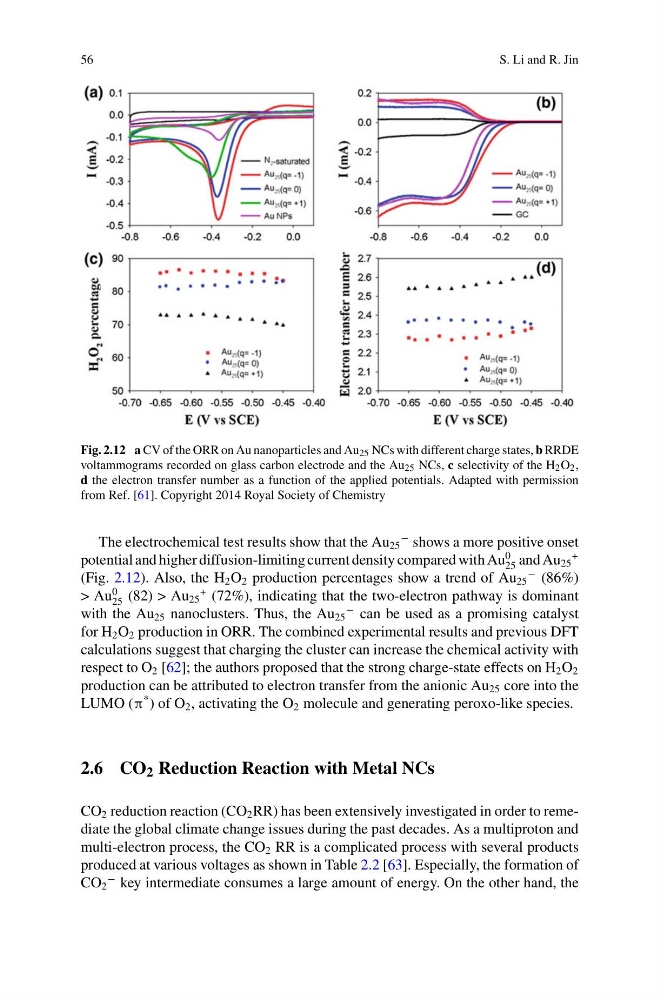
Fig. 2.12 a CV of the ORR on Au nanoparticles and Au 25 NCs with different charge states, b RRDE
voltammograms recorded on glass carbon electrode and the Au 25 NCs, c selectivity of the H 2 O 2 ,
d the electron transfer number as a function of the applied potentials. Adapted with permission
from Ref. [61]. Copyright 2014 Royal Society of Chemistry
The electrochemical test results show that the Au 25
− shows a more positive onset
potential and higher diffusion-limiting current density compared with Au
0
25 and Au 25
+
(Fig. 2.12). Also, the H 2 O 2 production percentages show a trend of Au 25
− (86%)
> Au
0
25 (82) > Au 25
+ (72%), indicating that the two-electron pathway is dominant
with the Au 25 nanoclusters. Thus, the Au 25
− can be used as a promising catalyst
for H 2 O 2 production in ORR. The combined experimental results and previous DFT
calculations suggest that charging the cluster can increase the chemical activity with
respect to O 2 [62]; the authors proposed that the strong charge-state effects on H 2 O 2
production can be attributed to electron transfer from the anionic Au 25 core into the
LUMO (π
* ) of O 2 , activating the O 2 molecule and generating peroxo-like species.
2.6 CO 2 Reduction Reaction with Metal NCs
CO 2 reduction reaction (CO 2 RR) has been extensively investigated in order to remediate the global climate change issues during the past decades. As a multiproton and
multi-electron process, the CO 2 RR is a complicated process with several products
produced at various voltages as shown in Table 2.2 [63]. Especially, the formation of
CO 2
− key intermediate consumes a large amount of energy. On the other hand, the
S. Li and R. Jin
Fig. 2.12 a CV of the ORR on Au nanoparticles and Au 25 NCs with different charge states, b RRDE
voltammograms recorded on glass carbon electrode and the Au 25 NCs, c selectivity of the H 2 O 2 ,
d the electron transfer number as a function of the applied potentials. Adapted with permission
from Ref. [61]. Copyright 2014 Royal Society of Chemistry
The electrochemical test results show that the Au 25
− shows a more positive onset
potential and higher diffusion-limiting current density compared with Au
0
25 and Au 25
+
(Fig. 2.12). Also, the H 2 O 2 production percentages show a trend of Au 25
− (86%)
> Au
0
25 (82) > Au 25
+ (72%), indicating that the two-electron pathway is dominant
with the Au 25 nanoclusters. Thus, the Au 25
− can be used as a promising catalyst
for H 2 O 2 production in ORR. The combined experimental results and previous DFT
calculations suggest that charging the cluster can increase the chemical activity with
respect to O 2 [62]; the authors proposed that the strong charge-state effects on H 2 O 2
production can be attributed to electron transfer from the anionic Au 25 core into the
LUMO (π
* ) of O 2 , activating the O 2 molecule and generating peroxo-like species.
2.6 CO 2 Reduction Reaction with Metal NCs
CO 2 reduction reaction (CO 2 RR) has been extensively investigated in order to remediate the global climate change issues during the past decades. As a multiproton and
multi-electron process, the CO 2 RR is a complicated process with several products
produced at various voltages as shown in Table 2.2 [63]. Especially, the formation of
CO 2
− key intermediate consumes a large amount of energy. On the other hand, the