

2 Atomically Precise Nanoclusters as Electrocatalysts
55
Table 2.1 Experimental parameters for Au NC-catalyzed ORR (n: the number of transferred
electrons)
Sample
η(V ) at j = –1 mA cm −2
n
HO − (%)
Au 23 /SWNT
0.68
2.1
53
Au 30 /SWNT
0.25
2.5
63
Au 46 /SWNT
0.24
2.0
50
Au 65 /SWNT
0.08
3.2
80
Data from Ref. [56]
In the electrochemical test (Table 2.1), the Au 65 exhibits a transfer of 3.2 electrons,
which is higher than that of other NCs (approximately 2 electrons). Also, the potential
at −1 mA cm
−2 shows a trend of Au 65 < Au 46 < Au 30 < Au 23 , indicating that the
ORR catalytic activity increases as the nanocluster size grows. Therefore, it can be
concluded that larger NCs can facilitate the ORR with smaller overpotential, higher
diffusion-limiting current and higher selectivity toward OH
− production.
2.5.3 Charge-State-Dependent ORR Activity of Au 25 NCs
In 2007, Negishi et al. reported the charge state of Au 25 NCs can be tuned between
−1, 0 and +1 [57]. This unique property provides an ideal model to study the chargestate effect of Au NCs in electrochemical catalysis [58–60]. Later in 2014, Lu et al.
synthesized these atomically precise Au 25 NCs protected by dodecanethiolate with
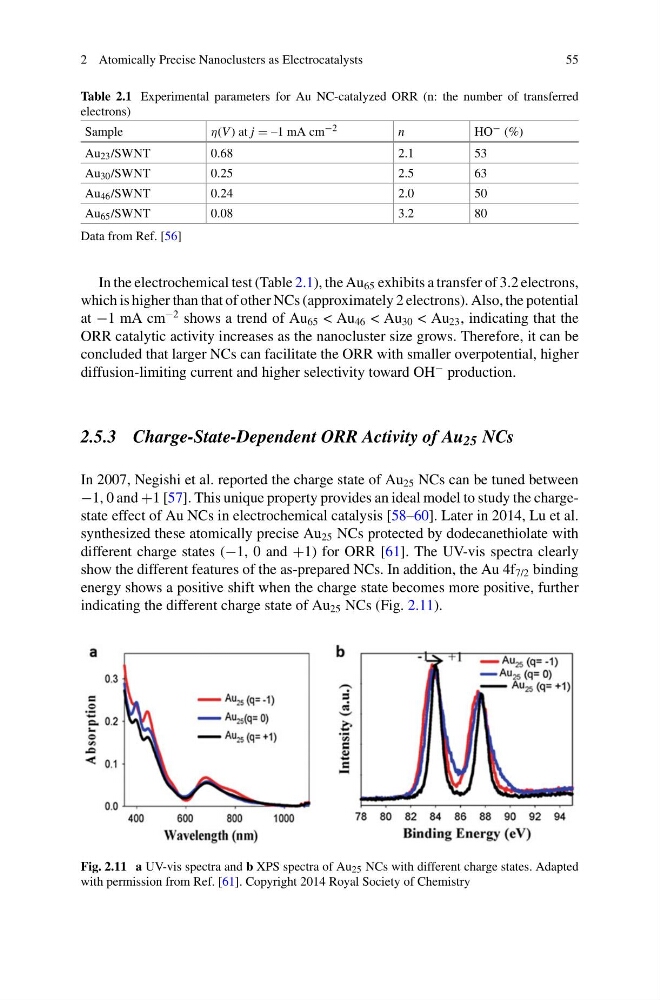
different charge states (−1, 0 and +1) for ORR [61]. The UV-vis spectra clearly
show the different features of the as-prepared NCs. In addition, the Au 4f 7/2 binding
energy shows a positive shift when the charge state becomes more positive, further
indicating the different charge state of Au 25 NCs (Fig. 2.11).
Fig. 2.11 a UV-vis spectra and b XPS spectra of Au 25 NCs with different charge states. Adapted
with permission from Ref. [61]. Copyright 2014 Royal Society of Chemistry
55
Table 2.1 Experimental parameters for Au NC-catalyzed ORR (n: the number of transferred
electrons)
Sample
η(V ) at j = –1 mA cm −2
n
HO − (%)
Au 23 /SWNT
0.68
2.1
53
Au 30 /SWNT
0.25
2.5
63
Au 46 /SWNT
0.24
2.0
50
Au 65 /SWNT
0.08
3.2
80
Data from Ref. [56]
In the electrochemical test (Table 2.1), the Au 65 exhibits a transfer of 3.2 electrons,
which is higher than that of other NCs (approximately 2 electrons). Also, the potential
at −1 mA cm
−2 shows a trend of Au 65 < Au 46 < Au 30 < Au 23 , indicating that the
ORR catalytic activity increases as the nanocluster size grows. Therefore, it can be
concluded that larger NCs can facilitate the ORR with smaller overpotential, higher
diffusion-limiting current and higher selectivity toward OH
− production.
2.5.3 Charge-State-Dependent ORR Activity of Au 25 NCs
In 2007, Negishi et al. reported the charge state of Au 25 NCs can be tuned between
−1, 0 and +1 [57]. This unique property provides an ideal model to study the chargestate effect of Au NCs in electrochemical catalysis [58–60]. Later in 2014, Lu et al.
synthesized these atomically precise Au 25 NCs protected by dodecanethiolate with
different charge states (−1, 0 and +1) for ORR [61]. The UV-vis spectra clearly
show the different features of the as-prepared NCs. In addition, the Au 4f 7/2 binding
energy shows a positive shift when the charge state becomes more positive, further
indicating the different charge state of Au 25 NCs (Fig. 2.11).
Fig. 2.11 a UV-vis spectra and b XPS spectra of Au 25 NCs with different charge states. Adapted
with permission from Ref. [61]. Copyright 2014 Royal Society of Chemistry