

12 Ligand Effects in Ruthenium Nanoparticle Catalysis
441
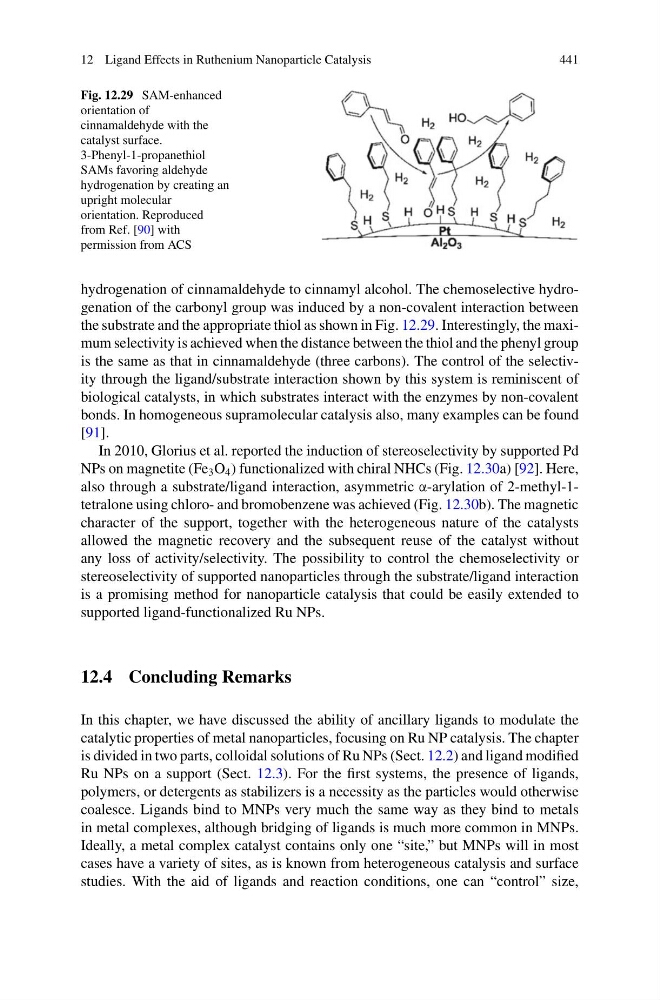
Fig. 12.29 SAM-enhanced
orientation of
cinnamaldehyde with the
catalyst surface.
3-Phenyl-1-propanethiol
SAMs favoring aldehyde
hydrogenation by creating an
upright molecular
orientation. Reproduced
from Ref. [90] with
permission from ACS
hydrogenation of cinnamaldehyde to cinnamyl alcohol. The chemoselective hydrogenation of the carbonyl group was induced by a non-covalent interaction between
the substrate and the appropriate thiol as shown in Fig. 12.29. Interestingly, the maximum selectivity is achieved when the distance between the thiol and the phenyl group
is the same as that in cinnamaldehyde (three carbons). The control of the selectivity through the ligand/substrate interaction shown by this system is reminiscent of
biological catalysts, in which substrates interact with the enzymes by non-covalent
bonds. In homogeneous supramolecular catalysis also, many examples can be found
[91].
In 2010, Glorius et al. reported the induction of stereoselectivity by supported Pd
NPs on magnetite (Fe 3 O 4 ) functionalized with chiral NHCs (Fig. 12.30a) [92]. Here,
also through a substrate/ligand interaction, asymmetric α-arylation of 2-methyl-1tetralone using chloro- and bromobenzene was achieved (Fig. 12.30b). The magnetic
character of the support, together with the heterogeneous nature of the catalysts
allowed the magnetic recovery and the subsequent reuse of the catalyst without
any loss of activity/selectivity. The possibility to control the chemoselectivity or
stereoselectivity of supported nanoparticles through the substrate/ligand interaction
is a promising method for nanoparticle catalysis that could be easily extended to
supported ligand-functionalized Ru NPs.
12.4 Concluding Remarks
In this chapter, we have discussed the ability of ancillary ligands to modulate the
catalytic properties of metal nanoparticles, focusing on Ru NP catalysis. The chapter
is divided in two parts, colloidal solutions of Ru NPs (Sect. 12.2) and ligand modified
Ru NPs on a support (Sect. 12.3). For the first systems, the presence of ligands,
polymers, or detergents as stabilizers is a necessity as the particles would otherwise
coalesce. Ligands bind to MNPs very much the same way as they bind to metals
in metal complexes, although bridging of ligands is much more common in MNPs.
Ideally, a metal complex catalyst contains only one “site,” but MNPs will in most
cases have a variety of sites, as is known from heterogeneous catalysis and surface
studies. With the aid of ligands and reaction conditions, one can “control” size,
441
Fig. 12.29 SAM-enhanced
orientation of
cinnamaldehyde with the
catalyst surface.
3-Phenyl-1-propanethiol
SAMs favoring aldehyde
hydrogenation by creating an
upright molecular
orientation. Reproduced
from Ref. [90] with
permission from ACS
hydrogenation of cinnamaldehyde to cinnamyl alcohol. The chemoselective hydrogenation of the carbonyl group was induced by a non-covalent interaction between
the substrate and the appropriate thiol as shown in Fig. 12.29. Interestingly, the maximum selectivity is achieved when the distance between the thiol and the phenyl group
is the same as that in cinnamaldehyde (three carbons). The control of the selectivity through the ligand/substrate interaction shown by this system is reminiscent of
biological catalysts, in which substrates interact with the enzymes by non-covalent
bonds. In homogeneous supramolecular catalysis also, many examples can be found
[91].
In 2010, Glorius et al. reported the induction of stereoselectivity by supported Pd
NPs on magnetite (Fe 3 O 4 ) functionalized with chiral NHCs (Fig. 12.30a) [92]. Here,
also through a substrate/ligand interaction, asymmetric α-arylation of 2-methyl-1tetralone using chloro- and bromobenzene was achieved (Fig. 12.30b). The magnetic
character of the support, together with the heterogeneous nature of the catalysts
allowed the magnetic recovery and the subsequent reuse of the catalyst without
any loss of activity/selectivity. The possibility to control the chemoselectivity or
stereoselectivity of supported nanoparticles through the substrate/ligand interaction
is a promising method for nanoparticle catalysis that could be easily extended to
supported ligand-functionalized Ru NPs.
12.4 Concluding Remarks
In this chapter, we have discussed the ability of ancillary ligands to modulate the
catalytic properties of metal nanoparticles, focusing on Ru NP catalysis. The chapter
is divided in two parts, colloidal solutions of Ru NPs (Sect. 12.2) and ligand modified
Ru NPs on a support (Sect. 12.3). For the first systems, the presence of ligands,
polymers, or detergents as stabilizers is a necessity as the particles would otherwise
coalesce. Ligands bind to MNPs very much the same way as they bind to metals
in metal complexes, although bridging of ligands is much more common in MNPs.
Ideally, a metal complex catalyst contains only one “site,” but MNPs will in most
cases have a variety of sites, as is known from heterogeneous catalysis and surface
studies. With the aid of ligands and reaction conditions, one can “control” size,