

442
L. M. Martínez-Prieto and P. W. N. M. van Leeuwen
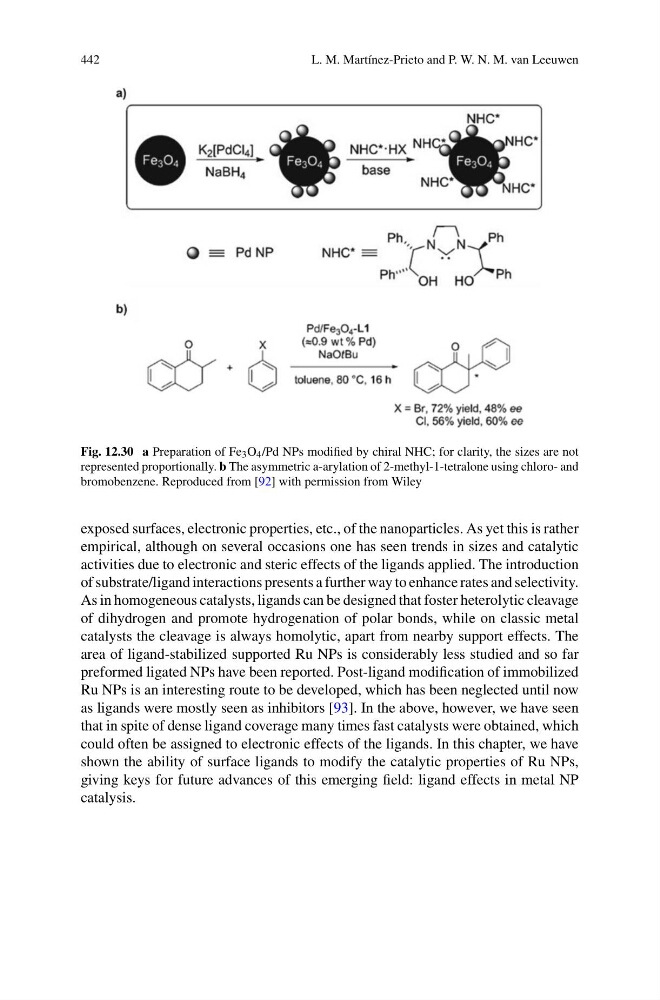
Fig. 12.30 a Preparation of Fe 3 O 4 /Pd NPs modified by chiral NHC; for clarity, the sizes are not
represented proportionally. b The asymmetric a-arylation of 2-methyl-1-tetralone using chloro- and
bromobenzene. Reproduced from [92] with permission from Wiley
exposed surfaces, electronic properties, etc., of the nanoparticles. As yet this is rather
empirical, although on several occasions one has seen trends in sizes and catalytic
activities due to electronic and steric effects of the ligands applied. The introduction
of substrate/ligand interactions presents a further way to enhance rates and selectivity.
As in homogeneous catalysts, ligands can be designed that foster heterolytic cleavage
of dihydrogen and promote hydrogenation of polar bonds, while on classic metal
catalysts the cleavage is always homolytic, apart from nearby support effects. The
area of ligand-stabilized supported Ru NPs is considerably less studied and so far
preformed ligated NPs have been reported. Post-ligand modification of immobilized
Ru NPs is an interesting route to be developed, which has been neglected until now
as ligands were mostly seen as inhibitors [93]. In the above, however, we have seen
that in spite of dense ligand coverage many times fast catalysts were obtained, which
could often be assigned to electronic effects of the ligands. In this chapter, we have
shown the ability of surface ligands to modify the catalytic properties of Ru NPs,
giving keys for future advances of this emerging field: ligand effects in metal NP
catalysis.
L. M. Martínez-Prieto and P. W. N. M. van Leeuwen
Fig. 12.30 a Preparation of Fe 3 O 4 /Pd NPs modified by chiral NHC; for clarity, the sizes are not
represented proportionally. b The asymmetric a-arylation of 2-methyl-1-tetralone using chloro- and
bromobenzene. Reproduced from [92] with permission from Wiley
exposed surfaces, electronic properties, etc., of the nanoparticles. As yet this is rather
empirical, although on several occasions one has seen trends in sizes and catalytic
activities due to electronic and steric effects of the ligands applied. The introduction
of substrate/ligand interactions presents a further way to enhance rates and selectivity.
As in homogeneous catalysts, ligands can be designed that foster heterolytic cleavage
of dihydrogen and promote hydrogenation of polar bonds, while on classic metal
catalysts the cleavage is always homolytic, apart from nearby support effects. The
area of ligand-stabilized supported Ru NPs is considerably less studied and so far
preformed ligated NPs have been reported. Post-ligand modification of immobilized
Ru NPs is an interesting route to be developed, which has been neglected until now
as ligands were mostly seen as inhibitors [93]. In the above, however, we have seen
that in spite of dense ligand coverage many times fast catalysts were obtained, which
could often be assigned to electronic effects of the ligands. In this chapter, we have
shown the ability of surface ligands to modify the catalytic properties of Ru NPs,
giving keys for future advances of this emerging field: ligand effects in metal NP
catalysis.