

12 Ligand Effects in Ruthenium Nanoparticle Catalysis
439
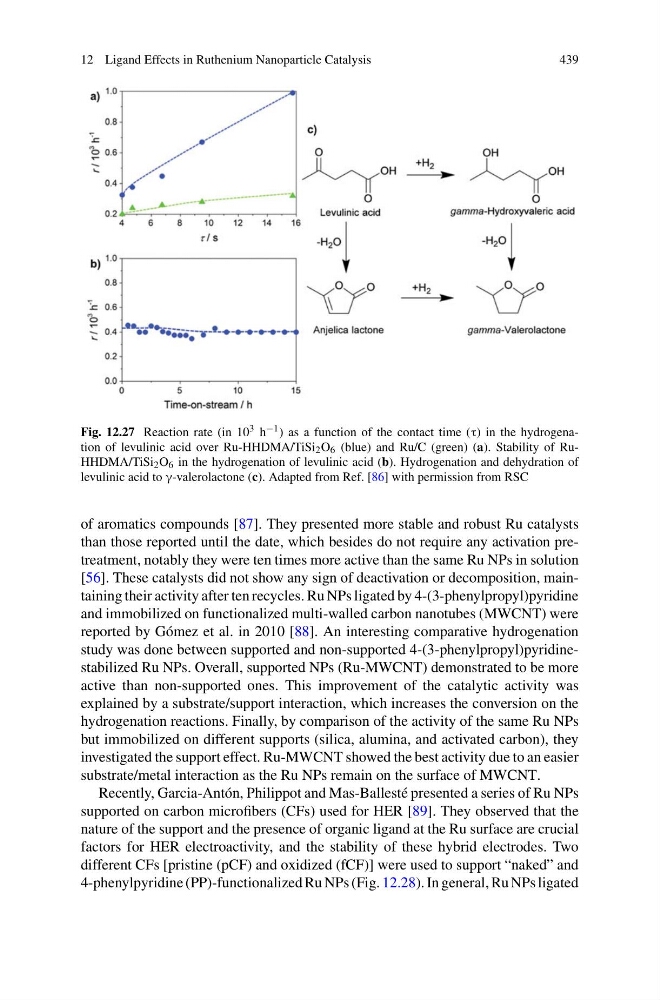
Fig. 12.27 Reaction rate (in 10 3 h −1 ) as a function of the contact time (τ) in the hydrogenation of levulinic acid over Ru-HHDMA/TiSi 2 O 6 (blue) and Ru/C (green) (a). Stability of RuHHDMA/TiSi 2 O 6 in the hydrogenation of levulinic acid (b). Hydrogenation and dehydration of
levulinic acid to γ-valerolactone (c). Adapted from Ref. [86] with permission from RSC
of aromatics compounds [87]. They presented more stable and robust Ru catalysts
than those reported until the date, which besides do not require any activation pretreatment, notably they were ten times more active than the same Ru NPs in solution
[56]. These catalysts did not show any sign of deactivation or decomposition, maintaining their activity after ten recycles. Ru NPs ligated by 4-(3-phenylpropyl)pyridine
and immobilized on functionalized multi-walled carbon nanotubes (MWCNT) were
reported by Gómez et al. in 2010 [88]. An interesting comparative hydrogenation
study was done between supported and non-supported 4-(3-phenylpropyl)pyridinestabilized Ru NPs. Overall, supported NPs (Ru-MWCNT) demonstrated to be more
active than non-supported ones. This improvement of the catalytic activity was
explained by a substrate/support interaction, which increases the conversion on the
hydrogenation reactions. Finally, by comparison of the activity of the same Ru NPs
but immobilized on different supports (silica, alumina, and activated carbon), they
investigated the support effect. Ru-MWCNT showed the best activity due to an easier
substrate/metal interaction as the Ru NPs remain on the surface of MWCNT.
Recently, Garcia-Antón, Philippot and Mas-Ballesté presented a series of Ru NPs
supported on carbon microfibers (CFs) used for HER [89]. They observed that the
nature of the support and the presence of organic ligand at the Ru surface are crucial
factors for HER electroactivity, and the stability of these hybrid electrodes. Two
different CFs [pristine (pCF) and oxidized (fCF)] were used to support “naked” and
4-phenylpyridine (PP)-functionalized Ru NPs (Fig. 12.28). In general, Ru NPs ligated
439
Fig. 12.27 Reaction rate (in 10 3 h −1 ) as a function of the contact time (τ) in the hydrogenation of levulinic acid over Ru-HHDMA/TiSi 2 O 6 (blue) and Ru/C (green) (a). Stability of RuHHDMA/TiSi 2 O 6 in the hydrogenation of levulinic acid (b). Hydrogenation and dehydration of
levulinic acid to γ-valerolactone (c). Adapted from Ref. [86] with permission from RSC
of aromatics compounds [87]. They presented more stable and robust Ru catalysts
than those reported until the date, which besides do not require any activation pretreatment, notably they were ten times more active than the same Ru NPs in solution
[56]. These catalysts did not show any sign of deactivation or decomposition, maintaining their activity after ten recycles. Ru NPs ligated by 4-(3-phenylpropyl)pyridine
and immobilized on functionalized multi-walled carbon nanotubes (MWCNT) were
reported by Gómez et al. in 2010 [88]. An interesting comparative hydrogenation
study was done between supported and non-supported 4-(3-phenylpropyl)pyridinestabilized Ru NPs. Overall, supported NPs (Ru-MWCNT) demonstrated to be more
active than non-supported ones. This improvement of the catalytic activity was
explained by a substrate/support interaction, which increases the conversion on the
hydrogenation reactions. Finally, by comparison of the activity of the same Ru NPs
but immobilized on different supports (silica, alumina, and activated carbon), they
investigated the support effect. Ru-MWCNT showed the best activity due to an easier
substrate/metal interaction as the Ru NPs remain on the surface of MWCNT.
Recently, Garcia-Antón, Philippot and Mas-Ballesté presented a series of Ru NPs
supported on carbon microfibers (CFs) used for HER [89]. They observed that the
nature of the support and the presence of organic ligand at the Ru surface are crucial
factors for HER electroactivity, and the stability of these hybrid electrodes. Two
different CFs [pristine (pCF) and oxidized (fCF)] were used to support “naked” and
4-phenylpyridine (PP)-functionalized Ru NPs (Fig. 12.28). In general, Ru NPs ligated