

438
L. M. Martínez-Prieto and P. W. N. M. van Leeuwen
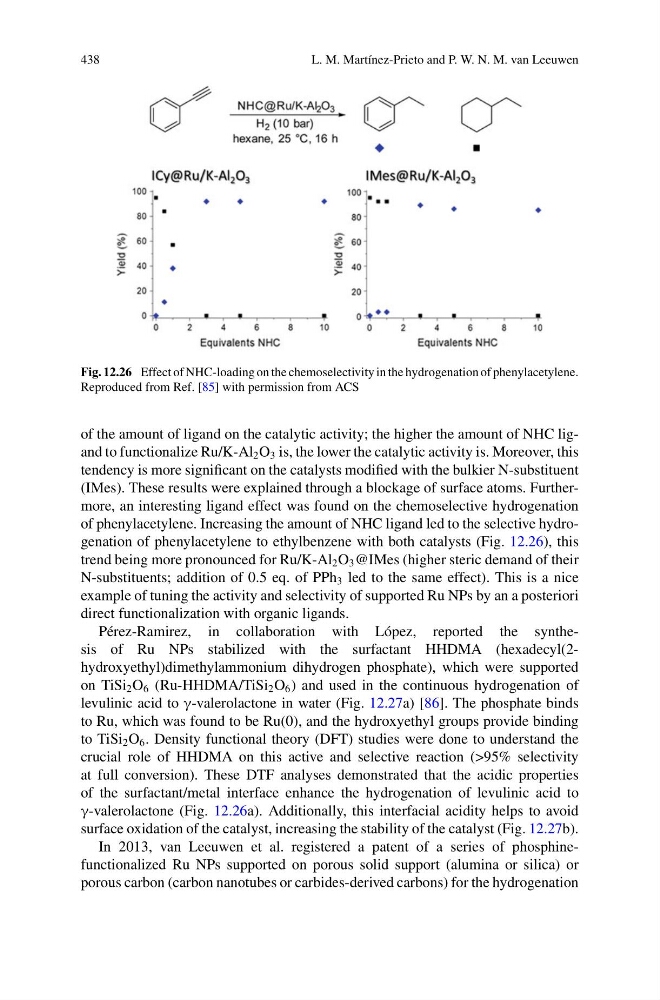
Fig. 12.26 Effect of NHC-loading on the chemoselectivity in the hydrogenation of phenylacetylene.
Reproduced from Ref. [85] with permission from ACS
of the amount of ligand on the catalytic activity; the higher the amount of NHC ligand to functionalize Ru/K-Al 2 O 3 is, the lower the catalytic activity is. Moreover, this
tendency is more significant on the catalysts modified with the bulkier N-substituent
(IMes). These results were explained through a blockage of surface atoms. Furthermore, an interesting ligand effect was found on the chemoselective hydrogenation
of phenylacetylene. Increasing the amount of NHC ligand led to the selective hydrogenation of phenylacetylene to ethylbenzene with both catalysts (Fig. 12.26), this
trend being more pronounced for Ru/K-Al 2 O 3 @IMes (higher steric demand of their
N-substituents; addition of 0.5 eq. of PPh 3 led to the same effect). This is a nice
example of tuning the activity and selectivity of supported Ru NPs by an a posteriori
direct functionalization with organic ligands.
Pérez-Ramirez, in collaboration with López, reported the synthesis of Ru NPs stabilized with the surfactant HHDMA (hexadecyl(2hydroxyethyl)dimethylammonium dihydrogen phosphate), which were supported
on TiSi 2 O 6 (Ru-HHDMA/TiSi 2 O 6 ) and used in the continuous hydrogenation of
levulinic acid to γ-valerolactone in water (Fig. 12.27a) [86]. The phosphate binds
to Ru, which was found to be Ru(0), and the hydroxyethyl groups provide binding
to TiSi 2 O 6 . Density functional theory (DFT) studies were done to understand the
crucial role of HHDMA on this active and selective reaction (>95% selectivity
at full conversion). These DTF analyses demonstrated that the acidic properties
of the surfactant/metal interface enhance the hydrogenation of levulinic acid to
γ-valerolactone (Fig. 12.26a). Additionally, this interfacial acidity helps to avoid
surface oxidation of the catalyst, increasing the stability of the catalyst (Fig. 12.27b).
In 2013, van Leeuwen et al. registered a patent of a series of phosphinefunctionalized Ru NPs supported on porous solid support (alumina or silica) or
porous carbon (carbon nanotubes or carbides-derived carbons) for the hydrogenation
L. M. Martínez-Prieto and P. W. N. M. van Leeuwen
Fig. 12.26 Effect of NHC-loading on the chemoselectivity in the hydrogenation of phenylacetylene.
Reproduced from Ref. [85] with permission from ACS
of the amount of ligand on the catalytic activity; the higher the amount of NHC ligand to functionalize Ru/K-Al 2 O 3 is, the lower the catalytic activity is. Moreover, this
tendency is more significant on the catalysts modified with the bulkier N-substituent
(IMes). These results were explained through a blockage of surface atoms. Furthermore, an interesting ligand effect was found on the chemoselective hydrogenation
of phenylacetylene. Increasing the amount of NHC ligand led to the selective hydrogenation of phenylacetylene to ethylbenzene with both catalysts (Fig. 12.26), this
trend being more pronounced for Ru/K-Al 2 O 3 @IMes (higher steric demand of their
N-substituents; addition of 0.5 eq. of PPh 3 led to the same effect). This is a nice
example of tuning the activity and selectivity of supported Ru NPs by an a posteriori
direct functionalization with organic ligands.
Pérez-Ramirez, in collaboration with López, reported the synthesis of Ru NPs stabilized with the surfactant HHDMA (hexadecyl(2hydroxyethyl)dimethylammonium dihydrogen phosphate), which were supported
on TiSi 2 O 6 (Ru-HHDMA/TiSi 2 O 6 ) and used in the continuous hydrogenation of
levulinic acid to γ-valerolactone in water (Fig. 12.27a) [86]. The phosphate binds
to Ru, which was found to be Ru(0), and the hydroxyethyl groups provide binding
to TiSi 2 O 6 . Density functional theory (DFT) studies were done to understand the
crucial role of HHDMA on this active and selective reaction (>95% selectivity
at full conversion). These DTF analyses demonstrated that the acidic properties
of the surfactant/metal interface enhance the hydrogenation of levulinic acid to
γ-valerolactone (Fig. 12.26a). Additionally, this interfacial acidity helps to avoid
surface oxidation of the catalyst, increasing the stability of the catalyst (Fig. 12.27b).
In 2013, van Leeuwen et al. registered a patent of a series of phosphinefunctionalized Ru NPs supported on porous solid support (alumina or silica) or
porous carbon (carbon nanotubes or carbides-derived carbons) for the hydrogenation