

12 Ligand Effects in Ruthenium Nanoparticle Catalysis
437
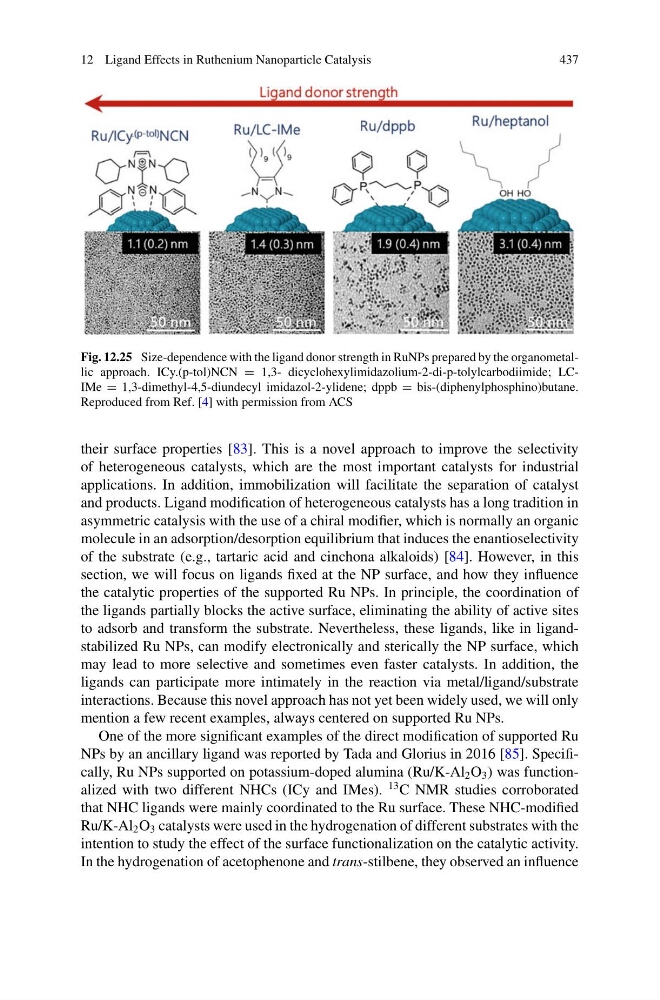
Fig. 12.25 Size-dependence with the ligand donor strength in RuNPs prepared by the organometallic approach. ICy.(p-tol)NCN = 1,3- dicyclohexylimidazolium-2-di-p-tolylcarbodiimide; LCIMe = 1,3-dimethyl-4,5-diundecyl imidazol-2-ylidene; dppb = bis-(diphenylphosphino)butane.
Reproduced from Ref. [4] with permission from ACS
their surface properties [83]. This is a novel approach to improve the selectivity
of heterogeneous catalysts, which are the most important catalysts for industrial
applications. In addition, immobilization will facilitate the separation of catalyst
and products. Ligand modification of heterogeneous catalysts has a long tradition in
asymmetric catalysis with the use of a chiral modifier, which is normally an organic
molecule in an adsorption/desorption equilibrium that induces the enantioselectivity
of the substrate (e.g., tartaric acid and cinchona alkaloids) [84]. However, in this
section, we will focus on ligands fixed at the NP surface, and how they influence
the catalytic properties of the supported Ru NPs. In principle, the coordination of
the ligands partially blocks the active surface, eliminating the ability of active sites
to adsorb and transform the substrate. Nevertheless, these ligands, like in ligandstabilized Ru NPs, can modify electronically and sterically the NP surface, which
may lead to more selective and sometimes even faster catalysts. In addition, the
ligands can participate more intimately in the reaction via metal/ligand/substrate
interactions. Because this novel approach has not yet been widely used, we will only
mention a few recent examples, always centered on supported Ru NPs.
One of the more significant examples of the direct modification of supported Ru
NPs by an ancillary ligand was reported by Tada and Glorius in 2016 [85]. Specifically, Ru NPs supported on potassium-doped alumina (Ru/K-Al 2 O 3 ) was functionalized with two different NHCs (ICy and IMes).
13 C NMR studies corroborated
that NHC ligands were mainly coordinated to the Ru surface. These NHC-modified
Ru/K-Al 2 O 3 catalysts were used in the hydrogenation of different substrates with the
intention to study the effect of the surface functionalization on the catalytic activity.
In the hydrogenation of acetophenone and trans-stilbene, they observed an influence
437
Fig. 12.25 Size-dependence with the ligand donor strength in RuNPs prepared by the organometallic approach. ICy.(p-tol)NCN = 1,3- dicyclohexylimidazolium-2-di-p-tolylcarbodiimide; LCIMe = 1,3-dimethyl-4,5-diundecyl imidazol-2-ylidene; dppb = bis-(diphenylphosphino)butane.
Reproduced from Ref. [4] with permission from ACS
their surface properties [83]. This is a novel approach to improve the selectivity
of heterogeneous catalysts, which are the most important catalysts for industrial
applications. In addition, immobilization will facilitate the separation of catalyst
and products. Ligand modification of heterogeneous catalysts has a long tradition in
asymmetric catalysis with the use of a chiral modifier, which is normally an organic
molecule in an adsorption/desorption equilibrium that induces the enantioselectivity
of the substrate (e.g., tartaric acid and cinchona alkaloids) [84]. However, in this
section, we will focus on ligands fixed at the NP surface, and how they influence
the catalytic properties of the supported Ru NPs. In principle, the coordination of
the ligands partially blocks the active surface, eliminating the ability of active sites
to adsorb and transform the substrate. Nevertheless, these ligands, like in ligandstabilized Ru NPs, can modify electronically and sterically the NP surface, which
may lead to more selective and sometimes even faster catalysts. In addition, the
ligands can participate more intimately in the reaction via metal/ligand/substrate
interactions. Because this novel approach has not yet been widely used, we will only
mention a few recent examples, always centered on supported Ru NPs.
One of the more significant examples of the direct modification of supported Ru
NPs by an ancillary ligand was reported by Tada and Glorius in 2016 [85]. Specifically, Ru NPs supported on potassium-doped alumina (Ru/K-Al 2 O 3 ) was functionalized with two different NHCs (ICy and IMes).
13 C NMR studies corroborated
that NHC ligands were mainly coordinated to the Ru surface. These NHC-modified
Ru/K-Al 2 O 3 catalysts were used in the hydrogenation of different substrates with the
intention to study the effect of the surface functionalization on the catalytic activity.
In the hydrogenation of acetophenone and trans-stilbene, they observed an influence